


























Views
Downloads
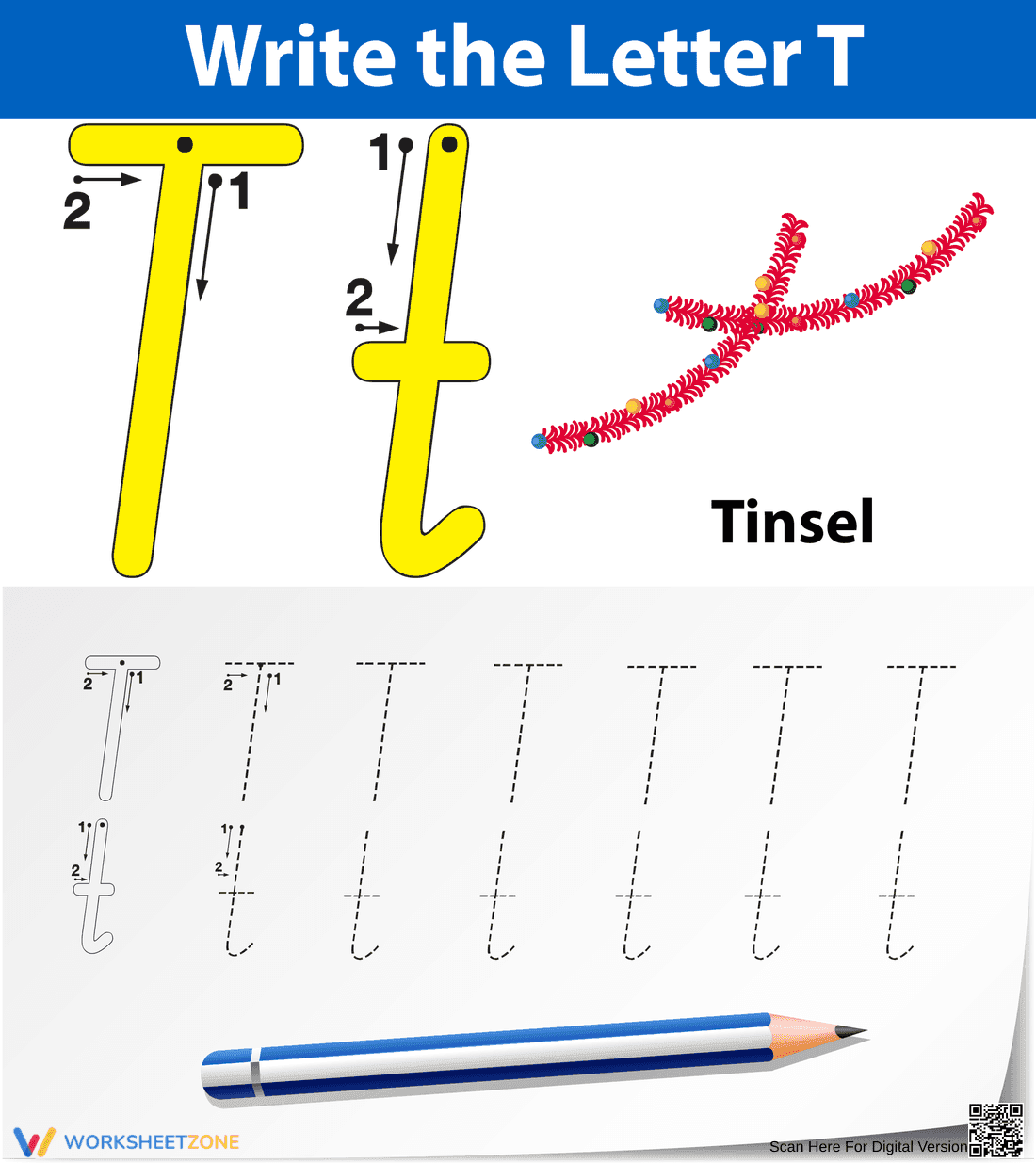

Writing Letter T Worksheet | Grade 1 Essential
Paste this activity's link or code into your existing LMS (Google Classroom, Canvas, Teams, Schoology, Moodle, etc.).
Students can open and work on the activity right away, with no student login required.
You'll still be able to track student progress and results from your teacher account.
Master the formation of the letter T with this focused handwriting resource. Students practice both uppercase and lowercase versions, ensuring they develop the muscle memory required for legible writing. By connecting the letter to the word "tinsel," learners also strengthen their initial sound recognition and phonemic awareness in a festive, engaging context.
At a Glance
- Grade: 1 · Subject: English
- Standard:
CCSS.ELA-LITERACY.L.1.1.A— Print all upper- and lowercase letters legibly- Skill Focus: Letter T formation
- Format: 1 page · 14 problems · Answer key included · PDF
- Best For: Independent morning work or literacy centers
- Time: 5–10 minutes
This single-page PDF features a clear, high-contrast layout designed for young learners. It includes two large guided models with numbered stroke arrows to demonstrate proper pencil movement. Below the models, students find 14 dedicated tracing tasks—seven for uppercase 'T' and seven for lowercase 't'—set on standard primary dashed lines to support consistent letter height and alignment.
The zero-prep workflow is designed for maximum efficiency in busy classrooms. First, print the required number of copies in less than 30 seconds. Second, distribute the sheets during your phonics block or as a transition activity, requiring zero verbal instructions due to the intuitive visual cues. Finally, review student work in under 1 minute by checking for proper stroke direction and line adherence. This makes it an ideal resource for emergency sub plans or quiet-time transitions.
This resource is specifically aligned to `CCSS.ELA-LITERACY.L.1.1.A`, which requires students to demonstrate command of the conventions of standard English grammar and usage when writing, specifically printing all upper- and lowercase letters. It also supports foundational phonics by linking the grapheme to the phoneme /t/. Both standard codes can be copied directly into lesson plans, IEP goals, or district curriculum mapping tools.
Use this worksheet as a formative assessment during the first weeks of school to identify students who may need additional fine motor support. It also serves as an excellent "fast finisher" activity for students who complete their primary writing tasks early. Expect most Grade 1 students to complete the tracing and the coloring of the tinsel illustration within a 5 to 10-minute window, making it a perfect fit for short instructional blocks.
This worksheet is ideal for first-grade students, but it also provides valuable remediation for second graders struggling with letter reversals. It pairs naturally with an alphabet anchor chart or a direct instruction lesson on the "down-across" stroke sequence. For students with dysgraphia, the large guided models provide a helpful visual reference for proper letter construction and spatial awareness.
According to the RAND AIRS 2024 report on foundational literacy, explicit instruction in letter formation is a critical precursor to writing fluency and overall reading comprehension. This worksheet addresses the CCSS.ELA-LITERACY.L.1.1.A standard by providing the repetitive, structured practice necessary for students to internalize the physical movements of writing. Research from Fisher & Frey (2014) emphasizes that gradual release of responsibility begins with clear modeling, which is provided here through the numbered stroke guides. By isolating the letter T, teachers can ensure students master specific graphemes before moving to complex word construction. This targeted approach reduces cognitive load, allowing young writers to focus on precision and legibility. Consistent use of such structured tracing tools has been shown to improve fine motor control and letter recognition speed in early elementary populations, providing a solid foundation for future literacy success.


