


























Views
Downloads



Essential Percent Increase & Decrease Practice | Grade 7
Paste this activity's link or code into your existing LMS (Google Classroom, Canvas, Teams, Schoology, Moodle, etc.).
Students can open and work on the activity right away, with no student login required.
You'll still be able to track student progress and results from your teacher account.
Mastering percentage change is a critical milestone for middle school mathematicians. This comprehensive worksheet guides students through the mechanics of calculating both growth and reduction, transitioning from simple numerical pairs to complex real-world applications. By identifying the direction of change and applying the correct ratio formulas, students develop the fluency needed for high-school-level finance and statistics.
At a Glance
- Grade: 7 · Subject: Math
- Standard:
CCSS.MATH.CONTENT.7.RP.A.3— Solve multistep ratio and percent problems including percent increase and decrease- Skill Focus: Calculating percent change
- Format: 4 pages · 25 problems · Answer key included · PDF
- Best For: Independent practice and formative assessment
- Time: 40–50 minutes
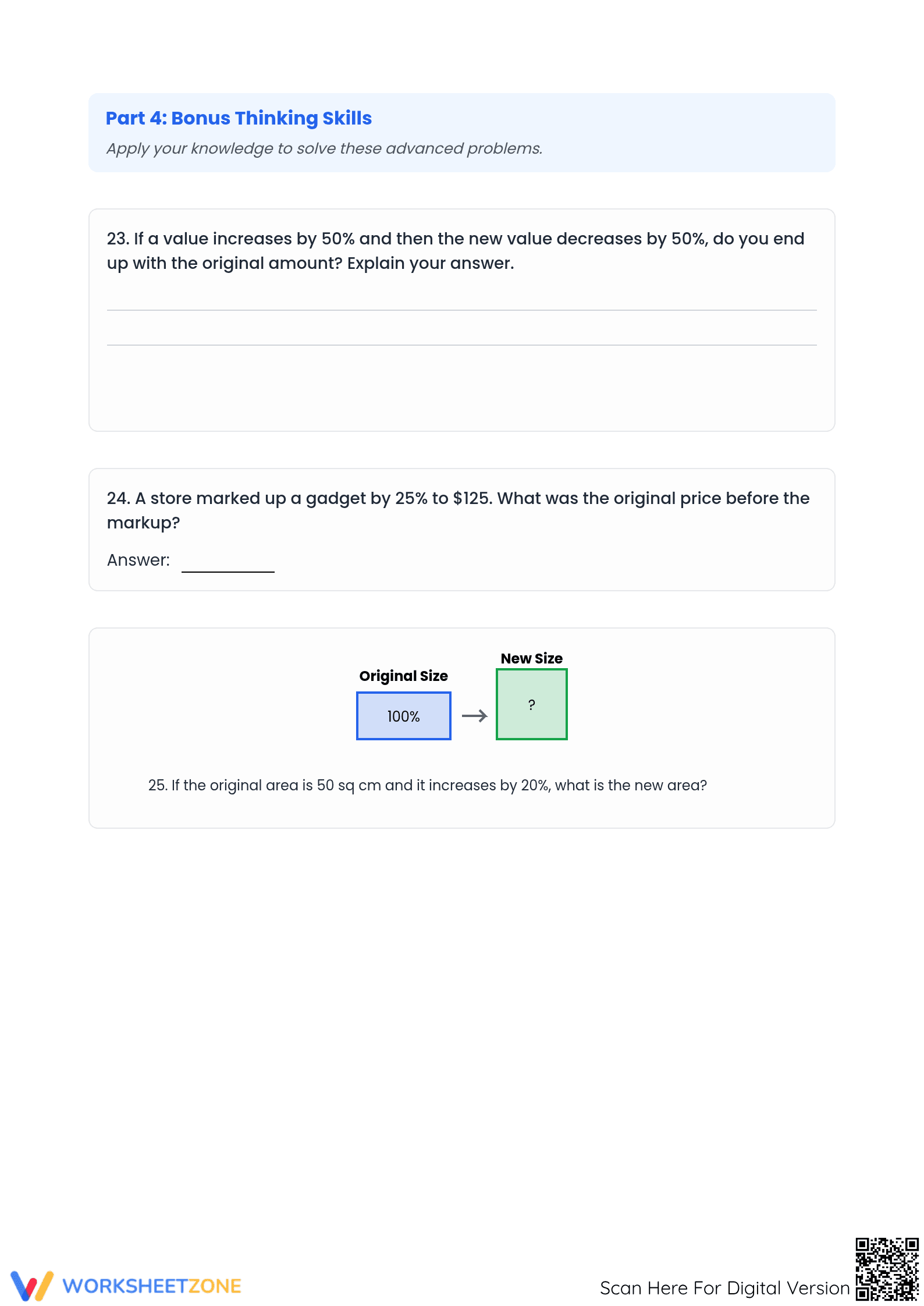
This four-page instructional packet contains 25 sequenced problems to build accuracy. The resource begins with a structured table for basic calculations, moves into conceptual multiple-choice questions, and culminates in diverse word problems. A dedicated "Bonus Thinking Skills" section challenges students with higher-order logic, such as inverse markups and multi-step percentage shifts. A full answer key is included.
Skill Progression
- Guided practice: The first twelve problems provide a clear framework where students compare original and new amounts, determine the direction of change, and calculate the exact percentage.
- Supported practice: The middle sections transition into multiple-choice and scenario-based word problems, requiring students to extract data from text and identify appropriate mathematical operations.
- Independent practice: The final "Bonus Thinking" tasks remove scaffolds entirely, asking students to explain conceptual paradoxes and solve complex problems without provided formulas or hints.
This progression follows the gradual-release model, ensuring students master the procedural steps before moving to application.
Standards Alignment
The primary focus is CCSS.MATH.CONTENT.7.RP.A.3, which requires students to use proportional relationships to solve multistep ratio and percent problems. This worksheet specifically addresses the "percent increase and decrease" component of the standard. By requiring students to calculate change in context—such as shopping discounts, population growth, and investment shifts—the resource ensures that learners can bridge the gap between abstract arithmetic and functional application. This standard code is easily integrated into lesson plans or digital gradebooks.
How to Use It
This resource is ideal for use during the "You Do" phase of a gradual-release instructional model. After modeling the percentage change formula, assign the first two pages to gauge immediate comprehension. For a formative assessment tip, observe students as they work on the multiple-choice section; those who struggle with the "direction" of change often require a quick refresher on identifying the "original" vs. "new" amount. Expect a 45-minute completion time for the full set.
Who It's For
Designed for 7th-grade students, this worksheet is also highly effective for 6th-grade acceleration or 8th-grade remediation. The structured layout supports English Language Learners by using consistent terminology and clear visual cues. It pairs naturally with real-world price tags, bank statements, or population charts to provide concrete context for the mathematical operations.
The ability to calculate percentage change is a fundamental literacy skill extending into personal finance and scientific analysis. Research from RAND AIRS 2024 highlights that students mastering proportional reasoning in middle grades show higher proficiency in algebra during high school. This worksheet addresses CCSS.MATH.CONTENT.7.RP.A.3 by providing the high-repetition practice necessary to internalize the relationship between parts and wholes. By moving from procedural fluency in Part 1 to conceptual explanation in the final section, the resource mirrors the rigor found in modern state assessments. Educators can utilize this 25-task set to gather evidence of mastery or to differentiate instruction for learners at various stages of the percent-change learning progression. This standalone resource serves as a comprehensive tool for classroom instruction or independent study.


