


























Views
Downloads


Printable Percent Increase & Decrease Worksheet | Grade 7
Paste this activity's link or code into your existing LMS (Google Classroom, Canvas, Teams, Schoology, Moodle, etc.).
Students can open and work on the activity right away, with no student login required.
You'll still be able to track student progress and results from your teacher account.
Calculating changes in value is a fundamental skill that bridges school math with real-world financial literacy. This printable worksheet provides a comprehensive practice set for students to master percent increase and decrease. By moving from structured tables to complex word problems, learners develop the procedural fluency needed to handle proportional relationships with confidence.
At a Glance
- Grade: 7 · Subject: Math
- Standard:
7.RP.A.3— Use proportional relationships to solve multistep percent problems including percent increase and decrease- Skill Focus: Calculating percentage change
- Format: 4 pages · 27 problems · Answer key included · PDF
- Best For: Independent practice or formative assessment
- Time: 35–50 minutes
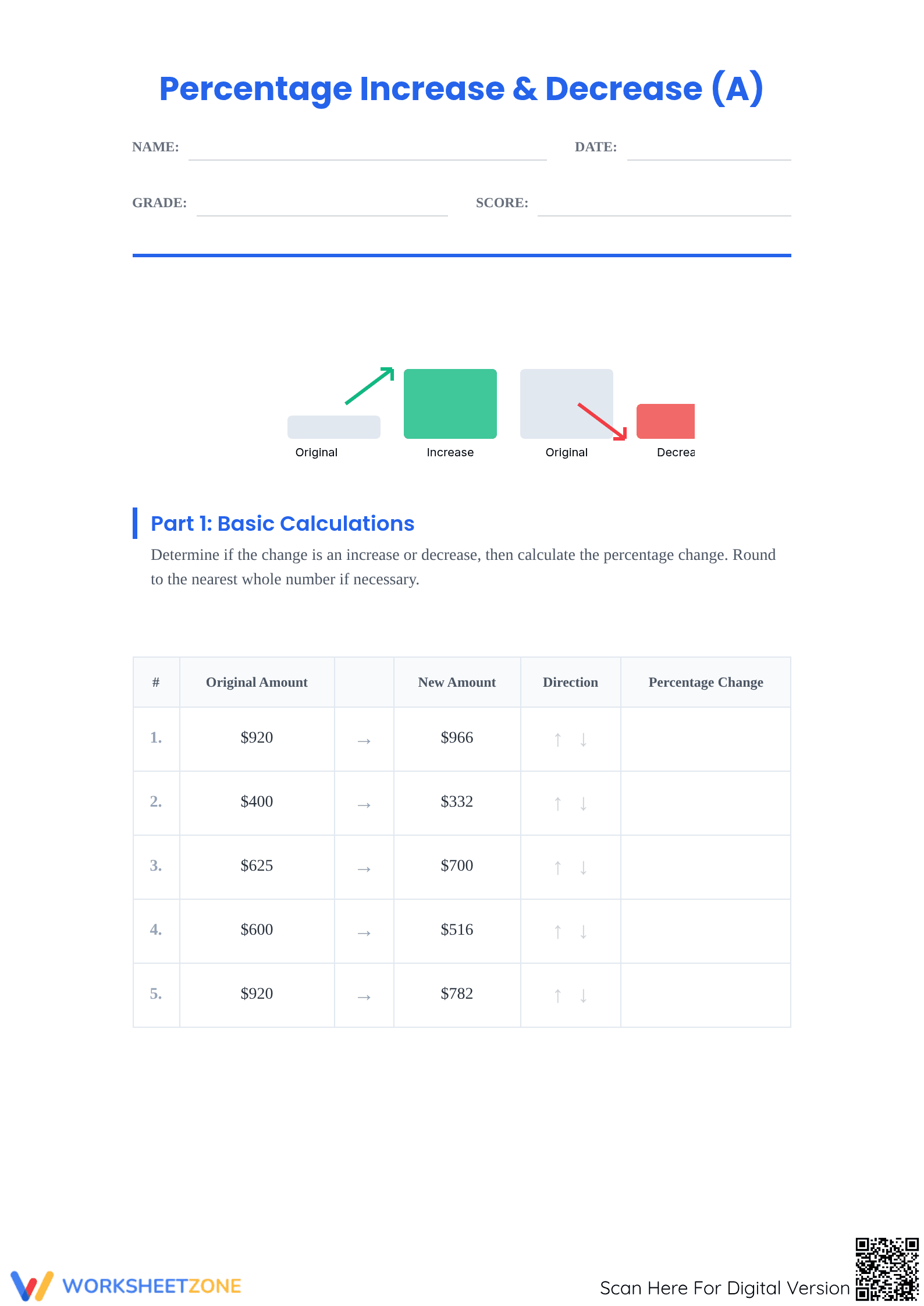
This four-page instructional packet contains twenty-seven distinct tasks organized into three logical tiers of difficulty. It features two pages of structured calculation tables to build speed, followed by a page of realistic word problems involving retail sales, population growth, and business metrics. The final page includes a dedicated "Challenge Zone" designed to stretch critical thinking through multi-step logic.
The worksheet follows a scaffolded gradual-release model:
- Guided Practice: The first ten problems use a clear table format where students identify the direction of change before calculating the final percentage.
- Supported Practice: Problems 11-20 remove some visual cues, requiring students to set up their own proportions or equations from raw numbers.
- Independent Practice: Five contextual word problems and two "Challenge Zone" items require students to interpret scenarios without preset frameworks.
This structure ensures a smooth transition from basic calculation to higher-order application.
This resource is explicitly aligned to CCSS.MATH.CONTENT.7.RP.A.3, focusing on the application of proportional relationships to solve multi-step percent problems. Students must accurately compare original amounts to new amounts to find the rate of change. This standard code can be copied directly into lesson plans, IEP goals, or district curriculum mapping tools.
Introduce this worksheet after a direct instruction lesson on the percent change formula. For a formative assessment, have students complete the first page independently, then check for the common error of dividing by the new amount instead of the original. Use the "Challenge Zone" as an extension for early finishers or as a collaborative "Think-Pair-Share" activity to deepen conceptual understanding.
This resource is designed for seventh-grade math students, though it serves as excellent remediation for eighth graders or an advanced challenge for sixth graders. It pairs naturally with instructional videos on proportions or interactive slide decks on markup and markdown. The clear layout supports students with executive functioning needs who benefit from structured workspace and logical headers.
Effective instruction in proportional reasoning requires moving beyond rote memorization of formulas toward applying math in varied contexts. According to the RAND AIRS 2024 report, students who engage with multiple representations of percentage problems—including tables and narrative scenarios—demonstrate significantly higher retention rates than those who only practice isolated calculations. This worksheet addresses that need by providing 27 problems that range from simple procedural drills to higher-order word problems involving multi-step logic. By requiring students to first identify the "direction" of change, the resource builds a conceptual foundation that prevents common misapplications of the percent formula. Educators can use this tool to verify that students understand the "original amount" as the base of the ratio, a critical threshold concept for success in Algebra I. This alignment ensures that the material meets the rigorous demands of state and national frameworks.


