


























Views
Downloads
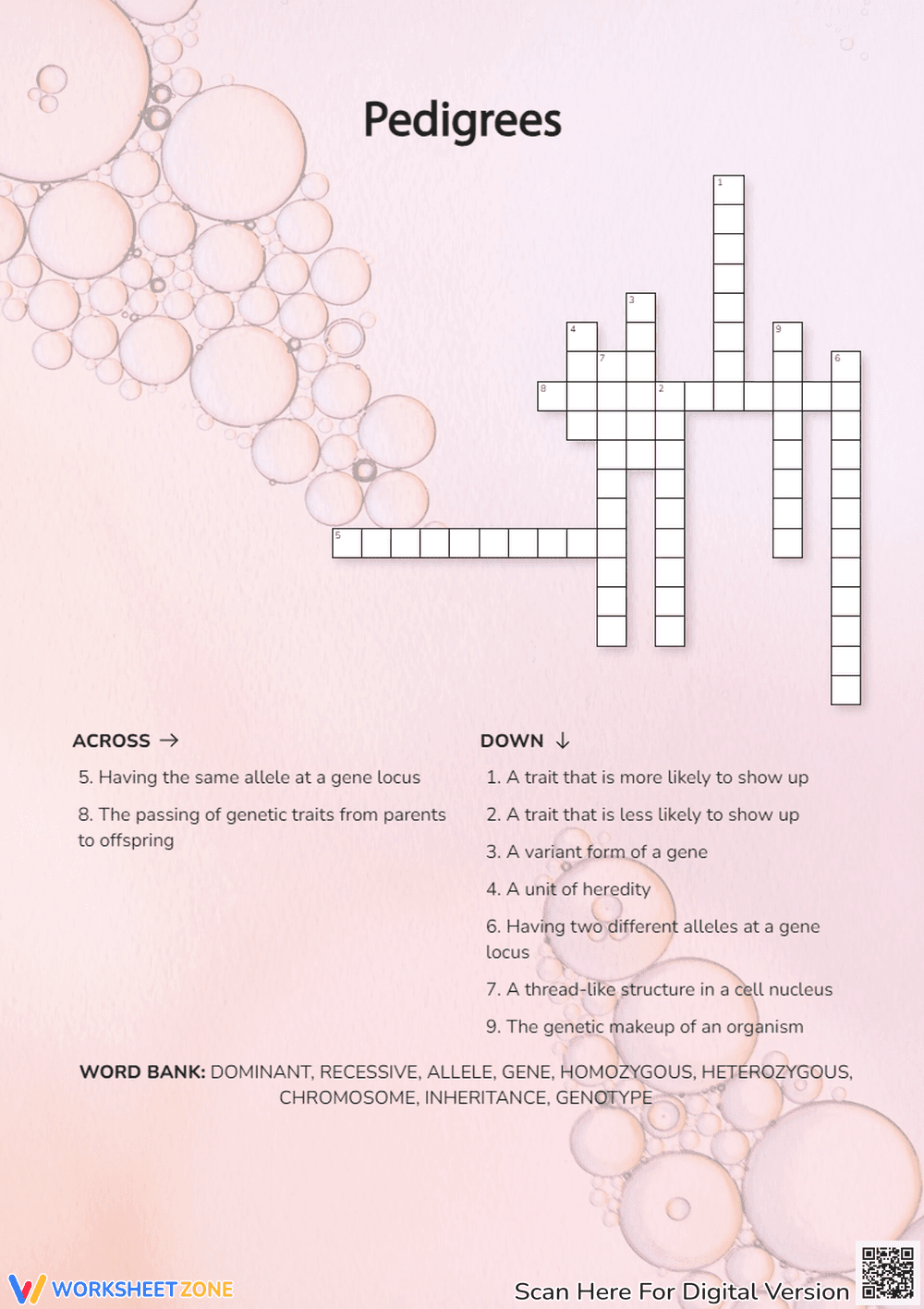

Genetics Crossword Worksheet | Grade 5 Printable
Paste this activity's link or code into your existing LMS (Google Classroom, Canvas, Teams, Schoology, Moodle, etc.).
Students can open and work on the activity right away, with no student login required.
You'll still be able to track student progress and results from your teacher account.
This Grade 5 science crossword puzzle helps students master essential genetics vocabulary. By matching definitions to key terms like allele, genotype, and heterozygous, learners build a strong foundation in heredity concepts. The engaging format reinforces complex biological ideas while keeping students focused and motivated to complete the challenge.
At a Glance
- Grade: 5 · Subject: Science
- Standard:
MS-LS3-2— Understand how genetic traits are passed to offspring- Skill Focus: Genetics Vocabulary
- Format: 1 page · 9 problems · Answer key included · PDF
- Best For: Independent practice and review
- Time: 15–20 minutes
This comprehensive resource features a single-page crossword puzzle focused on pedigrees and genetic inheritance. It includes nine distinct clues divided into across and down sections, paired with a helpful word bank containing terms like dominant, recessive, and chromosome. A complete answer key is provided to ensure accurate grading and immediate feedback for students.
Implementing this activity requires minimal effort with a streamlined three-step workflow. First, print the puzzle and answer key (1 minute). Next, distribute the copies to your students during the science block (1 minute). Finally, review the correct terms together using the provided key (3 minutes). The total teacher preparation time is under two minutes, making this an ideal, self-explanatory resource for emergency sub plans or quick transitions.
This activity aligns with MS-LS3-2, challenging students to develop and use a model to describe why sexual reproduction results in offspring with genetic variation. While targeting middle school standards, it serves as an excellent advanced preparation tool for fifth graders exploring heredity. Both standard codes can be copied directly into lesson plans, IEP goals, or district curriculum mapping tools.
Deploy this crossword puzzle as a formative assessment after direct instruction on basic genetics. It works perfectly as a quiet, independent activity while the teacher circulates to observe which vocabulary words require further explanation. Alternatively, assign it as a focused homework task to reinforce the day's lesson. Teachers can quickly gauge comprehension by noting if students rely heavily on the word bank or if they can solve the clues from memory. Expected completion time ranges from 15 to 20 minutes.
This worksheet is designed for fifth-grade general education students and advanced fourth graders ready for rigorous life science concepts. The included word bank provides built-in differentiation, acting as a scaffold for English Language Learners or students needing vocabulary support. It pairs exceptionally well with an introductory anchor chart on dominant and recessive traits or a direct instruction lesson on Punnett squares.
Mastering scientific terminology is a critical step in understanding complex biological systems. This resource targets MS-LS3-2, helping students understand how genetic traits are passed to offspring through structured vocabulary practice. According to a recent ScienceDirect TpT Analysis, integrating word puzzles into STEM education significantly improves long-term retention of domain-specific language compared to rote memorization. When learners actively engage with terms like homozygous and inheritance in a problem-solving context, they build stronger cognitive connections. This crossword format reduces cognitive overload by providing a word bank, allowing students to focus on the conceptual meaning of each term rather than struggling with spelling or recall anxiety. By bridging the gap between abstract genetic concepts and concrete definitions, this tool ensures foundational mastery, preparing students for more advanced investigations into cellular biology and heredity.


