


























Views
Downloads

Essential Plant Parts Worksheet | Grade 3 Printable
Paste this activity's link or code into your existing LMS (Google Classroom, Canvas, Teams, Schoology, Moodle, etc.).
Students can open and work on the activity right away, with no student login required.
You'll still be able to track student progress and results from your teacher account.
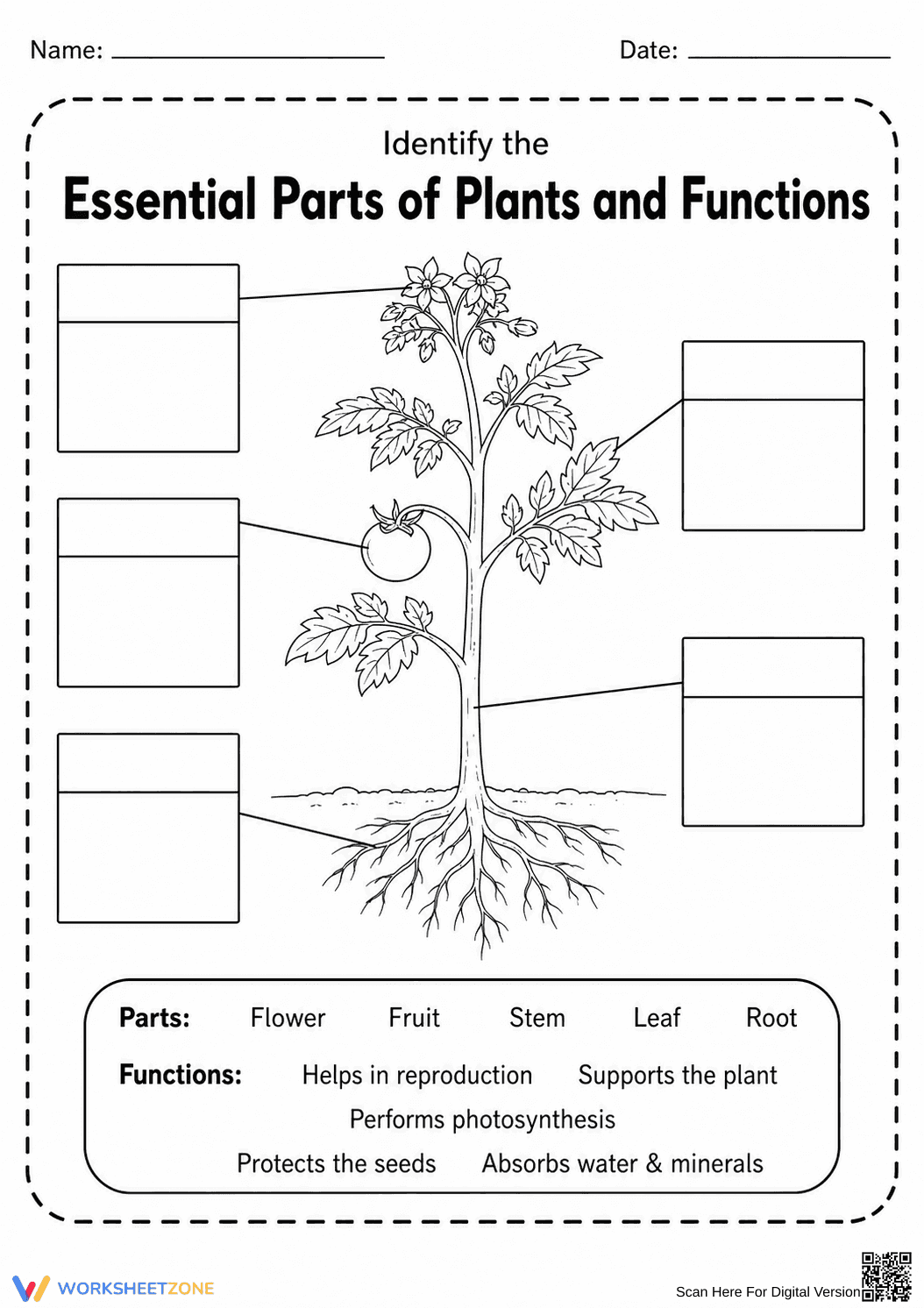
This Grade 3 science worksheet helps students master plant anatomy by identifying five key structures and their biological roles. By connecting physical parts like the stem and roots to specific functions, learners build a foundational understanding of how organisms survive. This resource provides a clear, visual method for students to demonstrate knowledge.
At a Glance
- Grade: 3 · Subject: Science
- Standard:
3-LS1-1— Develop models to describe that organisms have unique and diverse life cycles- Skill Focus: Plant anatomy and physiological functions
- Format: 1 page · 5 problems · Answer key included · PDF
- Best For: Independent practice or formative assessment
- Time: 15–20 minutes
What's Inside
The worksheet features a detailed botanical illustration of a flowering plant. Below the diagram, a structured word bank provides vocabulary for both parts and functions. Students fill in five dual-entry boxes, naming the part and explaining its purpose within the plant's system. A full answer key is included for rapid grading.
Zero-Prep Workflow
- Print: Generate the single-page PDF in seconds.
- Distribute: Hand out during independent practice; the word bank allows students to work without intervention.
- Review: Use the key to review answers as a group, providing immediate feedback.
Total teacher prep time is under 2 minutes, making this ideal for sub plans.
Standards Alignment
This resource aligns with 3-LS1-1: "Develop models to describe that organisms have unique and diverse life cycles." It addresses growth and reproduction by highlighting how structures facilitate these processes. Standard codes can be copied directly into lesson plans, IEP goals, or district curriculum mapping tools.
How to Use It
Use this as a formative assessment following direct instruction. Observe if students correctly pair roots with nutrient absorption to gauge understanding of resource acquisition. It also serves as an exit ticket to check mastery before moving to photosynthesis. Completion takes 15 to 20 minutes.
Who It's For
Designed for third grade, this is effective for second-grade enrichment or fourth-grade review. Visuals and word banks support English Language Learners and students with IEPs. Pair this with a live plant observation to reinforce the connection between diagrams and real-world biology.
This Grade 3 science resource aligns with NGSS 3-LS1-1, focusing on the internal and external structures of plants that support survival and growth. By requiring students to link specific anatomical parts—such as roots and leaves—to their physiological functions like nutrient absorption and photosynthesis, the worksheet reinforces the concept of biological systems. Research from the RAND AIRS 2024 report suggests that high-quality, targeted practice materials significantly improve retention of core disciplinary ideas in elementary science. Educators can utilize this tool to bridge the gap between direct instruction and independent application, ensuring students meet state-level proficiency standards for life science. The inclusion of a word bank serves as a critical scaffold for academic language acquisition, allowing students to focus on the conceptual relationship between form and function rather than just spelling.


