


























Views
Downloads
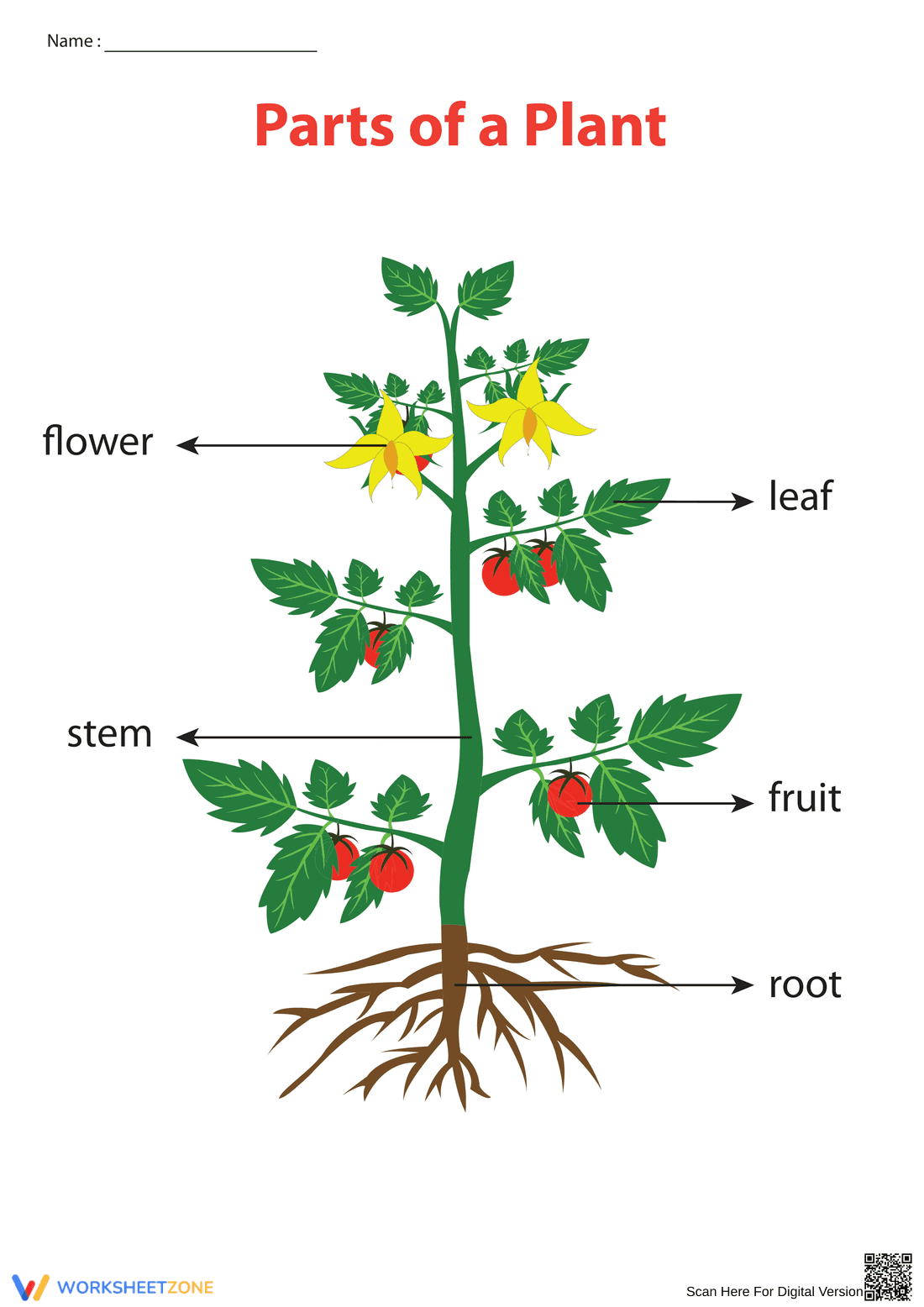

Essential Parts of a Plant Chart | Grade 1 Printable
Paste this activity's link or code into your existing LMS (Google Classroom, Canvas, Teams, Schoology, Moodle, etc.).
Students can open and work on the activity right away, with no student login required.
You'll still be able to track student progress and results from your teacher account.
This Grade 1 science resource provides a clear, visual reference for students to identify the primary components of a flowering plant. By isolating the flower, leaf, stem, fruit, and root, students develop the foundational biological vocabulary necessary to describe how living things grow and survive in their environments.
At a Glance
- Grade: 1 · Subject: Living Things
- Standard:
1-LS1-1— Identify external parts of plants that help them survive and grow- Skill Focus: Plant Anatomy Identification
- Format: 1 page · 5 labeled parts · Reference Chart · PDF
- Best For: Science centers and student reference folders
- Time: 5–10 minutes
This printable PDF features a high-quality, full-color illustration of a tomato plant. The chart includes five distinct labels with directional arrows pointing precisely to the flower, leaf, stem, fruit, and root system. The layout is optimized for primary learners, using large, legible fonts and a clean white background to minimize visual distraction and maximize information retention for students during their initial science exploration.
This resource is designed for immediate classroom integration with a total teacher prep time of under two minutes. Simply print the color version to display as an anchor chart or provide individual copies for student science journals. Teachers can distribute these during direct instruction to serve as a visual guide while students examine real plant specimens. Because it is self-explanatory, it also serves as an excellent reference page for substitute teacher plans or independent science center activities.
This resource is specifically aligned to the Next Generation Science Standard 1-LS1-1, which requires students to understand how the external parts of plants help them meet their needs. By identifying these structures, students begin to categorize how leaves capture sunlight, roots absorb water, and stems provide support. This standard code can be copied directly into lesson plans, IEP goals, or district curriculum mapping tools to ensure rigorous instructional alignment.
Use this chart as a visual anchor during the "Explore" phase of a 5E lesson. Project the image and have students come up to circle parts they recognize on a live plant. Alternatively, use it as a formative assessment tool by asking students to point to specific parts on their own copy as you describe their functions. This approach allows for a quick check for understanding in a low-stakes, interactive environment.
This chart is tailored for first-grade students but is also highly effective for Kindergarten learners or English Language Learners who need visual support to build basic science vocabulary. It pairs naturally with a hands-on seed planting activity or a classroom nature walk where students can observe these structures in diverse plant species. The clear labeling supports literacy development alongside scientific inquiry and observation.
The systematic identification of plant structures at the primary level is a critical prerequisite for understanding complex biological systems. According to EdReports 2024, high-quality visual aids that provide clear labels for external anatomy help Grade 1 students transition from simple observation to more sophisticated scientific description. By focusing on the 1-LS1-1 standard, this chart ensures that learners are not just memorizing names but are building the conceptual framework required to analyze how these parts function collectively to support the life of the organism. This foundational knowledge is essential for meeting state science benchmarks and developing a long-term interest in the natural world. Research indicates that students relate more strongly to familiar, food-producing plants, which enhances engagement and long-term memory of the specific anatomical labels provided in this essential science resource, making the tomato plant an ideal model.


