


























Views
Downloads

Edible Parts of a Plant Printable Worksheet | Grade 1
Paste this activity's link or code into your existing LMS (Google Classroom, Canvas, Teams, Schoology, Moodle, etc.).
Students can open and work on the activity right away, with no student login required.
You'll still be able to track student progress and results from your teacher account.
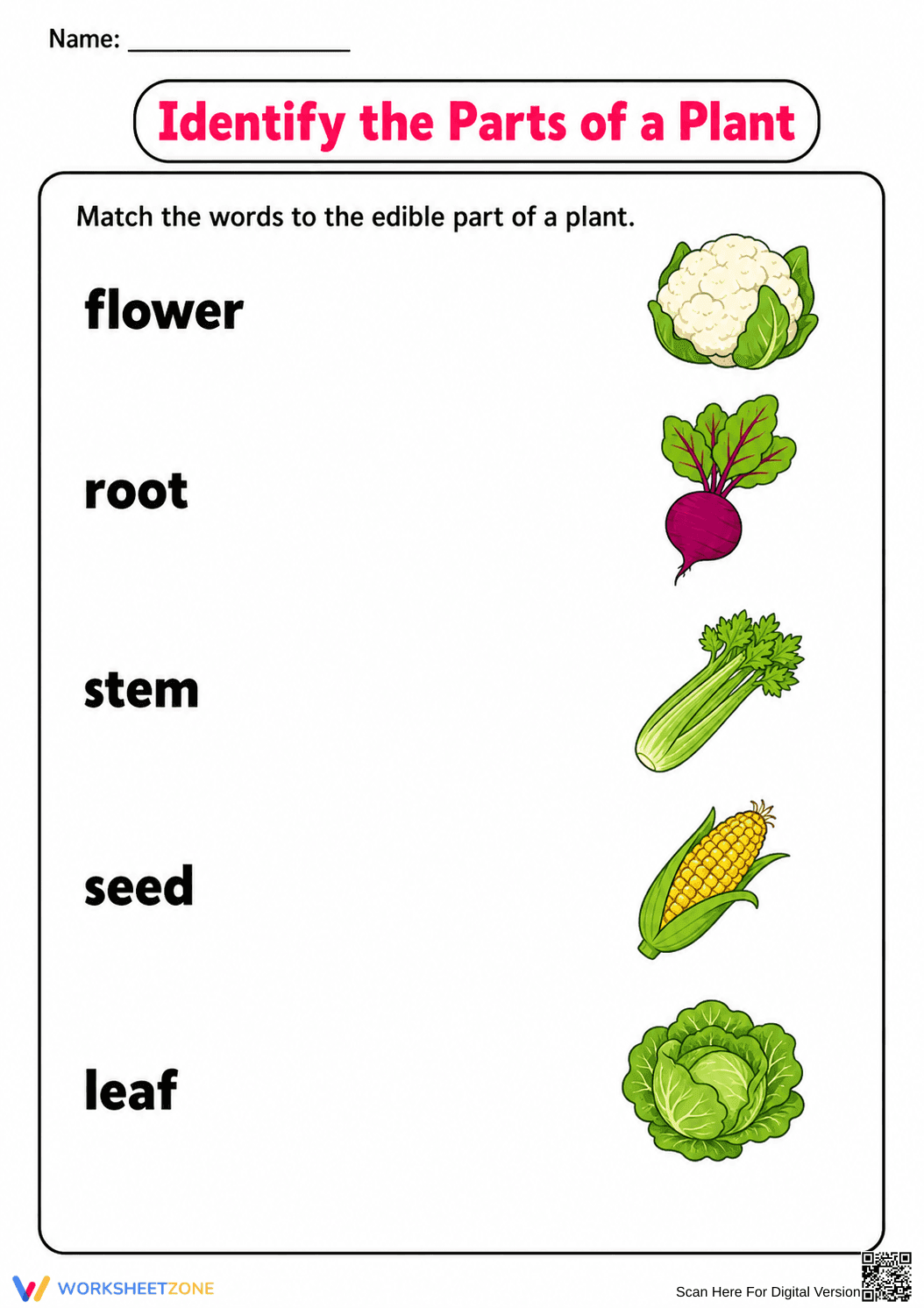
This Grade 1 science worksheet helps students identify edible plant parts by matching vocabulary words to clear, full-color illustrations. By connecting terms like root, stem, and leaf to familiar foods like carrots and celery, young learners build foundational biology skills and discover exactly where their food comes from.
At a Glance
- Grade: 1 · Subject: Science
- Standard:
1-LS1-1— Identify and describe the external parts of plants- Skill Focus: Identifying edible plant parts
- Format: 2 pages · 5 problems · Answer key included · PDF
- Best For: Independent practice
- Time: 10–15 minutes
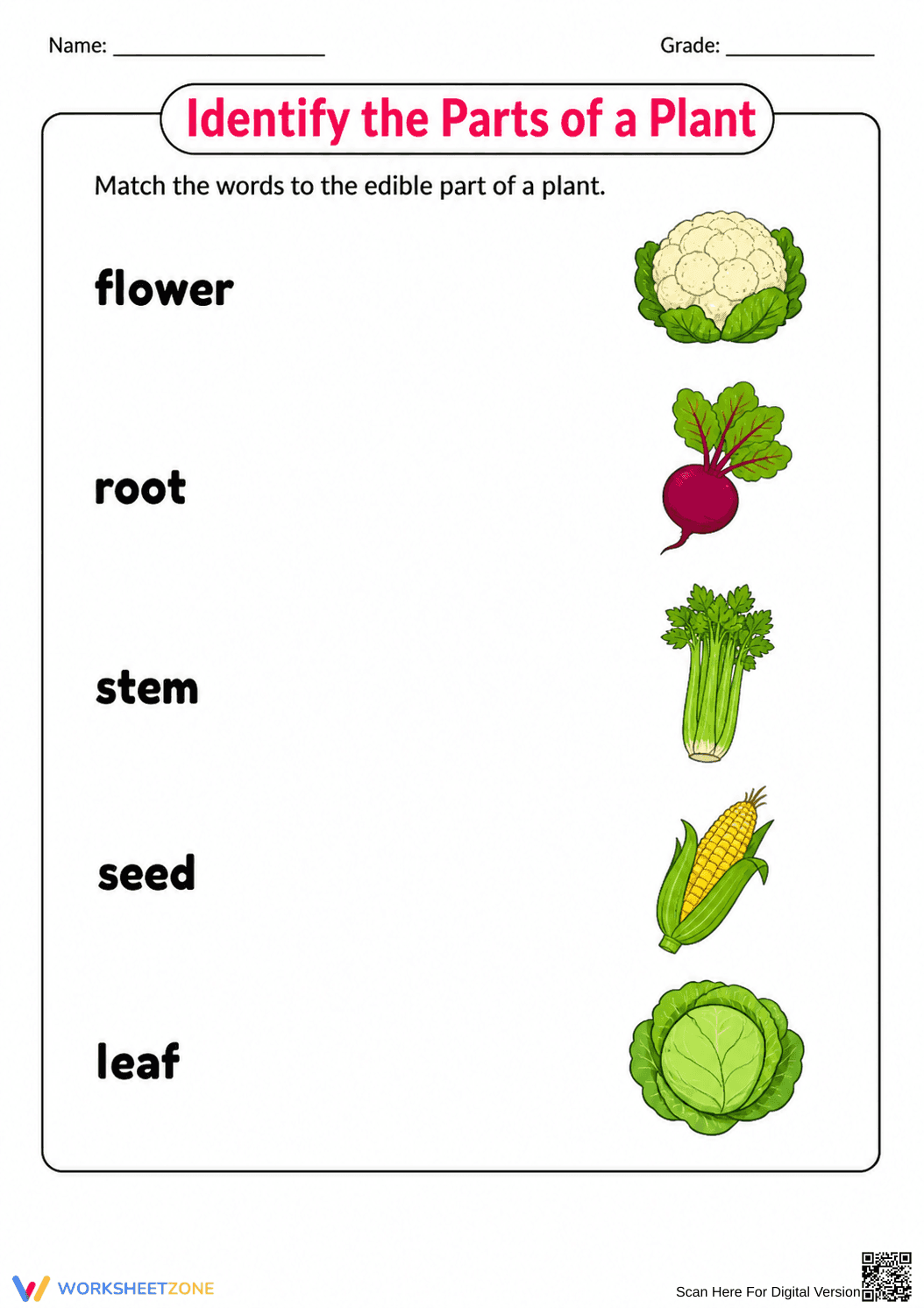
Students draw lines connecting five plant vocabulary words (flower, root, stem, seed, leaf) to corresponding vegetable illustrations (cauliflower, turnip, celery, corn, cabbage). The download includes two page formats to accommodate different heading preferences, plus an answer key. Visual supports help early readers grasp concepts without heavy reading demands.
Zero-Prep Workflow
This worksheet requires zero teacher preparation.
- Print (1 minute): Download the PDF and print. Graphics work well in color or grayscale.
- Distribute (1 minute): Hand out with pencils. Instructions are self-explanatory.
- Review (3 minutes): Use the answer key to check work or project it for whole-class correction.
With prep time under two minutes, it is perfect for sub plans.
Standards Alignment
This aligns with Next Generation Science Standard 1-LS1-1: Use materials to design a solution to a human problem by mimicking how plants use their external parts to survive. This worksheet provides prerequisite knowledge by ensuring students identify external parts (roots, stems, leaves, flowers, seeds) in a real-world context. Both standard codes can be copied directly into lesson plans, IEP goals, or district curriculum mapping tools.
How to Use It
Use this as independent practice following a direct instruction lesson on plant anatomy, or as morning work before a school garden visit. As a formative assessment observation tip, watch how students approach the flower and seed matches to see if they understand that cauliflower and corn represent specific plant structures. Expected completion time is 10 to 15 minutes.
Who It's For
Designed for first-grade students, this serves as an excellent review for second graders. Visual cues make it highly accessible for English Language Learners and students requiring reading accommodations. It pairs naturally with a hands-on vegetable sorting activity or a read-aloud book about plant life cycles.
Mastering foundational science vocabulary requires repeated exposure to concepts in relatable contexts. According to a ScienceDirect TpT Analysis, integrating familiar, everyday items—such as the foods students eat—into early elementary science instruction significantly improves vocabulary retention and conceptual understanding. This worksheet supports that pedagogical approach by directly linking abstract botanical terms to concrete examples from the grocery store. By addressing standard 1-LS1-1, students learn to identify and describe the external parts of plants, building a necessary framework for future biological studies. When young learners understand that a turnip is a root and celery is a stem, they develop a deeper appreciation for the natural world and agricultural systems. This targeted practice ensures that foundational life science concepts are firmly established before students progress to more complex ecological relationships in later grades.


