




























Views
Downloads

Essential Parts of a Flower Worksheet | Grade 5 Ready

Paste this activity's link or code into your existing LMS (Google Classroom, Canvas, Teams, Schoology, Moodle, etc.).
Students can open and work on the activity right away, with no student login required.
You'll still be able to track student progress and results from your teacher account.
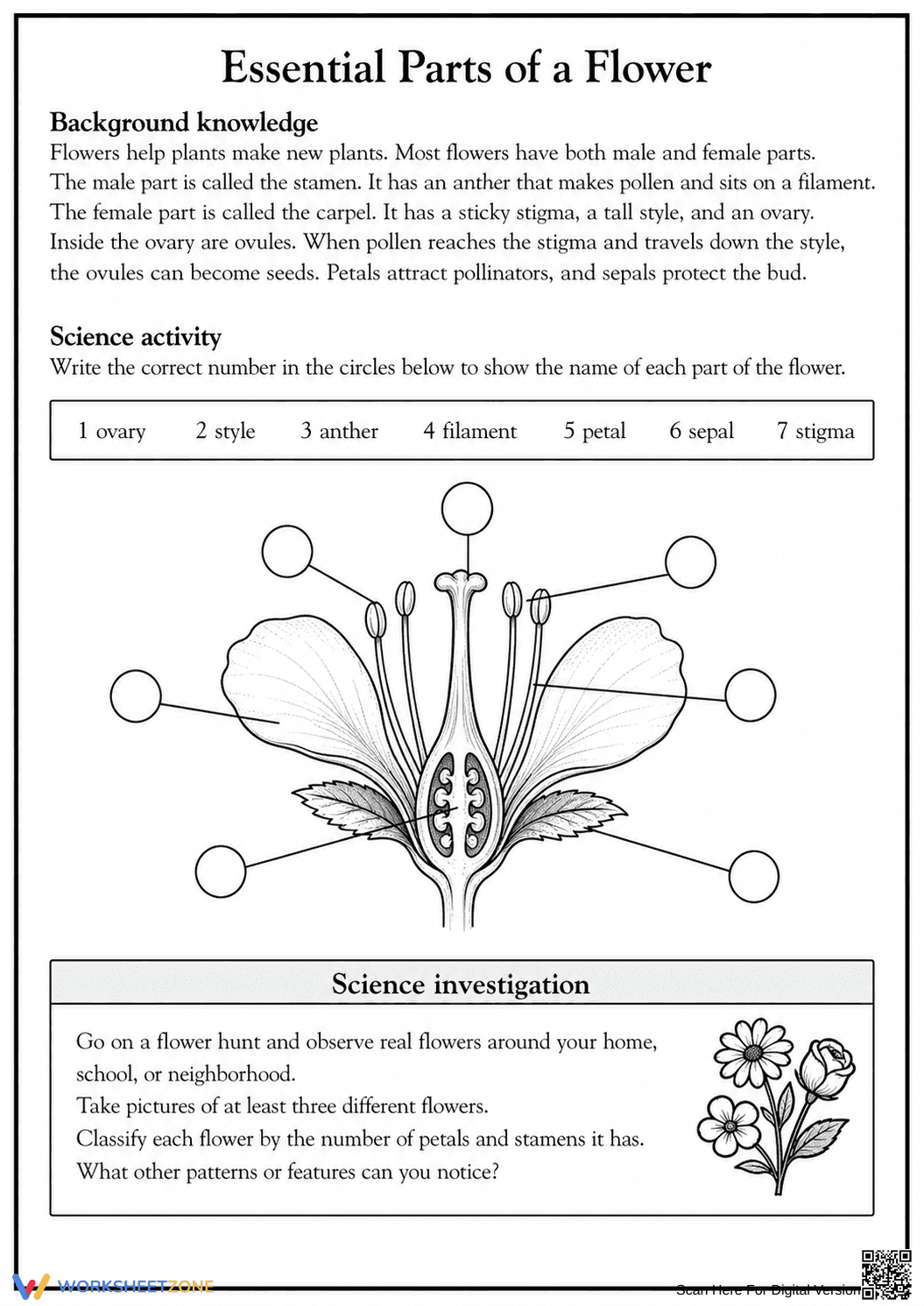
Understanding the biological structures of plants is a foundational skill in Grade 5 science. This worksheet enables students to map the reproductive anatomy of flowers, focusing on the stamen and carpel components. By connecting vocabulary to visual diagrams, learners develop a concrete understanding of how living things reproduce and thrive within their local ecosystems.
At a Glance
- Grade: 5 · Subject: Living Things
- Standard:
5-LS1-1— Support an argument that plants get what they need for growth- Skill Focus: Flower Anatomy Identification
- Format: 1 page · 8 tasks · Answer key included · PDF
- Best For: Independent science centers and nature walks
- Time: 20–30 minutes
The resource includes a detailed background knowledge section followed by a seven-part labeling activity. Students identify the ovary, style, anther, filament, petal, sepal, and stigma on a cross-section diagram. The second half features a science investigation task where students classify real-world flowers based on physical characteristics, promoting hands-on scientific observation and data collection.
Zero-Prep Workflow
- Print: Generate copies for your Grade 5 science block in under 30 seconds.
- Distribute: Hand out during direct instruction or as a prompt for a school-yard flower hunt.
- Review: Utilize the answer key for a five-minute whole-class check to verify student mastery of plant parts.
This worksheet is aligned to the 5-LS1-1 standard. It focuses on the internal and external structures that support plant survival and reproduction. This standard code can be copied directly into lesson plans, IEP goals, or district curriculum mapping tools to ensure instructional alignment across the life science unit.
Use this resource as a formative assessment after a lesson on plant lifecycles. It also serves as an excellent guide for a field-based "Science Investigation" where students photograph and classify local flora. For a quick check, observe students as they label the diagram to identify common misconceptions about reproductive organs like the anther versus the stigma.
This activity is designed for Grade 5 students but can be adapted for Grade 4 or 6 learners. It is particularly effective for visual learners who benefit from clear diagrams and concise background text. Pair this worksheet with a physical flower dissection or a botanical passage to provide a comprehensive, multi-modal science experience.
According to Fisher & Frey (2014), visual scaffolds such as biological diagrams are essential for adolescent literacy and scientific comprehension. This Grade 5 worksheet targets the 5-LS1-1 standard by requiring students to categorize the internal structures of a flower. The resource features seven labeling tasks—including the ovary, style, anther, and filament—alongside a science investigation that encourages real-world application through observation. By bridging the gap between abstract biological concepts and observable natural phenomena, this resource supports the long-term retention of scientific vocabulary and morphological understanding. Educational research indicates that student-led investigations, such as the "flower hunt" included here, increase engagement and mastery of complex life science systems. This printable PDF serves as a robust tool for educators seeking to align their curriculum with NGSS expectations while providing clear, evidence-based instructional materials for diverse classroom environments.


