


























Views
Downloads

2-LS2-2 Worksheet: Essential Parts of a Flower — Grade 2
Paste this activity's link or code into your existing LMS (Google Classroom, Canvas, Teams, Schoology, Moodle, etc.).
Students can open and work on the activity right away, with no student login required.
You'll still be able to track student progress and results from your teacher account.
This Grade 2 science resource helps students identify flower anatomy and understand reproductive functions. By integrating informational text with a hands-on modeling craft and a labeling assessment, learners develop a concrete understanding of how external structures support plant survival. Students move from theoretical knowledge to practical application through model construction.
At a Glance
- Grade: 2 · Subject: Science
- Standard:
2-LS2-2— Develop a simple model that mimics pollination- Skill Focus: Identifying parts of a flower
- Format: 5 pages · 10 problems · No answer key · PDF
- Best For: Hands-on science instruction
- Time: 45–60 minutes
What's Inside
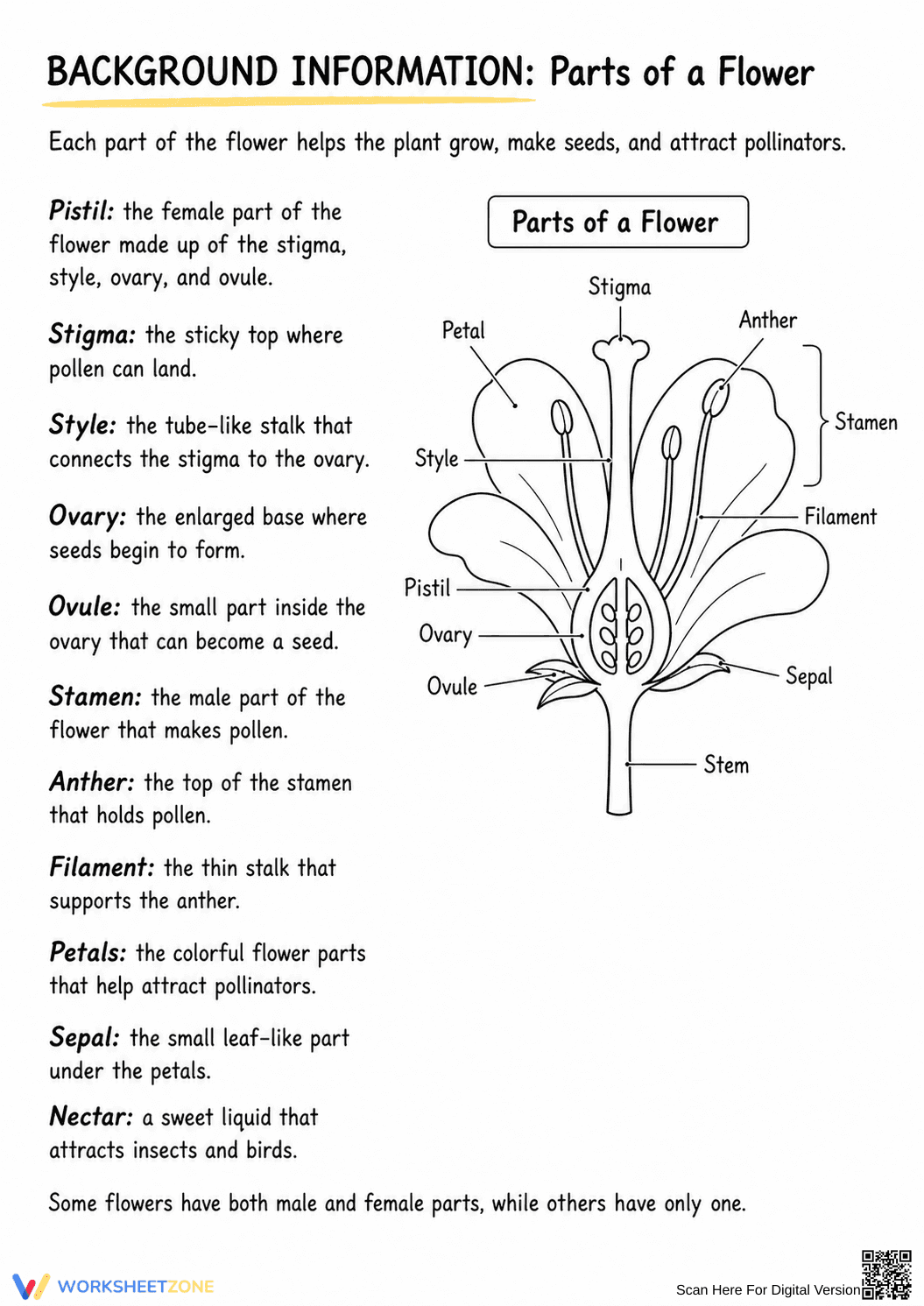
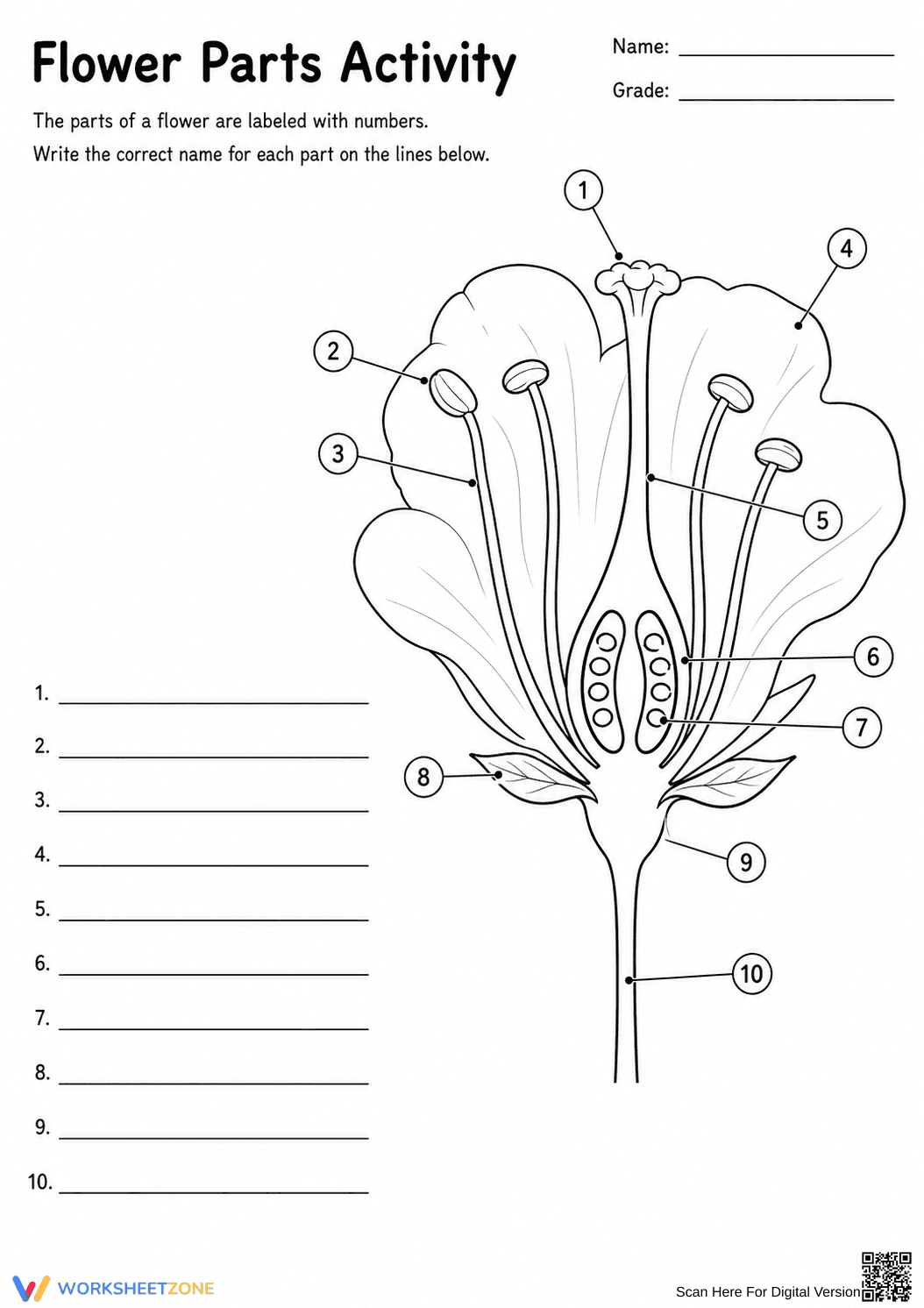
This 5-page packet contains a comprehensive lesson plan, two pages of detailed background information on pollination and anatomy, and a step-by-step guide for a tissue paper flower craft. It concludes with a 10-item labeling worksheet featuring a clear biological diagram of a flower's internal and external structures including the pistil, stamen, and sepals.
Mastery Evidence
Tasks are mapped to specific anatomical identification. The craft serves as a formative assessment for approaching mastery, while the 10-question diagram labeling provides evidence for meeting the standard. Students exceed expectations by explaining the relationship between the stamen and pistil during the extension dissection activity. Scores can be entered directly into gradebooks or IEP progress notes.
Standards Alignment
Aligned to primary standard 2-LS2-2: Develop a simple model that mimics the function of an animal in dispersing seeds or pollinating plants. The included craft activity directly supports this by having students build a model flower to understand where pollen is produced and collected. Both standard codes can be copied directly into lesson plans, IEP goals, or district curriculum mapping tools.
How to Use It
Use this during core science instruction. Start with the background reading to establish vocabulary, then facilitate the 20-minute craft. Use the 10-question worksheet as a summative exit ticket. Observe students during the craft to ensure they correctly place the "pollen" on the stigma. Expected completion time is 45 to 60 minutes for the full lesson sequence.
Who It's For
This is designed for Grade 2 students but works well for Grade 1 enrichment or Grade 3 review. It is particularly effective for kinesthetic learners who benefit from tactile modeling. Pair this lesson with a real lily dissection or a video on pollinators to enhance the learning experience and provide a natural pairing for direct instruction.
This resource is anchored in the NGSS 2-LS2-2 standard, which requires students to develop models mimicking biological processes like pollination. By identifying the pistil, stamen, and petals, students build the foundational vocabulary necessary for life science mastery. Research from the ScienceDirect TpT Analysis indicates that multi-modal instruction—combining tactile modeling with diagrammatic labeling—significantly increases retention of complex biological terms in early elementary learners. The 10-question assessment provides clear data on student ability to differentiate between male and female plant structures. According to Fisher & Frey (2014), the gradual release of responsibility from teacher-led reading to independent labeling ensures that students internalize the functions of external plant structures before moving to higher-order ecological concepts. This 5-page lesson plan provides a structured pathway for Grade 2 students to achieve proficiency in identifying parts of a flower while engaging in hands-on scientific inquiry.


