




























Views
Downloads
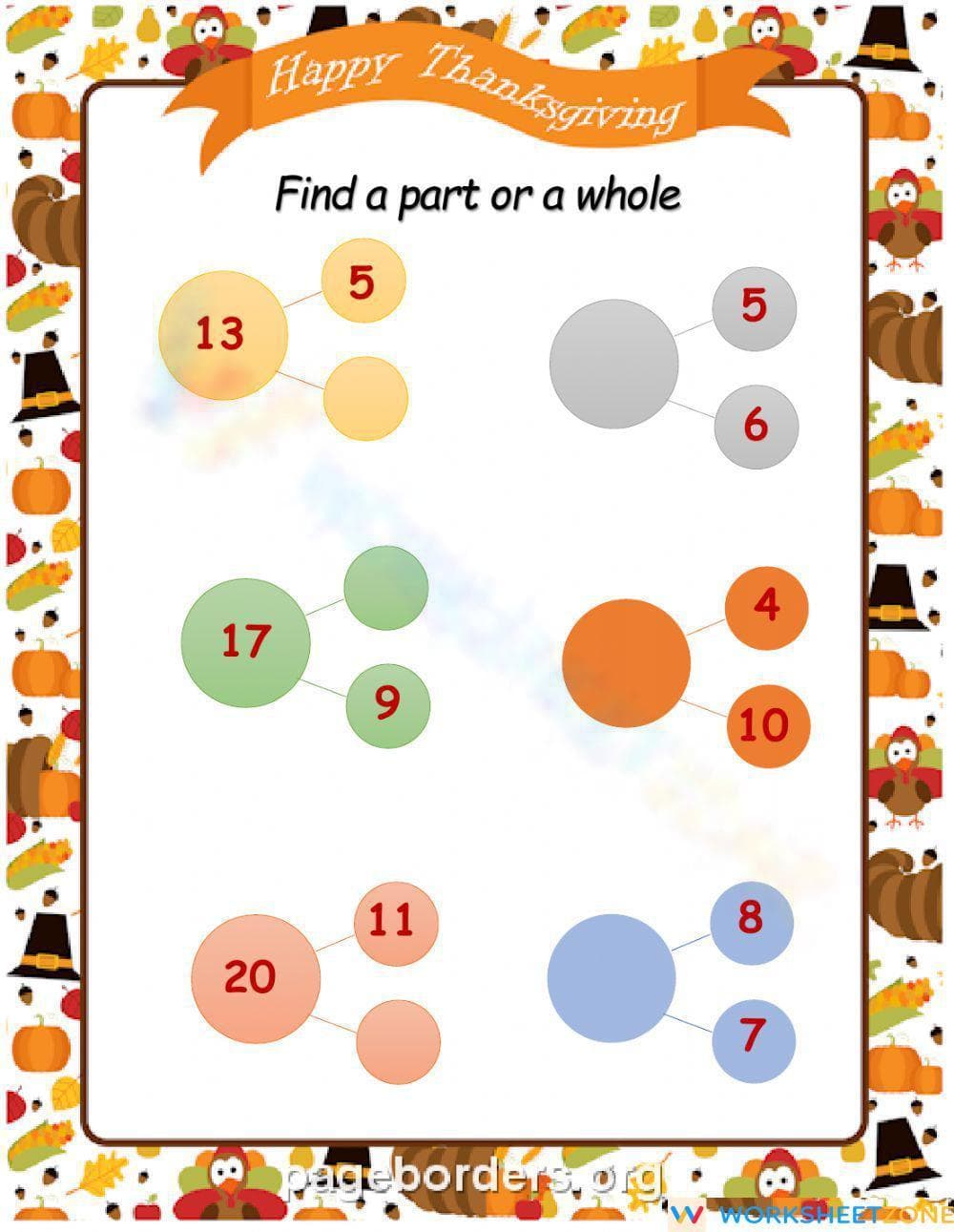

Part or Whole Number Bonds | Grade 1-3 Printable

Paste this activity's link or code into your existing LMS (Google Classroom, Canvas, Teams, Schoology, Moodle, etc.).
Students can open and work on the activity right away, with no student login required.
You'll still be able to track student progress and results from your teacher account.
This Grade 1-3 math worksheet helps students master the relationship between addition and subtraction through visual number bonds. By identifying the missing part or whole in six distinct problems, learners develop the algebraic thinking necessary for mental math fluency. This resource provides immediate practice in decomposing numbers up to 20.
At a Glance
- Grade: 1-3 · Subject: Math
- Standard:
CCSS.MATH.CONTENT.1.OA.D.8— Determine the unknown whole number in an addition or subtraction equation.- Skill Focus: Number Bonds & Part-Whole Relationships
- Format: 1 page · 6 problems · Answer key included · PDF
- Best For: Seasonal morning work or math centers
- Time: 10–15 minutes
The worksheet features a festive Thanksgiving theme with six colorful part-part-whole diagrams. Each task presents either the "whole" and one "part," or two "parts" requiring the student to calculate the sum. The clear, circular layout helps students visualize the mathematical connection between the numbers. A full answer key is provided to facilitate quick grading or student self-correction.
This resource is designed for immediate classroom implementation with a total teacher prep time of under 2 minutes. First, print the single-page PDF for your class (30 seconds). Next, distribute the sheets as a warm-up or "bell-ringer" activity (30 seconds). Finally, review the six solutions together using a document camera to reinforce the inverse relationship between addition and subtraction (1 minute). It is an ideal emergency sub plan component.
The primary focus is CCSS.MATH.CONTENT.1.OA.D.8, which requires students to "Determine the unknown whole number in an addition or subtraction equation relating three whole numbers." By using number bonds, students also touch upon supporting standards like understanding subtraction as an unknown-addend problem. Both standard codes can be copied directly into lesson plans, IEP goals, or district curriculum mapping tools.
Use this worksheet during the "independent practice" phase of a lesson on fact families. It serves as an excellent formative assessment tool; observe if students use counting on, finger counting, or known facts to find the missing values. The expected completion time is 10 to 15 minutes, making it perfect for a transition period or a focused math station.
This resource is tailored for first through third-grade students who are refining their addition and subtraction strategies within 20. It is particularly helpful for English Language Learners (ELLs) and students with IEPs because the visual representation of number bonds reduces the heavy linguistic load often found in word problems. Pair this with a physical manipulative set like snap cubes or counters for extra support.
This number bond worksheet aligns with the instructional shifts identified in the RAND AIRS 2024 report, which emphasizes the importance of visual representations in early numeracy development. By focusing on the part-whole relationship, the resource supports the Concrete-Representational-Abstract (CRA) sequence, a proven pedagogical framework for building deep mathematical understanding. Research from Fisher & Frey (2014) suggests that structured practice with inverse operations, such as the six tasks provided here, accelerates the transition from basic counting to advanced mental computation. The worksheet addresses CCSS.MATH.CONTENT.1.OA.D.8 by requiring students to identify unknown values within a relational structure rather than just solving isolated equations. This approach ensures that students recognize the underlying logic of arithmetic, which is a critical predictor of success in later algebraic coursework. Educators can confidently integrate this tool into evidence-based math blocks to support diverse learners in achieving grade-level mastery.


