


























Views
Downloads
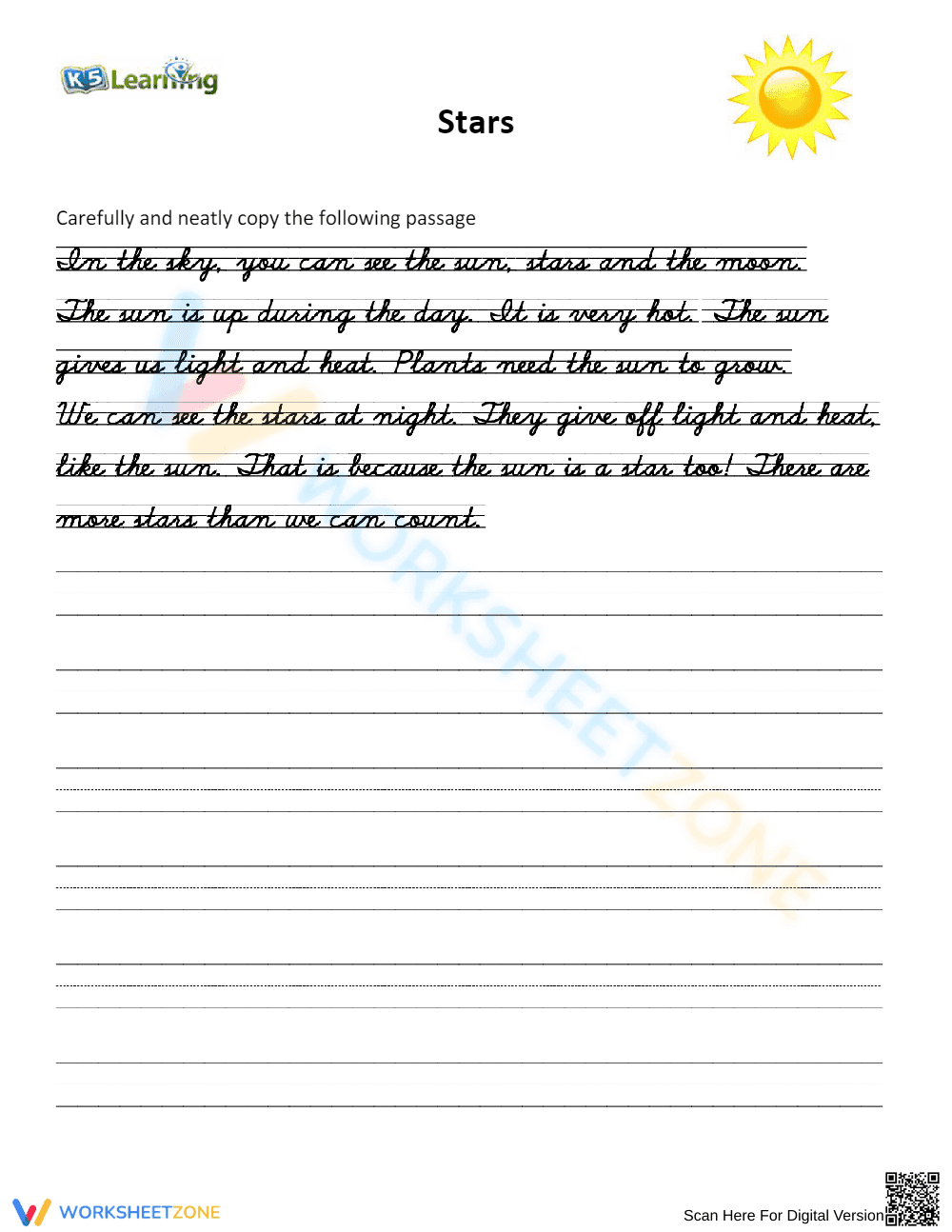

Printable Cursive Handwriting Worksheet | Grade 3
Paste this activity's link or code into your existing LMS (Google Classroom, Canvas, Teams, Schoology, Moodle, etc.).
Students can open and work on the activity right away, with no student login required.
You'll still be able to track student progress and results from your teacher account.
This printable cursive handwriting worksheet helps third and fourth-grade students develop legible penmanship by copying a short, engaging paragraph about stars. By practicing letter formation and spacing on standard lined paper, learners build the fine motor control required for fluent, everyday writing tasks.
At a Glance
- Grade: 3 · Subject: English
- Standard:
CCSS.ELA-LITERACY.L.3.2— Demonstrate command of standard English conventions.- Skill Focus: Cursive handwriting and penmanship
- Format: 1 page · 1 task · No answer key needed · PDF
- Best For: Independent practice and morning work
- Time: 10–15 minutes
Inside this single-page resource, educators will find a modeled cursive paragraph titled "Stars" at the top. The passage contains five sentences detailing facts about the sun, providing meaningful content to transcribe. Below the model text, blank handwriting lines with dotted midlines give students the structural support needed to practice proper letter height, slant, and word spacing.
This resource is designed for immediate classroom implementation with a streamlined workflow:
- Print (1 minute): Generate copies of the single-page PDF for your entire class.
- Distribute (1 minute): Hand out the worksheets during morning work or a dedicated handwriting block.
- Review (1 minute): Quickly scan student work for legibility and proper line usage.
With under two minutes of total teacher prep time, this self-explanatory activity is highly suitable for substitute teacher plans or quiet independent work stations.
This activity aligns with CCSS.ELA-LITERACY.L.3.2: "Demonstrate command of the conventions of standard English capitalization, punctuation, and spelling when writing." By carefully copying the provided text, students reinforce their understanding of sentence boundaries, proper capitalization, and correct punctuation placement. This standard code can be copied directly into lesson plans, IEP goals, or district curriculum mapping tools.
Teachers can utilize this worksheet as a calming transition activity after recess or as a focused morning bell-ringer. Before students begin, briefly review the importance of maintaining a consistent slant and resting letters on the baseline. As a formative assessment observation tip, walk around the room while students write to monitor their pencil grip and posture, offering gentle corrections as needed. The entire copying task has an expected completion time range of ten to fifteen minutes.
This practice sheet is primarily designed for third and fourth-grade students who have already been introduced to basic cursive letter formation and are ready to transition to writing full words and sentences. For differentiation, teachers can allow students who struggle with fine motor skills to trace the model text first before attempting to write it independently on the blank lines below. This worksheet pairs naturally with a brief direct instruction lesson on cursive connections or a science unit about the solar system.
Developing fluent handwriting remains a critical component of early elementary education, directly impacting a student's ability to express ideas without cognitive overload. This resource targets CCSS.ELA-LITERACY.L.3.2, helping students demonstrate command of standard English conventions through focused transcription. According to an EdReports 2024 review of foundational literacy skills, explicit handwriting practice significantly improves reading fluency and written composition quality in elementary learners. When students do not have to consciously think about forming letters, their working memory is freed to focus on vocabulary and sentence structure. By integrating short copying tasks into the weekly routine, educators provide the repetition necessary for students to achieve automaticity in penmanship, supporting broader academic success.


