


























Views
Plays



Printable Paragraph Sequencing Worksheet | College Prep
Paste this activity's link or code into your existing LMS (Google Classroom, Canvas, Teams, Schoology, Moodle, etc.).
Students can open and work on the activity right away, with no student login required.
You'll still be able to track student progress and results from your teacher account.
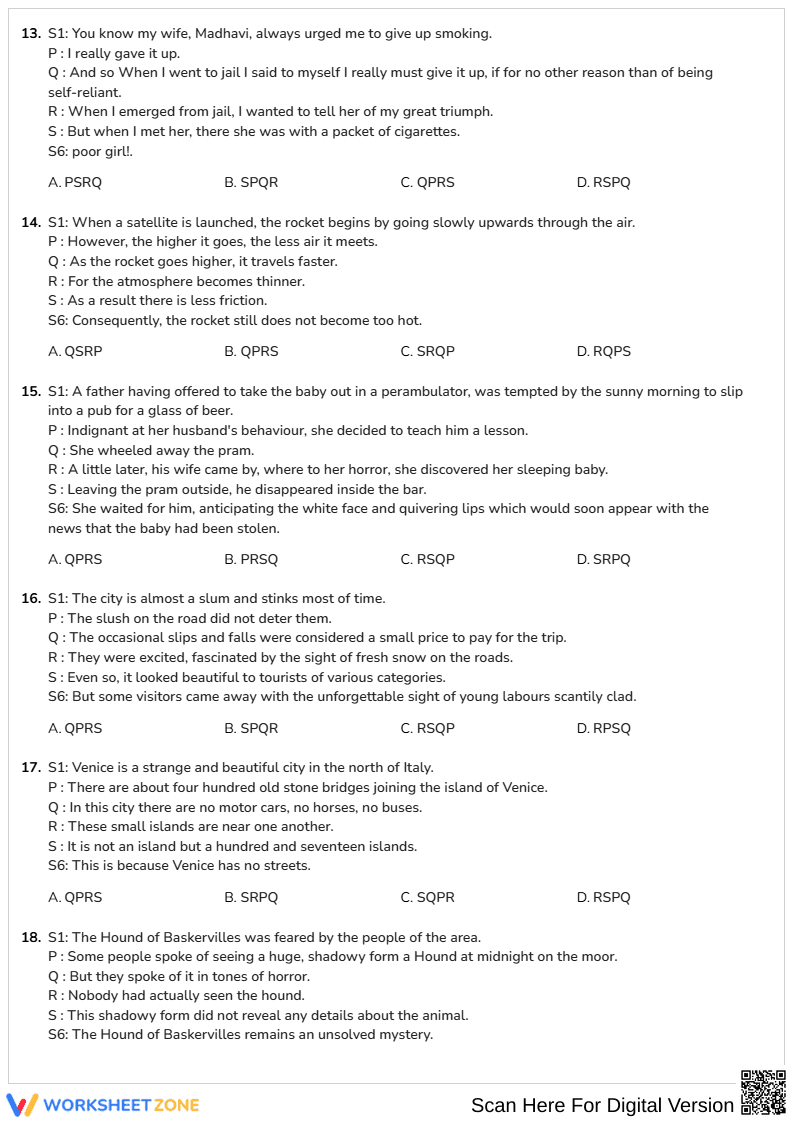
This comprehensive paragraph sequencing worksheet helps college-level and advanced high school students master text cohesion and logical progression. By rearranging jumbled sentences into coherent paragraphs, learners strengthen their reading comprehension and structural analysis skills, ensuring they can identify how authors build arguments and narratives effectively.
At a Glance
- Grade: College · Subject: ELA
- Standard:
CCSS.ELA-LITERACY.RI.11-12.5— Analyze and evaluate the effectiveness of text structure- Skill Focus: Paragraph Sequencing and Cohesion
- Format: 4 pages · 20 problems · Answer key included · PDF
- Best For: Independent practice and test prep
- Time: 30–45 minutes
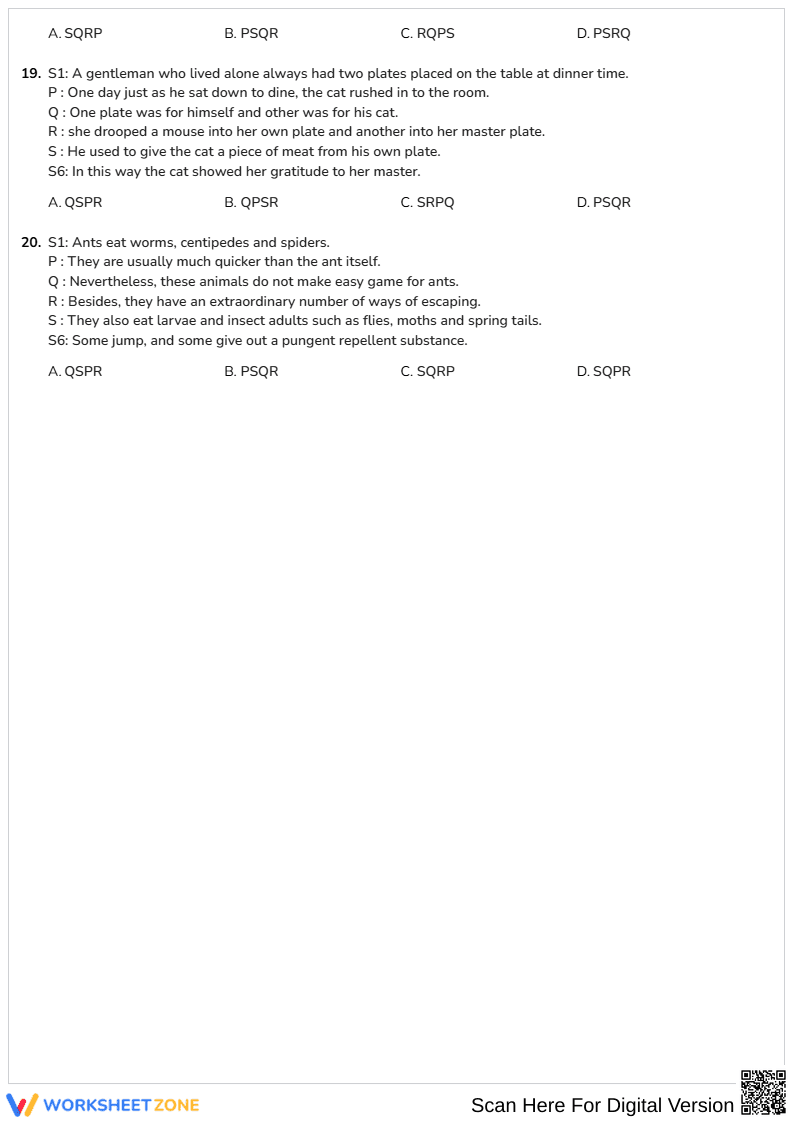
This resource features 20 multiple-choice paragraph jumble tasks spread across 4 pages. Each problem presents four to six out-of-order sentences that students must logically sequence. The passages cover a variety of topics, from historical anecdotes to scientific observations, requiring students to rely on transition words, pronoun antecedents, and chronological cues. A complete answer key is included for fast grading.
Designed for immediate classroom implementation, this zero-prep resource follows a simple three-step workflow:
- Print (1 minute): Generate the 4-page PDF and the accompanying answer key.
- Distribute (1 minute): Hand out the packets for independent work or standardized test preparation.
- Review (5 minutes): Use the answer key to quickly check student responses or facilitate a peer-grading session.
With under two minutes of total teacher prep time, this worksheet is an excellent option for emergency sub plans or focused intervention blocks.
This material is directly aligned with CCSS.ELA-LITERACY.RI.11-12.5, requiring students to analyze and evaluate the effectiveness of the structure an author uses in their exposition or argument. It also supports general reading comprehension and logical reasoning skills. Both standard codes can be copied directly into lesson plans, IEP goals, or district curriculum mapping tools.
This worksheet is highly versatile. Use it as a formative assessment after a mini-lesson on text structure and transition words, allowing students to apply their knowledge independently. Alternatively, assign it as targeted test prep for exams that feature sentence rearrangement and logical sequencing questions. As an observation tip, watch for students who struggle to identify the topic sentence; this often indicates a need for additional instruction on main ideas. Expect completion to take 30 to 45 minutes.
This resource is ideal for college-prep high school students, early college learners, and adult education classes focusing on advanced literacy. For differentiation, educators can allow struggling readers to work in pairs to debate the logical flow before selecting an answer. It pairs perfectly with an anchor chart on transition words or a direct instruction lesson on paragraph anatomy.
Mastering paragraph sequencing is a critical component of advanced literacy and an essential skill for long-term academic success. According to the comprehensive RAND AIRS 2024 report, explicit and consistent practice with text structure, logical flow, and cohesion significantly improves both reading comprehension and analytical writing skills in older students. When learners actively engage with the rigorous expectations of CCSS.ELA-LITERACY.RI.11-12.5, they systematically develop the crucial ability to analyze and evaluate the overall effectiveness of an author's chosen text structure. This targeted practice ensures that students can confidently navigate increasingly complex informational texts, identify subtle transitional cues, and ultimately construct their own highly logical arguments. By mastering these foundational structural elements, educators are actively bridging the challenging gap between standard high school reading expectations and the demanding academic rigor required at the college level. Ultimately, this focused approach empowers students to become highly proficient, critical readers who can easily deconstruct sophisticated arguments and communicate their ideas with exceptional clarity.


