




























Views
Downloads

Pacific Salmon Life Cycle Worksheet | Essential Grade 3-5

Paste this activity's link or code into your existing LMS (Google Classroom, Canvas, Teams, Schoology, Moodle, etc.).
Students can open and work on the activity right away, with no student login required.
You'll still be able to track student progress and results from your teacher account.
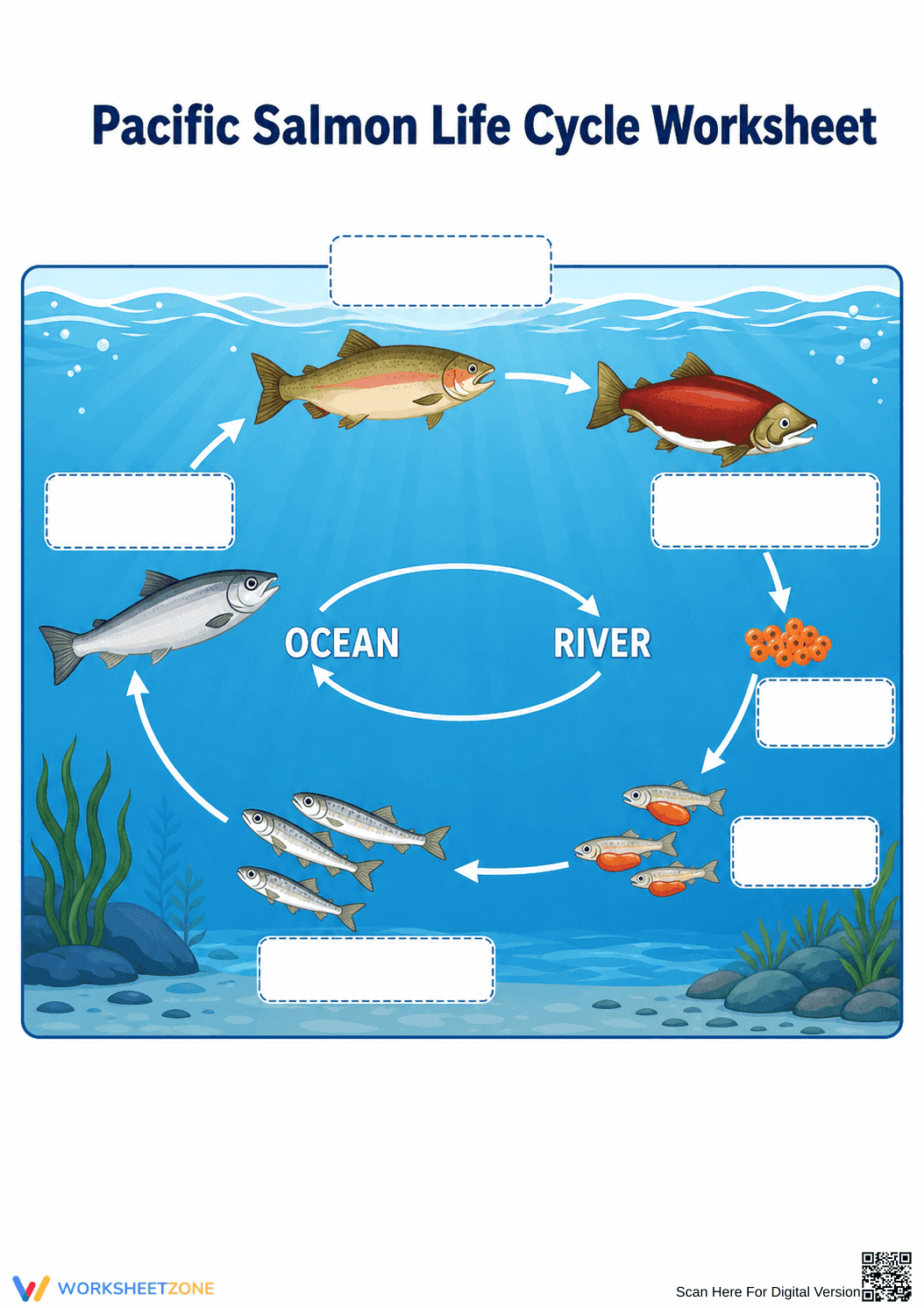
This Pacific Salmon life cycle worksheet provides a clear, visual model for students to identify the biological stages of an anadromous fish. By labeling the progression from eggs to spawning adults, learners grasp the complex relationship between freshwater and saltwater ecosystems. It is designed to meet core life science requirements for elementary grades.
At a Glance
- Grade: 3 · Subject: Science
- Standard:
3-LS1-1— Develop models to describe unique and diverse organism life cycles- Skill Focus: Life cycle sequencing and habitat migration
- Format: 1 page · 6 problems · Answer key included · PDF
- Best For: Visual learners and introductory biology lessons
- Time: 15–20 minutes
What's Inside
This single-page PDF features a high-quality color diagram illustrating the circular journey of the Pacific Salmon. It includes 6 empty labeling boxes strategically placed next to key developmental stages, including the egg phase, fry with yolk sacs, smolts, and adult phases in both river and ocean environments. The clear arrows indicate the direction of migration, helping students visualize the transition between habitats.
Zero-Prep Workflow
- Print: Generate copies of the single-page PDF for your class in under 1 minute.
- Distribute: Hand out the sheets as a warm-up or formative assessment during your life cycles unit.
- Review: Use the provided answer key to review labels as a whole group, clarifying the difference between spawning and returning adults in 5 minutes.
Standards Alignment
This worksheet aligns with `3-LS1-1`, requiring students to develop models describing that organisms have unique life cycles including birth, growth, reproduction, and death. It serves as a specific model for complex cycles involving migration. Both standard codes can be copied directly into lesson plans, IEP goals, or district curriculum mapping tools.
How to Use It
Use this worksheet as a formative assessment after a direct instruction lesson on aquatic ecosystems. Observe if students can correctly distinguish between the "Ocean" and "River" phases of the salmon's life. It also works well as a reference sheet for a research project where students must describe the environmental challenges salmon face at each of the 6 stages. Expected completion time is 15 to 20 minutes.
Who It's For
This resource is ideal for Grade 2 through Grade 5 students, particularly those who benefit from visual aids and spatial organization. It is a natural pairing for an anchor chart about animal adaptations or a non-fiction reading passage about the Pacific Northwest ecosystem.
According to the RAND AIRS 2024 analysis of science instructional materials, visual modeling of life cycles significantly improves long-term retention of biological concepts in elementary learners. This worksheet aligns with the 3-LS1-1 standard by requiring students to sequence the birth, growth, and reproduction phases of the Pacific Salmon. By identifying the 6 distinct stages—from eggs in the river to adults in the ocean—students develop a concrete understanding of how organisms interact with diverse environments throughout their lives. Research indicates that labeling tasks reduce cognitive load while reinforcing technical vocabulary like "smolt" and "spawning." This resource provides a structured framework for students to demonstrate mastery of life science standards through evidence-based modeling.


