


























Views
Downloads

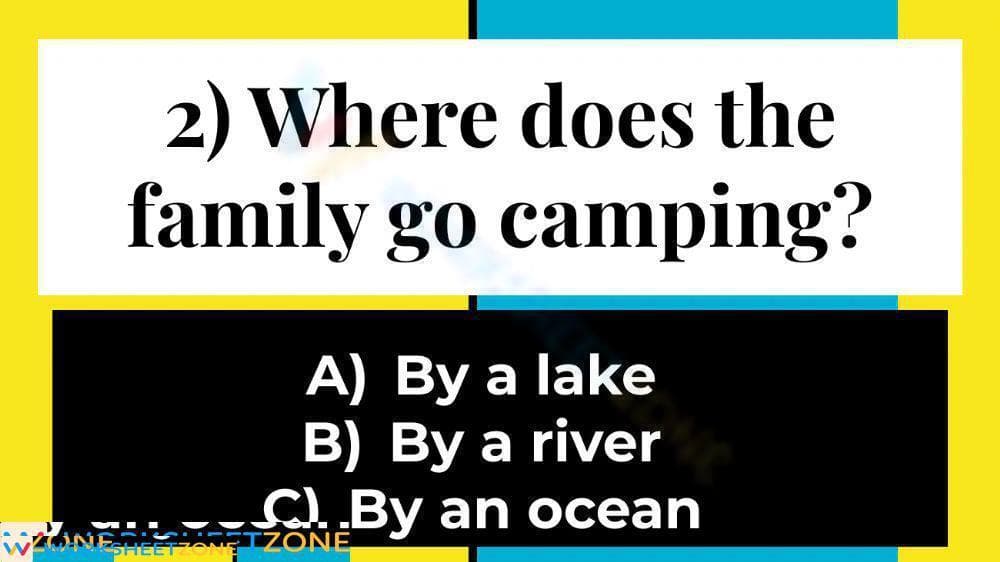


Essential Our Camping Trip Reading Worksheet | Grade 5
Paste this activity's link or code into your existing LMS (Google Classroom, Canvas, Teams, Schoology, Moodle, etc.).
Students can open and work on the activity right away, with no student login required.
You'll still be able to track student progress and results from your teacher account.
Mastering reading comprehension is a critical milestone for upper elementary students. This "Our Camping Trip" worksheet allows Grade 5 learners to demonstrate their ability to recall key details and sequence events from a literary text. By engaging with these text-dependent questions, students solidify their understanding of narrative structure and vocabulary in context.
At a Glance
- Grade: 5 · Subject: ELA
- Standard:
CCSS.ELA-LITERACY.RL.5.1— Quote accurately from a text when explaining what the text says explicitly- Skill Focus: Literary Reading Comprehension
- Format: 5 pages · 5 problems · Answer key included · PDF
- Best For: Post-reading comprehension check and review
- Time: 10–15 minutes
This resource comprises five multiple-choice questions designed to assess student understanding of the story "Our Camping Trip." Each page focuses on a unique element of the narrative, from plot points to vocabulary acquisition. The layout features high-contrast text and clear options. A comprehensive answer key is included to facilitate quick grading and immediate student feedback.
The worksheet follows a logical progression. Guided Practice begins with literal recall questions regarding the story's introduction and setting. Supported Practice moves into identifying specific sensory details and character actions observed during the trip. Finally, Independent Practice challenges students to define domain-specific vocabulary, ensuring they can apply knowledge to broader linguistic concepts. This gradual release model builds student confidence throughout the exercise.
This resource is primarily aligned with CCSS.ELA-LITERACY.RL.5.1, which requires students to quote accurately from a text when explaining what the text says explicitly. Additionally, it supports RL.5.4 by requiring students to determine the meaning of words and phrases. Both standard codes can be copied directly into lesson plans, IEP goals, or district curriculum mapping tools to ensure instructional continuity.
This worksheet is effective as a post-reading formative assessment. After reading "Our Camping Trip," distribute the questions to monitor comprehension. Teachers should observe students who struggle with sequencing or identifying evidence for their answers. It also serves as a warm-up activity to review previous content. Most Grade 5 learners will complete the task in approximately 12 minutes.
Designed for Grade 5 students, this resource is also highly effective for Grade 3 and 4 learners who are ready for increased textual complexity. It is particularly useful for English Language Learners (ELLs) due to its clear, concise language and multiple-choice format. This worksheet pairs naturally with a plot-diagram anchor chart or a short passage about outdoor activities to provide additional context and support.
According to Fisher & Frey (2014), the use of text-dependent questions is essential for developing deep comprehension skills in upper elementary students. This "Our Camping Trip" worksheet implements this research-backed strategy by focusing on the CCSS.ELA-LITERACY.RL.5.1 standard, which emphasizes the importance of using explicit evidence from the text to support claims. By requiring students to identify the specific actions and settings described in the narrative, the resource ensures that learners are not relying on outside knowledge but are instead engaging directly with the author's words. This practice of literal and inferential comprehension is a fundamental building block for the more complex literary analysis required in middle school. The 5-question format provides a high-signal assessment of a student's current proficiency level, allowing educators to make data-driven decisions about future instructional interventions and scaffolding needs for diverse classroom populations.


