


























Views
Downloads

Halloween Optical Illusion Activity | Grade 1-3 Essential
Paste this activity's link or code into your existing LMS (Google Classroom, Canvas, Teams, Schoology, Moodle, etc.).
Students can open and work on the activity right away, with no student login required.
You'll still be able to track student progress and results from your teacher account.
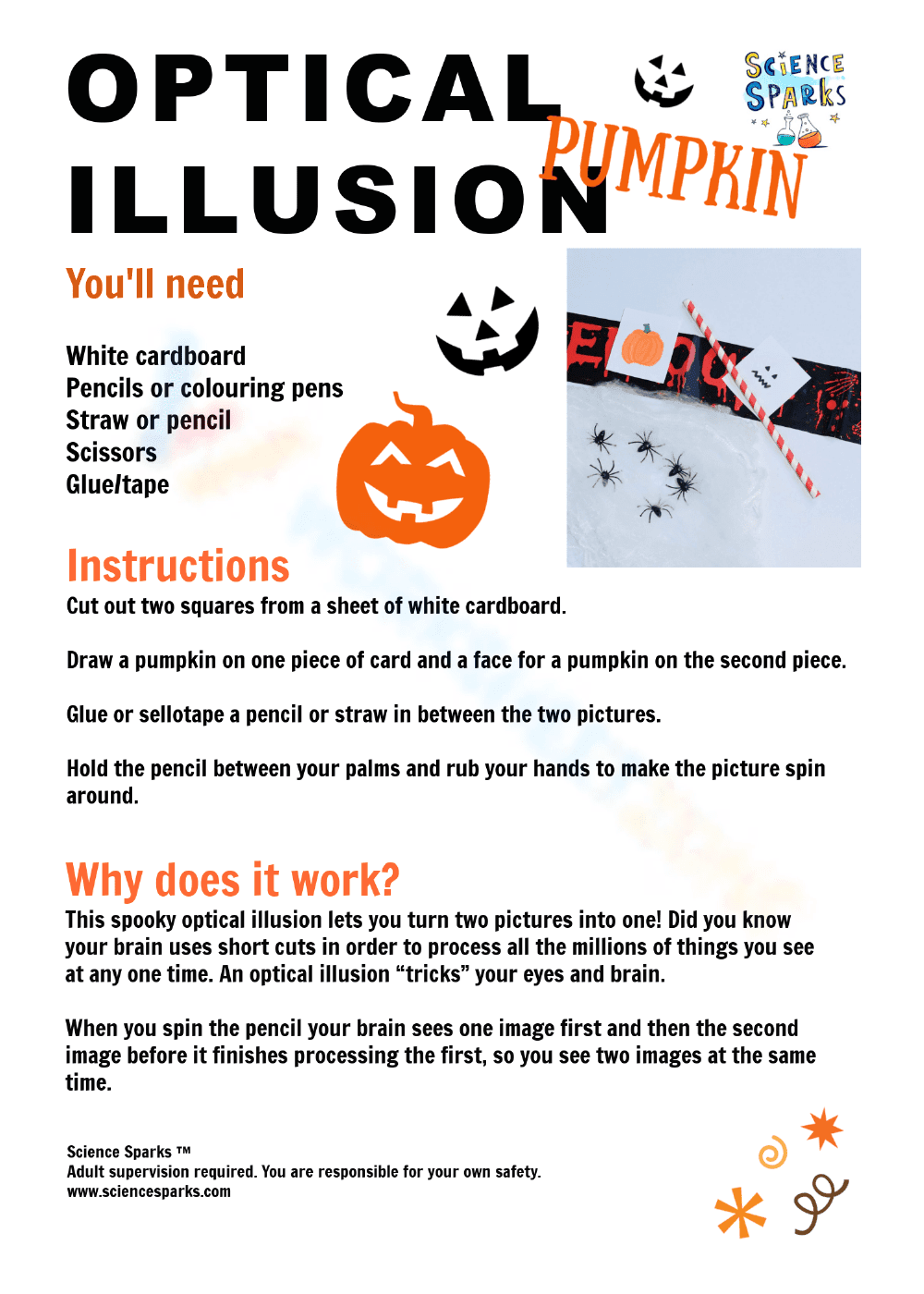
This Grade 1-3 science activity guides students through creating a classic thaumatrope optical illusion featuring a Halloween pumpkin. By spinning two separate images, students observe how the human brain merges visual data into a single coherent picture. This hands-on experiment provides a tangible demonstration of persistence of vision and sensory processing.
At a Glance
- Grade: 1-3 · Subject: Science
- Standard:
1-PS4-2— Make observations to explain how objects are seen and processed by the eyes- Skill Focus: Persistence of vision and neurological processing
- Format: 1 page · 1 project · Activity guide included · PDF
- Best For: Festive science centers and sensory units
- Time: 15–20 minutes
The worksheet includes a clear materials list requiring only basic classroom supplies like cardboard, pencils, and scissors. It features a 4-step instructional sequence that leads students from construction to observation. A dedicated "Why does it work?" section explains the neurological shortcuts the brain takes when processing rapid visual stimuli, making complex biological concepts accessible for young learners through the lens of a spooky holiday theme.
This resource is designed for a zero-prep classroom workflow. First, print the single-page guide for each student or small group (30 seconds). Second, distribute the materials and have students follow the illustrated steps to assemble their pumpkin illusion (10 minutes). Third, facilitate a brief class discussion using the provided explanation to review the science of sight (5 minutes). Total teacher preparation time is under 2 minutes, making it an ideal choice for busy educators or last-minute sub plans.
This activity aligns with 1-PS4-2: "Make observations to construct an evidence-based account that objects can be seen only when illuminated." While focusing on the mechanics of vision, it also supports foundational concepts in life science regarding how animals use their senses to process information. Both standard codes can be copied directly into lesson plans, IEP goals, or district curriculum mapping tools.
Use this as a festive "Science of Halloween" station during a classroom party or as a quick hook before a unit on the five senses. Teachers should observe if students can explain the merging effect in their own words during the formative assessment phase. Expected completion time is 15–20 minutes depending on the fine motor skill levels of the participating students.
This worksheet is ideal for Grade 1, 2, and 3 students, particularly those who benefit from kinesthetic learning and hands-on experimentation. It pairs naturally with a primary science text about the human eye or a video demonstration of animation history. The simple language ensures that early readers can follow the instructions with minimal teacher intervention.
Research by Fisher & Frey (2014) emphasizes that hands-on modeling in science helps solidify abstract concepts like sensory perception. This activity utilizes the 1-PS4-2 standard to bridge the gap between physical objects and neurological interpretation. By creating a thaumatrope, students engage in active observation, a core competency identified by the NAEP science framework. The pumpkin illusion serves as a concrete model for persistence of vision, where the retina retains an image for a fraction of a second, allowing the brain to stitch sequential frames together. This phenomenon is the fundamental basis for modern cinematography and animation. Providing students with a 1-page structured guide ensures that the cognitive load remains focused on the scientific observation rather than complex assembly, supporting better retention of the core biological principles involved in human vision and image processing.


