


























Views
Downloads

Essential Grade 1 Science: Complete Circuits Worksheet
Paste this activity's link or code into your existing LMS (Google Classroom, Canvas, Teams, Schoology, Moodle, etc.).
Students can open and work on the activity right away, with no student login required.
You'll still be able to track student progress and results from your teacher account.
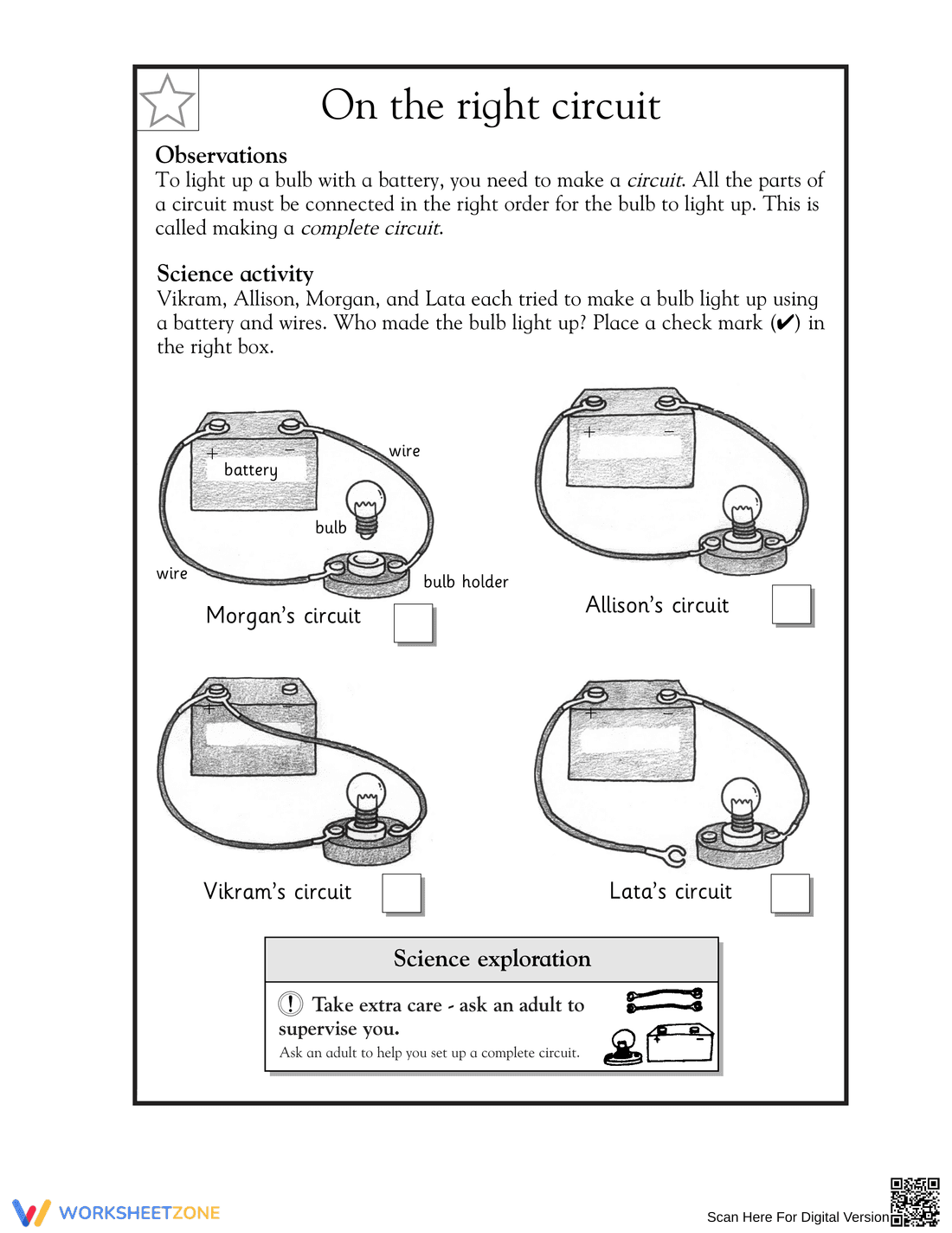
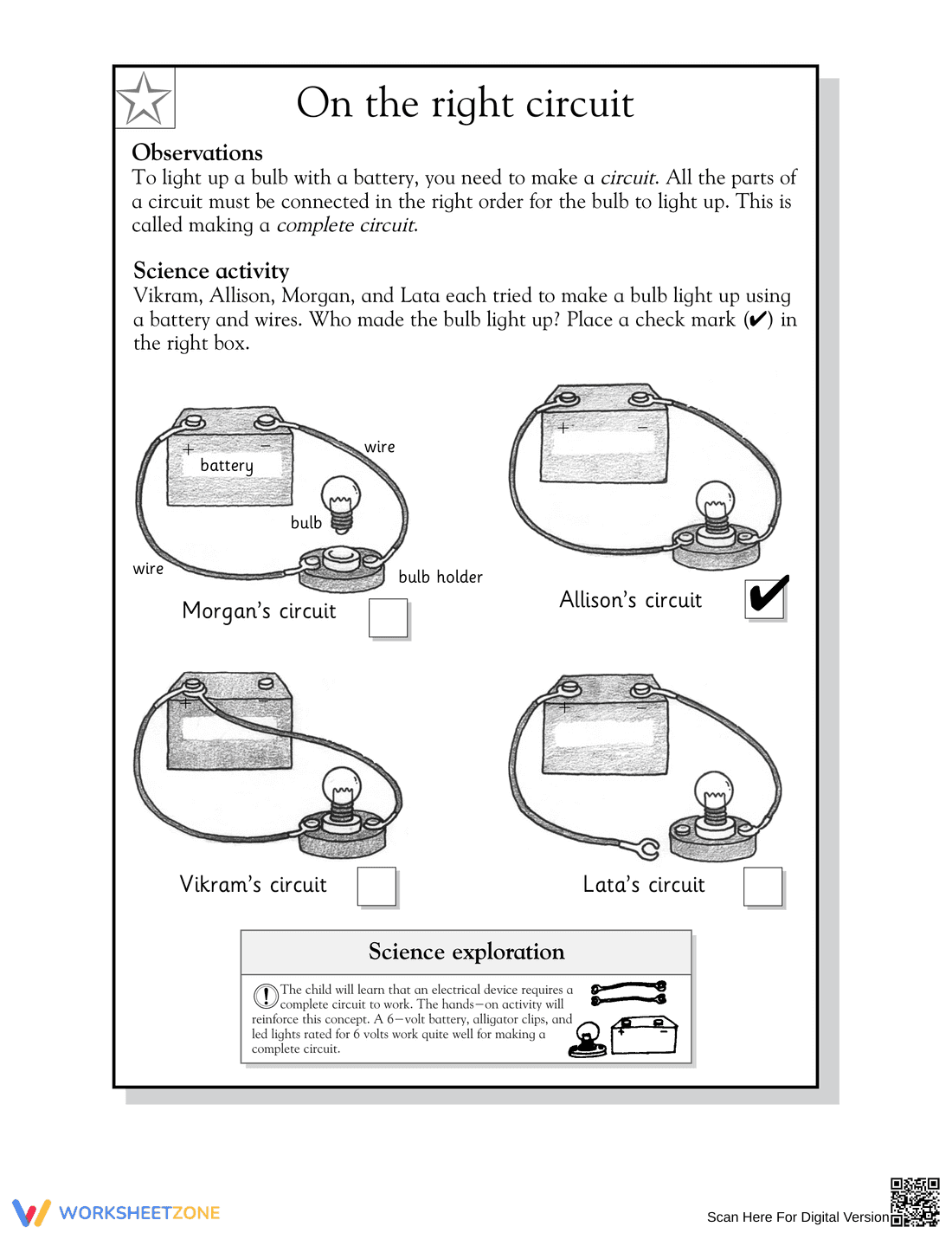
This Grade 1 science worksheet helps students identify the components of a complete electrical circuit. By evaluating diagrams featuring a battery, bulb, and wires, children learn how energy transfers to light a bulb. Students develop critical observation skills as they determine which connection successfully completes the path for electricity to flow.
At a Glance
- Grade: 1 · Subject: Science
- Standard:
1-PS4-2— Observe physical models to determine how energy illuminates objects in a system- Skill Focus: Electrical circuit identification
- Format: 1 page · 4 problems · Answer key included · PDF
- Best For: Introduction to energy and electricity
- Time: 15–20 minutes
This single-page resource features four distinct circuit diagrams for students to analyze. Each diagram includes a battery, wires, and a bulb. The worksheet provides a clear "Observations" section that defines a complete circuit, followed by a "Science activity" where students mark the correct setup. A bonus "Science exploration" section offers a hands-on extension using real batteries and wires.
This zero-prep worksheet is designed for immediate classroom deployment. The workflow is simple: Print (1 minute), Distribute (1 minute), and Review (5 minutes). With a total teacher prep time of under 2 minutes, this activity is an ideal resource for substitute teacher plans or as a quick transition between core subjects. Students can work through the four identification scenarios independently, using the visual cues to determine which setup successfully powers the bulb.
This activity is aligned to standard `1-PS4-2`, focusing on making observations to construct an evidence-based account of how light interacts within a system. It also supports `K-2-ETS1-1` by requiring students to analyze physical models. Both standard codes can be copied directly into lesson plans, IEP goals, or district curriculum mapping tools.
Use this worksheet during the "Explore" phase of a science lesson to bridge the gap between abstract concepts and physical reality. It serves as a formative assessment tool; observe if students recognize that both terminals of the battery must be connected for the bulb to function. Expect completion in 10-15 minutes, followed by a brief discussion about battery polarity.
This resource is perfect for first-grade students beginning their exploration of physical science. It includes visual scaffolds like labeled diagrams to support emerging readers. Pair this worksheet with a hands-on lab using D-cell batteries and alligator clips to reinforce the concept through direct tactile experience.
According to RAND AIRS 2024, early exposure to physical science concepts like circuit logic significantly improves long-term scientific literacy and systems thinking in elementary learners. By identifying a complete circuit, students engage in foundational engineering practices that define the relationship between power sources and energy outputs. This Grade 1 resource targets standard code 1-PS4-2 and the plain-English skill of predicting system behavior through observation, which aligns with modern STEM pedagogical frameworks that emphasize evidence-based reasoning over rote memorization. Fisher & Frey (2014) highlight the importance of visual models in the gradual release of responsibility, where students first evaluate static diagrams before attempting live experimentation. This worksheet provides that critical bridge, ensuring students understand the underlying physics of connectivity before handling materials, thereby reducing cognitive load and maximizing instructional efficiency during subsequent laboratory sessions.


