


























Views
Downloads

Printable Letter O Tracing Worksheet | Grade K
Paste this activity's link or code into your existing LMS (Google Classroom, Canvas, Teams, Schoology, Moodle, etc.).
Students can open and work on the activity right away, with no student login required.
You'll still be able to track student progress and results from your teacher account.
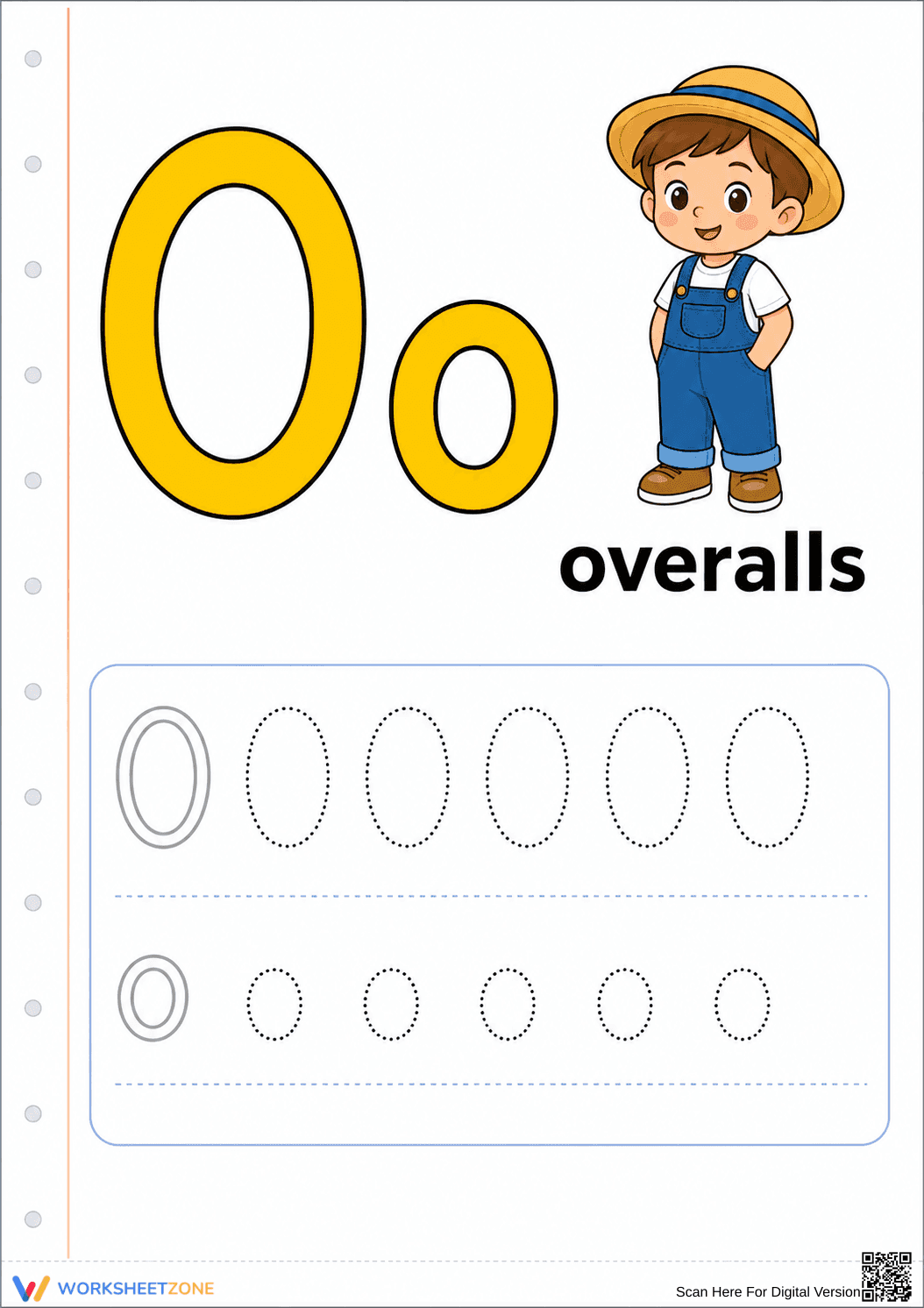
This printable Kindergarten ELA worksheet provides focused practice on the letter O. Students develop fine motor skills and letter recognition by tracing both uppercase and lowercase forms. Featuring a clear visual of overalls to reinforce the beginning sound, this resource helps early learners build foundational handwriting and phonics abilities.
At a Glance
- Grade: K · Subject: ELA
- Standard:
CCSS.ELA-LITERACY.L.K.1.A— Print many upper- and lowercase letters- Skill Focus: Letter O Tracing and Beginning Sounds
- Format: 1 page · 12 problems · No answer key needed · PDF
- Best For: Independent practice and centers
- Time: 10–15 minutes
This single-page resource features an illustration of a boy wearing overalls alongside the uppercase and lowercase letter O to establish a phoneme-grapheme connection. The main activity includes two guided tracing rows. The top row provides six dashed uppercase O outlines, while the bottom row offers six dashed lowercase o outlines. Each row includes clear baseline guides to support proper letter formation.
Zero-Prep Workflow
Designed for immediate classroom implementation.
- Print (1 min): Download the PDF and print.
- Distribute (1 min): Hand out with pencils. The intuitive layout requires almost no verbal instruction.
- Review (1 min): Scan student work to check for proper stroke direction.
Total teacher prep time is under two minutes, making it perfect for emergency sub plans or morning work.
Standards Alignment
This worksheet aligns directly with CCSS.ELA-LITERACY.L.K.1.A: Print many upper- and lowercase letters. By requiring students to trace both forms of the letter O within structured guidelines, the activity builds essential motor memory. Both standard codes can be copied directly into lesson plans, IEP goals, or district curriculum mapping tools.
How to Use It
This resource fits perfectly into morning work routines or dedicated literacy centers. Assign it immediately after direct instruction on the letter O to reinforce the shape and sound. As a formative assessment tip, observe students while they trace to ensure they are starting their letters at the top and moving in the correct circular direction, rather than starting from the bottom. Expected completion time ranges from 10 to 15 minutes, depending on the student's fine motor development.
Who It's For
This worksheet is designed primarily for Kindergarten students mastering the alphabet and basic handwriting skills. It also serves as an excellent intervention tool for first-grade students needing additional fine motor support or letter formation review. For differentiation, provide textured materials like glitter glue for tactile learners to trace over the letters. Pair this activity with an interactive read-aloud focusing on the short or long O sound to solidify the phonics connection.
Effective handwriting instruction requires consistent, guided repetition to build automaticity. According to Fisher & Frey (2014), providing structured practice opportunities is essential for transferring skills from short-term memory to long-term mastery. This worksheet directly supports CCSS.ELA-LITERACY.L.K.1.A by helping students print many upper- and lowercase letters through targeted tracing exercises. By isolating the letter O and providing clear visual boundaries, early learners can focus entirely on motor control and stroke sequence. The integration of the vocabulary word "overalls" simultaneously reinforces phonemic awareness, linking the physical act of writing to spoken language. Regular use of such targeted tracing activities ensures that students develop the foundational transcription skills necessary for later, more complex writing tasks, reducing cognitive load and allowing them to focus on content generation as they progress through early elementary grades.


