


























Views
Downloads
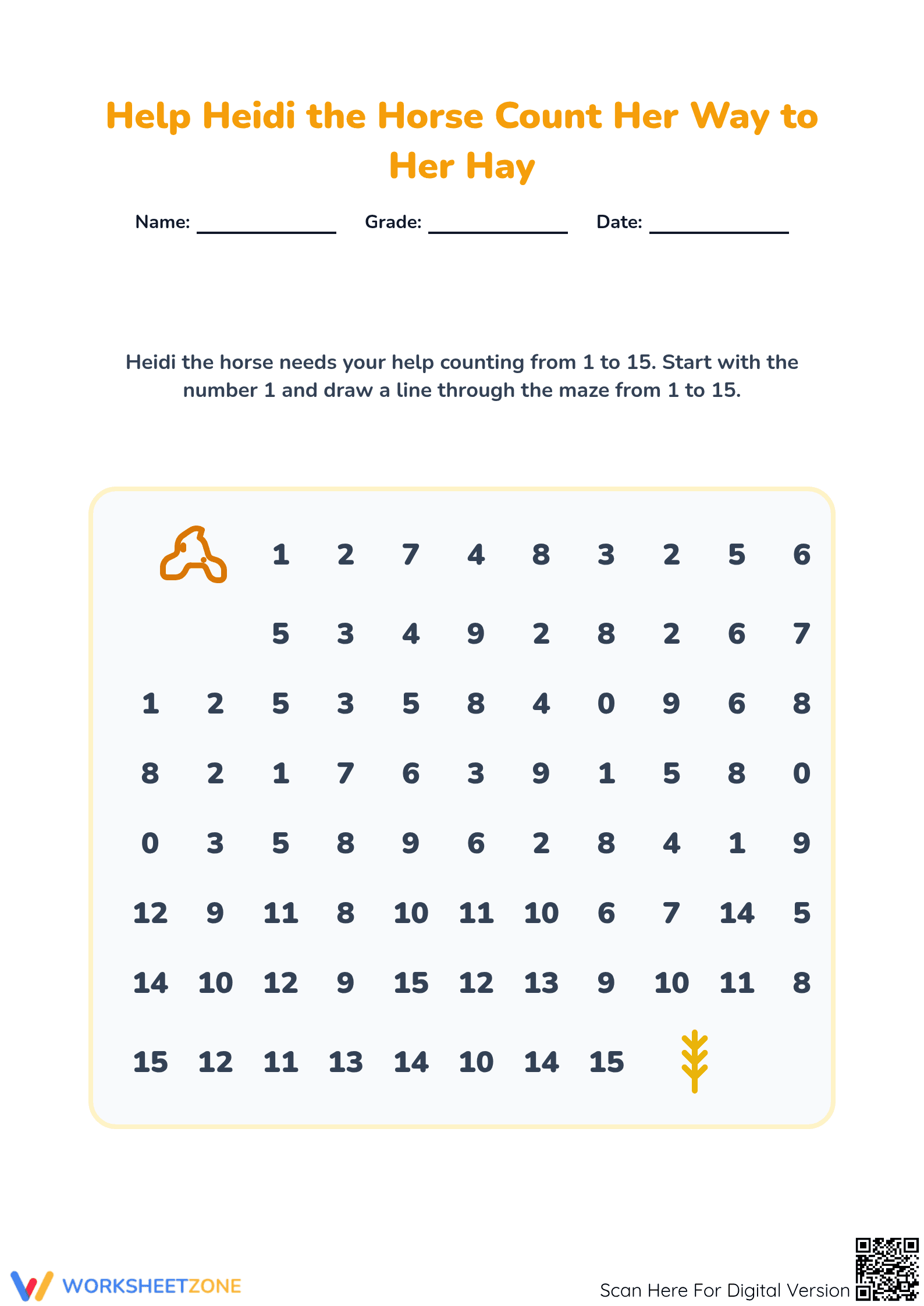

Printable Number Maze Counting 1-15 | Kindergarten Math
Paste this activity's link or code into your existing LMS (Google Classroom, Canvas, Teams, Schoology, Moodle, etc.).
Students can open and work on the activity right away, with no student login required.
You'll still be able to track student progress and results from your teacher account.
This Kindergarten number maze worksheet empowers young learners to master number sequencing by helping Heidi the Horse find her hay. By connecting numbers 1 through 15 in order, students reinforce counting fluency and visual-spatial skills. This engaging activity transforms rote counting into a purposeful, problem-solving journey for every student.
At a Glance
- Grade: Kindergarten · Subject: Math
- Standard:
K.CC.A.1— Count to 100 by ones and by tens to build foundational numeracy- Skill Focus: Sequential counting 1-15 and number recognition
- Format: 1 page · 1 maze · Answer key included · PDF
- Best For: Early finishers or independent math center practice
- Time: 10–15 minutes
What's Inside
Inside this resource is a one-page "Help Heidi the Horse" number maze. The worksheet features a grid filled with varied digits, challenging students to follow the correct numerical order from 1 to 15. The animal-themed narrative provides high motivation, while clear icons ensure students understand the goal. A complete answer key is included for quick verification.
Zero-Prep Workflow
This worksheet is designed for maximum efficiency with a zero-prep workflow for busy educators:
- Print: Generate the single-page PDF in less than 30 seconds.
- Distribute: Hand out the sheets during transitions; instructions are embedded for student independence.
- Review: Check student progress using the included answer key in under 1 minute.
Total preparation time is approximately 2 minutes, making it an ideal choice for emergency sub plans.
Standards Alignment
This activity is aligned to K.CC.A.1: "Count to 100 by ones and by tens." It provides the essential stepping stones for mastery of Kindergarten counting. It also supports K.CC.B.4, connecting counting to cardinality in a fixed order. Both standard codes can be copied directly into lesson plans, IEP goals, or district curriculum mapping tools.
How to Use It
Use this maze as a "bell-ringer" to settle students as they arrive for the school day. Alternatively, assign it as a formative assessment after a lesson on counting. During the activity, observe if students can identify the next number in the sequence without adult prompting. Expected completion time is 10 to 15 minutes.
Who It's For
The resource is primarily for Kindergarten students, but serves as an intervention for Grade 1 learners needing sequencing practice. It is suitable for English Language Learners due to its heavy visual component and minimal text. Pair this worksheet with a physical number line or a counting-themed picture book for a multi-modal learning experience.
Effective early mathematics instruction relies on the "number sense" foundation, which requires students to move beyond rote memorization to flexible number manipulation. According to the RAND AIRS 2024 report, scaffolded practice in number sequencing—such as counting mazes—helps bridge the gap between abstract recognition and applied cardinality. By engaging with numbers 1-15 in a non-linear grid, students develop cognitive flexibility and persistence. Fisher & Frey (2014) emphasize that such independent practice tasks are vital for the "You Do" phase of the gradual release of responsibility model, ensuring that learners can transfer their counting skills to novel contexts. This printable resource provides exactly that focused, high-engagement practice necessary for Kindergarten students to achieve the fluency benchmarks set by standards. Aligned to K.CC.A.1, this worksheet transforms simple counting into a cognitive challenge that prepares students for more complex mathematical operations.


