


























Views
Downloads
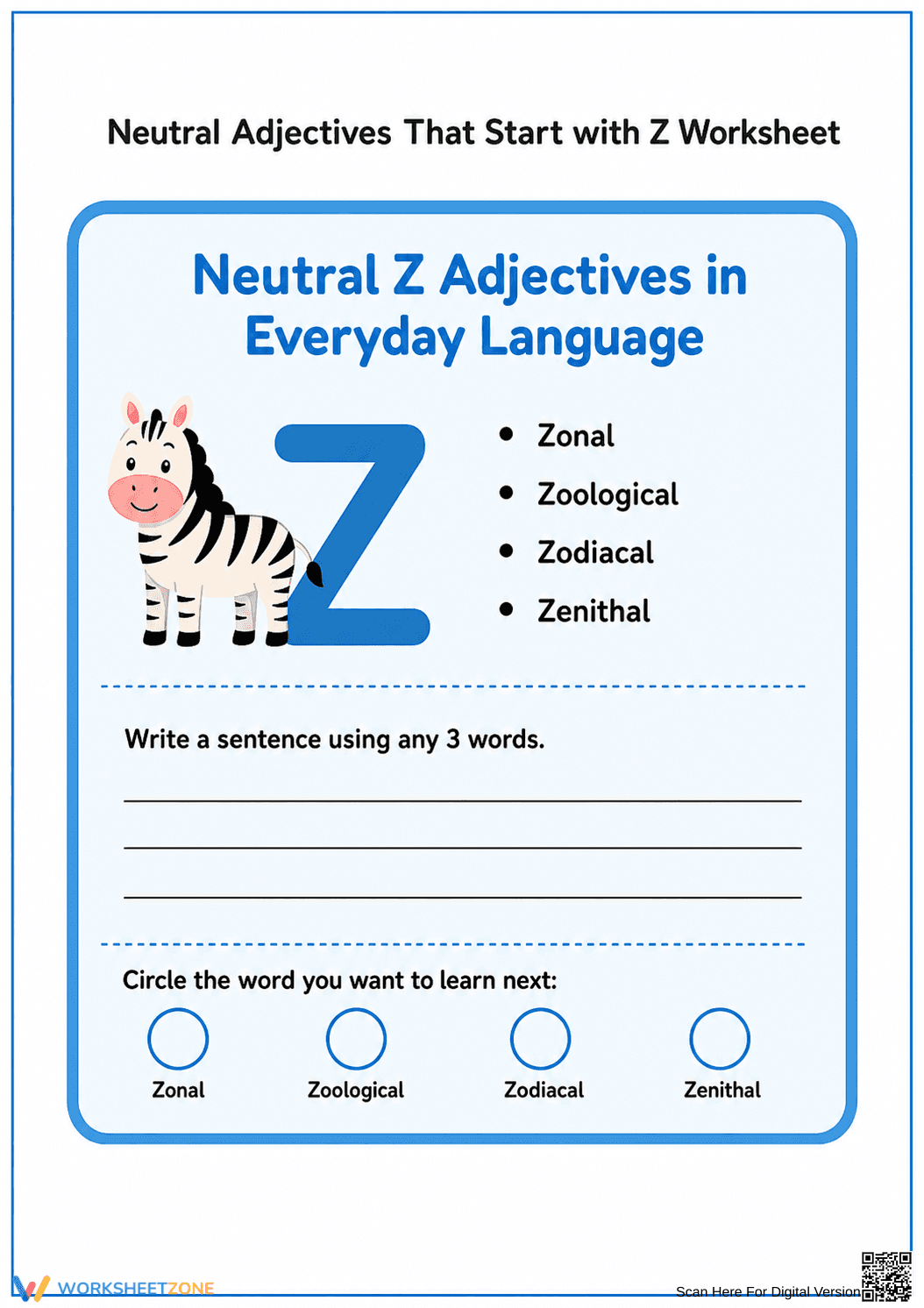

Grade 1 Z Adjectives — Printable No-Prep Worksheet
Paste this activity's link or code into your existing LMS (Google Classroom, Canvas, Teams, Schoology, Moodle, etc.).
Students can open and work on the activity right away, with no student login required.
You'll still be able to track student progress and results from your teacher account.
This printable Grade 1 vocabulary worksheet introduces students to neutral adjectives starting with the letter Z. By reading, selecting, and applying new words like "zonal" and "zoological" in original sentences, young learners actively expand their expressive vocabulary and practice foundational sentence construction in a focused, single-page format.
At a Glance
- Grade: 1 · Subject: ELA
- Standard:
CCSS.ELA-LITERACY.L.1.6— Use newly acquired words and phrases in expressive language- Skill Focus: Z Adjectives & Sentence Writing
- Format: 1 page · 2 tasks · No answer key needed · PDF
- Best For: Morning work or vocabulary centers
- Time: 10–15 minutes
Inside this single-page resource, educators will find a straightforward, visually appealing layout featuring a friendly zebra illustration to anchor the letter Z theme. The worksheet presents a curated list of four advanced Z adjectives. Students are tasked with writing one complete sentence incorporating at least three of the provided words, followed by a self-reflection activity where they circle the vocabulary word they wish to study next. Because the primary task involves original sentence generation, an answer key is not required.
This resource is designed for immediate classroom implementation with a zero-prep workflow.
- Print (1 minute): Download the PDF and print a class set. The clean design minimizes ink usage.
- Distribute (1 minute): Hand out during morning work or literacy centers.
- Review (3 minutes): Have students share their original sentences aloud to reinforce pronunciation.
Total preparation time is under two minutes, making this an excellent option for sub plans.
This worksheet is aligned to primary standard CCSS.ELA-LITERACY.L.1.6, which requires students to use words and phrases acquired through conversations, reading and being read to, and responding to texts. By prompting students to immediately apply newly introduced adjectives in a written sentence, the activity bridges the gap between receptive recognition and expressive use. Standard codes can be copied directly into lesson plans, IEP goals, or district curriculum mapping tools.
Teachers can utilize this worksheet effectively during independent literacy centers. After a brief whole-group introduction to the letter Z and its corresponding sounds, students can transition to this page to practice applying the vocabulary independently. Alternatively, it serves as an engaging early finisher task for students who complete their primary phonics assignments ahead of schedule. As a formative assessment observation tip, teachers should monitor the sentence-writing portion to ensure students use appropriate capitalization, punctuation, and syntactic structure when integrating the new adjectives. Expected completion time ranges from 10 to 15 minutes.
This resource is primarily designed for first-grade students developing their expressive vocabulary and basic sentence-writing capabilities. It offers natural differentiation; advanced learners can be challenged to write compound sentences using all four words, while students needing more support can dictate their sentence to a teacher before writing. This worksheet pairs perfectly with a read-aloud book featuring zoo animals or a classroom anchor chart dedicated to descriptive words.
Integrating targeted vocabulary practice into early elementary routines is essential for reading comprehension. Aligned with CCSS.ELA-LITERACY.L.1.6, this resource helps students use newly acquired words and phrases in expressive language. According to Fisher & Frey (2014), explicit vocabulary instruction combined with immediate opportunities for application significantly increases student retention of new terms. By requiring students to construct an original sentence using novel adjectives, this worksheet moves beyond rote memorization, prompting active cognitive engagement. The inclusion of a self-directed learning choice further supports student agency in the vocabulary acquisition process. Consistent exposure to rich language in the primary grades builds a critical foundation for the complex academic texts students will encounter later, ensuring they possess the lexical tools necessary for effective communication.


