


























Views
Downloads
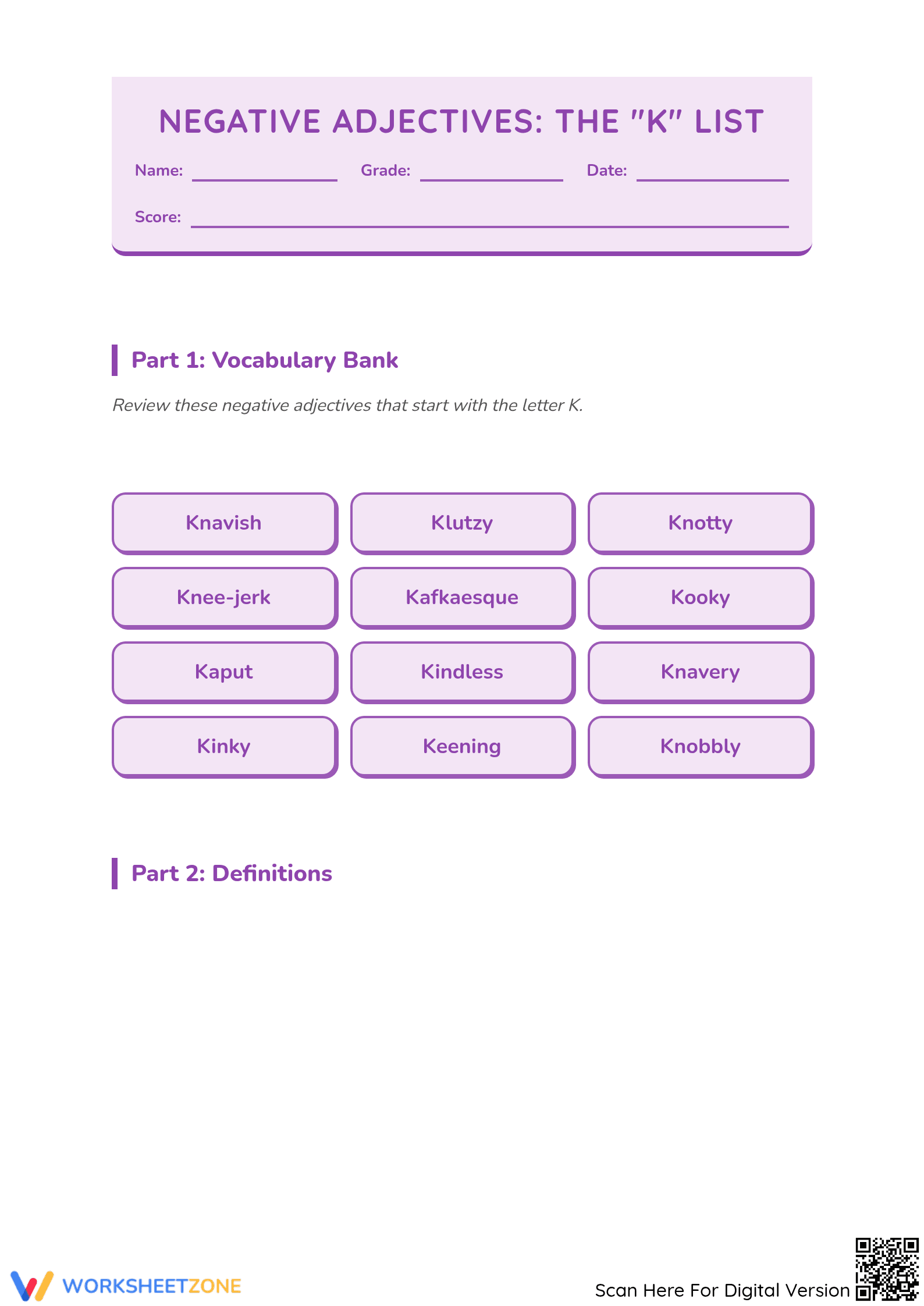



Negative Adjectives That Start with K | Grade 4 Printable
Paste this activity's link or code into your existing LMS (Google Classroom, Canvas, Teams, Schoology, Moodle, etc.).
Students can open and work on the activity right away, with no student login required.
You'll still be able to track student progress and results from your teacher account.
This vocabulary worksheet helps students expand their descriptive language by mastering negative adjectives that start with the letter K. By engaging with targeted definitions, matching exercises, and sentence completion tasks, learners will confidently incorporate complex vocabulary into their everyday writing and reading comprehension.
At a Glance
- Grade: 4 · Subject: ELA
- Standard:
CCSS.ELA-LITERACY.L.4.6— Acquire and use grade-appropriate vocabulary- Skill Focus: Negative adjectives starting with K
- Format: 3 pages · 11 problems · Answer key included · PDF
- Best For: Independent practice and vocabulary building
- Time: 15–20 minutes
This three-page resource features a comprehensive vocabulary bank introducing ten unique words, followed by a clear definitions table for easy reference. Students will then apply their knowledge through 11 distinct tasks, including a five-question matching section and a six-question sentence completion activity. A built-in word bank and an included answer key ensure students can self-monitor their progress while keeping teacher preparation to an absolute minimum.
- Guided practice: Students begin by reviewing the provided vocabulary bank and definitions table, establishing a strong foundational understanding of words like "knavish" and "klutzy."
- Supported practice: The matching section allows learners to connect words to their synonyms or simple descriptions, reinforcing meaning with direct support.
- Independent practice: The sentence completion tasks require students to use context clues to select the correct adjective, demonstrating full comprehension.
This gradual-release approach ensures students move smoothly from the "I Do" phase of reading definitions to the "You Do" phase of applying words in context.
This resource is aligned to CCSS.ELA-LITERACY.L.4.6, which requires students to acquire and use accurately grade-appropriate general academic and domain-specific words and phrases. It also supports reading comprehension by helping students decode unfamiliar descriptive language in complex texts. Both standard codes can be copied directly into lesson plans, IEP goals, or district curriculum mapping tools.
Deploy this worksheet during your dedicated vocabulary block or as a meaningful morning work assignment. It serves as an excellent follow-up activity after direct instruction on character traits or descriptive writing. As a formative assessment tip, observe which context clues students underline during the sentence completion section to gauge their analytical reading skills. The entire packet typically takes 15 to 20 minutes to complete.
This material is designed for third and fourth-grade students looking to improve their descriptive writing. It provides excellent differentiation for English Language Learners through its clear definitions table and structured word banks. Pair this activity with a creative writing prompt where students must describe a villain or a chaotic situation using at least three of their newly learned "K" adjectives.
Explicit vocabulary instruction is a critical component of reading comprehension and expressive writing. According to Fisher & Frey (2014), providing students with structured opportunities to interact with new words in multiple contexts significantly increases retention and accurate application. This worksheet directly supports CCSS.ELA-LITERACY.L.4.6 by requiring learners to acquire and use grade-appropriate vocabulary. By focusing on negative adjectives starting with K, students move beyond basic descriptors and learn to articulate nuanced concepts like "kafkaesque" or "knee-jerk." The progression from simple definition review to context-based sentence completion mirrors evidence-based practices for vocabulary acquisition. When students actively match terms and fill in contextual blanks, they build the cognitive pathways necessary for long-term memory storage, ultimately enhancing both their reading fluency and their ability to craft compelling written narratives.


