


























Views
Downloads
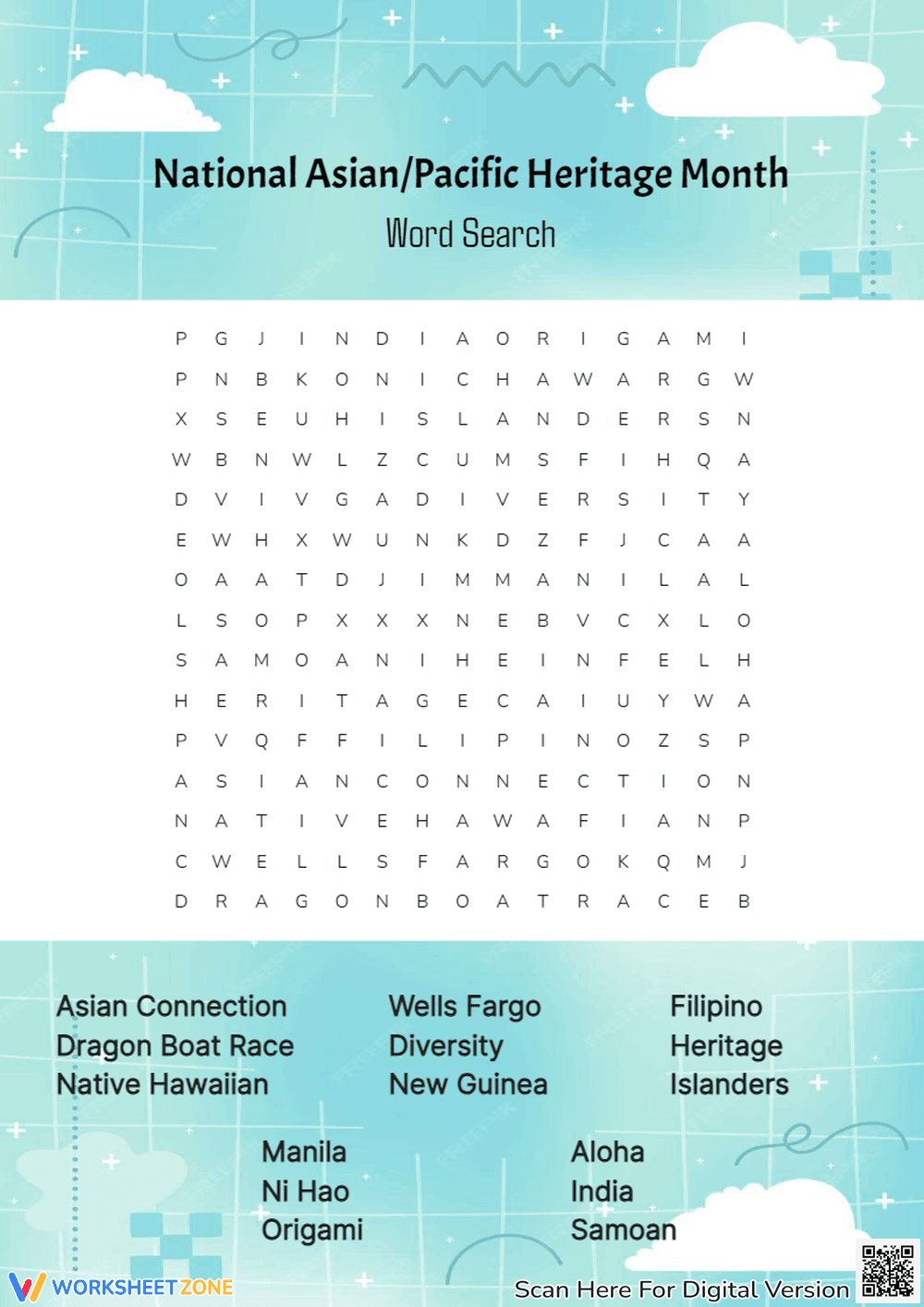

Asian Pacific Heritage Month Word Search | Essential
Paste this activity's link or code into your existing LMS (Google Classroom, Canvas, Teams, Schoology, Moodle, etc.).
Students can open and work on the activity right away, with no student login required.
You'll still be able to track student progress and results from your teacher account.
This Grade 2-5 National Asian/Pacific Heritage Month word search helps students identify key cultural terms and geographic locations associated with AAPI history. By engaging with 15 specific vocabulary words, learners build recognition and spelling skills while celebrating diversity. It provides a meaningful, low-stakes introduction to heritage month discussions before moving into deeper research projects.
At a Glance
- Grade: 2-5 · Subject: ELA & Social Studies
- Standard:
CCSS.ELA-LITERACY.L.3.4— Determine or clarify the meaning of unknown and multiple-meaning words- Skill Focus: Vocabulary Recognition & Cultural Awareness
- Format: 1 page · 15 problems · Answer key included · PDF
- Best For: Morning work or seasonal celebration
- Time: 15–20 minutes
What's Inside
This single-page PDF features a high-density letter grid containing 15 hidden terms related to Asian and Pacific Islander cultures. The word list includes diverse entries such as "Dragon Boat Race," "Origami," and "Samoan." The layout is clean and visually engaging, featuring a thematic border and clear fonts to support visual tracking for younger elementary students. A full answer key is provided to facilitate quick grading or student self-correction.
Zero-Prep Workflow
- Print: Generate copies of the single-sheet PDF in less than 30 seconds for your entire class.
- Distribute: Hand out the worksheets as students enter the room; the self-contained word list allows for immediate, independent work.
- Review: Spend 5 minutes at the end of the session discussing the significance of the terms found to provide cultural context.
Standards Alignment
The primary standard for this resource is `CCSS.ELA-LITERACY.L.3.4`, which focuses on vocabulary acquisition and usage. By identifying specific cultural nouns and adjectives, students reinforce their ability to recognize complex word patterns and expand their academic lexicon. This resource also supports Social Studies frameworks regarding cultural diversity and historical recognition. Both standard codes can be copied directly into lesson plans, IEP goals, or district curriculum mapping tools.
How to Use It
Assign this worksheet as a "bell-ringer" activity during the first week of May to introduce Asian Pacific American Heritage Month. It serves as an excellent formative assessment for visual scanning and pattern recognition. For an extension, ask students to choose one word from the list to research and present a single fact to the class. Completion typically takes 15 to 20 minutes depending on the grade level.
Who It's For
This resource is designed for elementary students in grades 2 through 5, with vocabulary that is accessible yet challenging. It is particularly useful for general education classrooms, ESL/ELL support groups, and as a quiet activity for early finishers. Pair this with a read-aloud book or an anchor chart featuring AAPI leaders to create a comprehensive and inclusive lesson plan.
Research from Fisher & Frey (2014) emphasizes that word-level activities like word searches can support the "incidental learning" of vocabulary by increasing student exposure to orthographic patterns and specific domain-related terms. This National Asian/Pacific Heritage Month Word Search aligns with CCSS.ELA-LITERACY.L.3.4 by requiring students to attend to the spelling and structure of 15 culturally significant words. According to the NAEP, providing students with diverse cultural contexts in literacy tasks improves engagement and broadens their background knowledge, which is a critical component of reading comprehension. By integrating these terms into a familiar puzzle format, educators provide a low-anxiety entry point for discussing complex topics of heritage and identity. This worksheet serves as a practical tool for building the foundational vocabulary necessary for more rigorous social studies and language arts units throughout the academic year.


