


























Views
Downloads
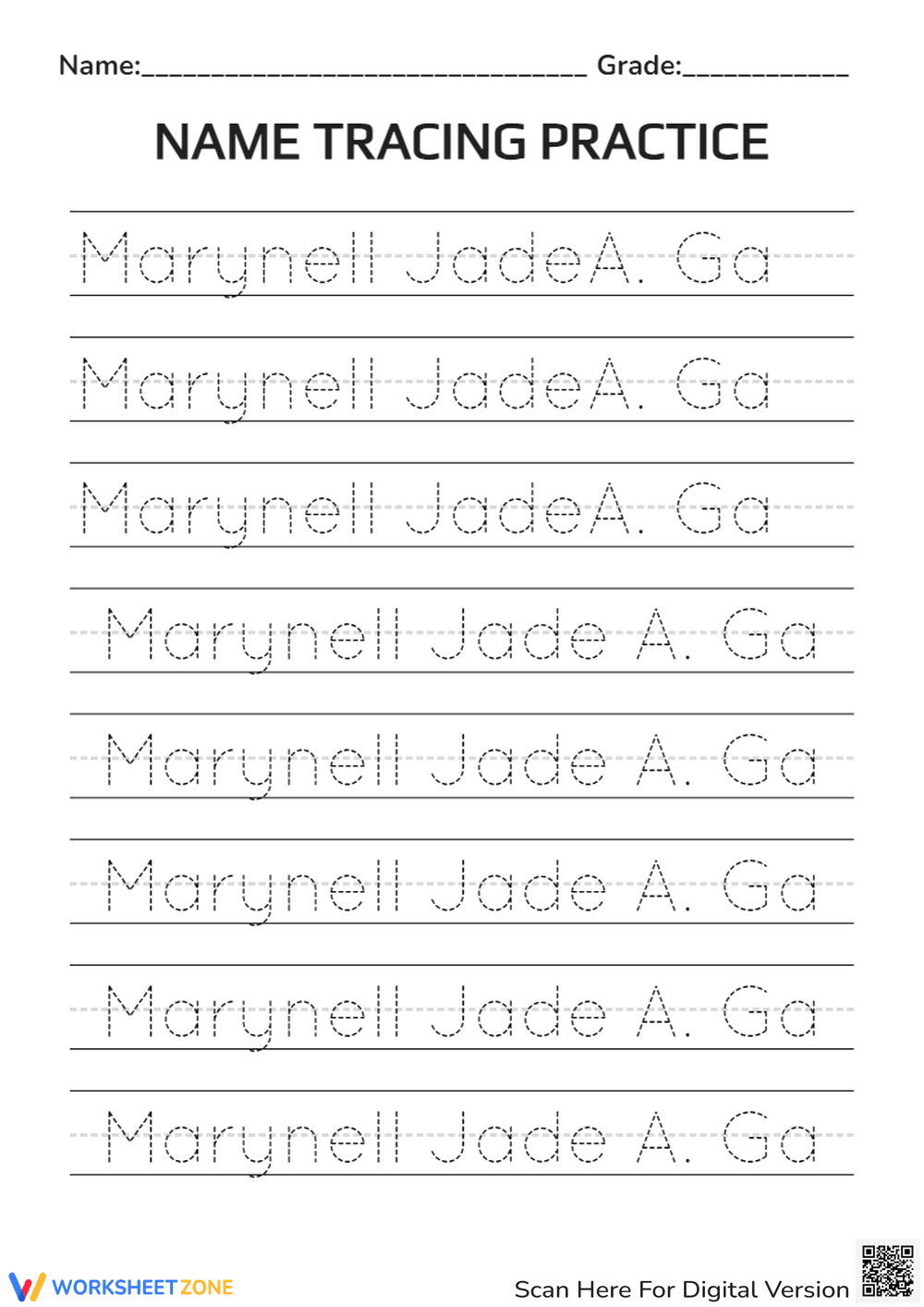

Name Tracing Worksheet | Grade 1 Essential Practice
Paste this activity's link or code into your existing LMS (Google Classroom, Canvas, Teams, Schoology, Moodle, etc.).
Students can open and work on the activity right away, with no student login required.
You'll still be able to track student progress and results from your teacher account.
This Grade 1 name tracing worksheet provides 8 lines of structured practice for the name Maryynell Jade A. Ga. By tracing dashed letters on primary-ruled lines, students develop the muscle memory and fine motor control necessary for legible handwriting. It is a practical tool for early literacy and personal identification skills.
At a Glance
- Grade: Grade 1 · Subject: Handwriting
- Standard:
CCSS.ELA-LITERACY.L.1.1.A— Print all upper- and lowercase letters correctly and legibly- Skill Focus: Name writing and letter formation
- Format: 1 page · 8 problems · Answer key N/A · PDF
- Best For: Morning work or daily sign-in practice
- Time: 5–10 minutes
The worksheet features a clean, distraction-free layout with 8 identical tracing tasks. Each line uses a large, dashed font specifically designed for young learners to follow. The primary-ruled lines include a midline to help students understand letter height and placement. This single-page PDF is ready for immediate printing and distribution to your entire class or individual students.
Teachers can integrate this resource into their daily routine in under 2 minutes. Simply print the required number of copies (30 seconds), distribute them during morning arrival or center rotations (30 seconds), and provide a quick visual check as students complete their tracing (1 minute). It serves as an excellent "quiet time" activity or a reliable sub-plan component that requires no prior explanation.
This resource aligns with `CCSS.ELA-LITERACY.L.1.1.A`, which requires students to print all upper- and lowercase letters. By focusing on a specific name, students practice a variety of letter shapes in a meaningful context. This standard code can be copied directly into lesson plans, IEP goals, or district curriculum mapping tools to document handwriting progress.
Use this worksheet during the first ten minutes of the school day as a "bell-ringer" to settle the class. It is also effective as a formative assessment tool; observe the student's pencil grip and stroke direction during the 5–10 minute completion window to identify those needing additional occupational therapy support or intervention. The repetitive nature helps solidify letter-order recognition.
This is designed for Grade 1 and Grade 2 students who are refining their handwriting. It is particularly helpful for English Language Learners (ELLs) or students with fine motor delays who need consistent, predictable practice. Pair this with a name-recognition anchor chart or a tactile sand-tray activity for a multi-sensory approach to writing before moving to independent paper-and-pencil tasks.
Handwriting remains a foundational skill for literacy development, as noted in the RAND AIRS 2024 report on early childhood education. This worksheet targets CCSS.ELA-LITERACY.L.1.1.A by providing repetitive, low-stakes practice in letter formation. Research from Fisher & Frey (2014) emphasizes that gradual release of responsibility begins with highly supported tasks like tracing before moving to independent writing. By providing 8 lines of guided practice, this resource ensures students build the necessary stamina and precision for legible script. The use of primary-ruled lines supports spatial awareness, a key component of the NAEP writing framework. This specific name-tracing task allows for personalized learning, ensuring that the most relevant word in a child's vocabulary—their own name—is the vehicle for mastering the alphabet and developing the fine motor control required for later academic success across all subject areas.


