




























Views
Downloads

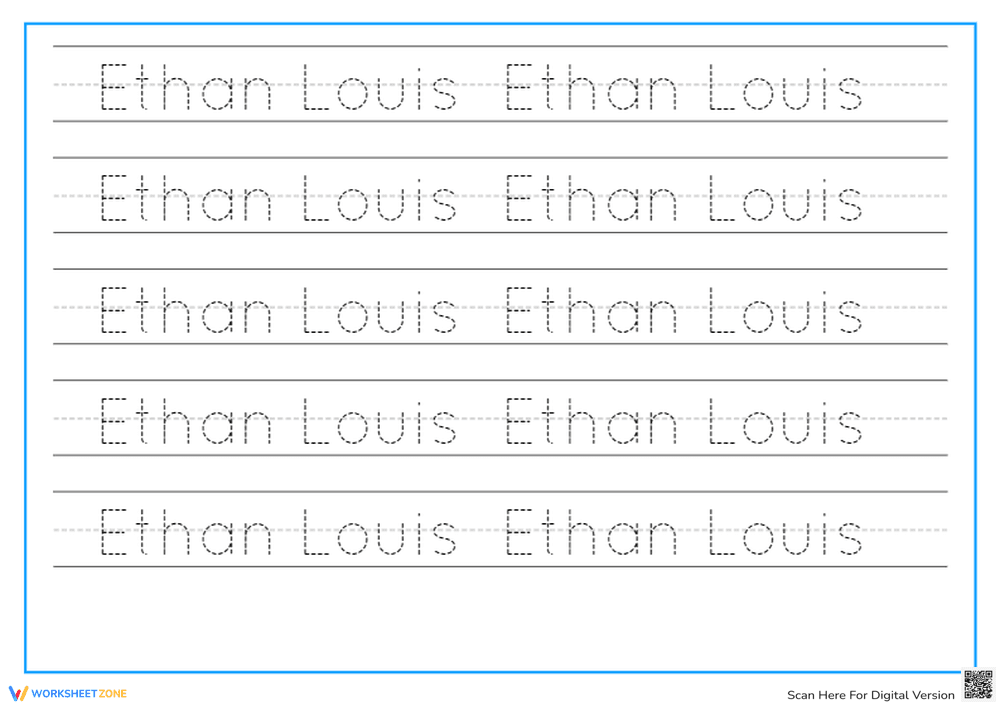

Grade K Name Tracing Worksheet | Printable

Paste this activity's link or code into your existing LMS (Google Classroom, Canvas, Teams, Schoology, Moodle, etc.).
Students can open and work on the activity right away, with no student login required.
You'll still be able to track student progress and results from your teacher account.
This printable name tracing worksheet helps early learners practice proper letter formation. Students trace the name "Ethan Louis" across multiple guided lines, building muscle memory for uppercase and lowercase letters. This focused handwriting activity ensures students develop confident writing habits.
At a Glance
- Grade: K · Subject: ELA
- Standard:
CCSS.ELA-LITERACY.L.K.1.A— Print many upper- and lowercase letters- Skill Focus: Name tracing and handwriting
- Format: 2 pages · 18 problems · PDF
- Best For: Independent morning work
- Time: 10–15 minutes
This resource includes two pages of structured handwriting practice. The first page features an introductory graphic and eight tracing instances on standard primary dashed lines. The second page provides ten additional tracing opportunities to reinforce letter sizing. The dashed-line format provides clear visual boundaries, helping young writers understand where each letter begins and ends.
This worksheet offers a seamless zero-prep workflow.
- Print (1 minute): Simply download the PDF and print the two-page set. No special formatting or cutting is required.
- Distribute (1 minute): Hand out the sheets during morning arrival or transition times. The intuitive tracing format means students can begin immediately.
- Review (1 minute): Quickly scan completed pages to check for proper pencil grip and stroke direction.
Total teacher prep time is under two minutes. The self-explanatory nature of the task makes it an excellent addition to any substitute teacher plan.
This activity aligns directly with CCSS.ELA-LITERACY.L.K.1.A, which requires students to print many upper- and lowercase letters. By repeatedly tracing a specific sequence of letters, students internalize the motor patterns necessary for fluent writing. Both standard codes can be copied directly into lesson plans, IEP goals, or district curriculum mapping tools.
Teachers can utilize this worksheet during morning work to establish a calm, focused routine as students enter the classroom. It also serves well as an independent center activity during literacy blocks. While students work, observe their pencil grip and note whether they are starting their letters from the top or bottom. This formative assessment takes only a few seconds per child but provides crucial data for future handwriting interventions. Expect students to complete both pages within 10 to 15 minutes.
This resource is primarily designed for Kindergarten and early Grade 1 students who are mastering basic letter formation. It is highly beneficial for students needing occupational therapy support or extra fine motor practice. For differentiation, teachers can provide pencil grips or highlight the bottom baseline for students struggling with spatial awareness. Pair this worksheet with a direct instruction lesson on letter sounds or a personalized anchor chart demonstrating proper stroke order.
Developing automaticity in handwriting is a foundational skill that directly impacts later reading and writing proficiency. This worksheet supports CCSS.ELA-LITERACY.L.K.1.A by having students print many upper- and lowercase letters through guided tracing. According to Fisher & Frey (2014), providing structured, repetitive practice with clear visual models is essential for moving students from novice to capable writers. When students do not have to expend cognitive energy on how to form a letter, they can focus entirely on composing meaning. This targeted practice builds the necessary muscle memory and spatial awareness required for legible print. By isolating the mechanical act of writing, educators can ensure that fine motor deficits do not become barriers to expressive communication. Consistent, brief practice sessions, such as those provided by this two-page activity, yield significant improvements in overall writing fluency and student confidence.


