




























Views
Downloads

Name Tracing Practice | Essential Grade 1 Handwriting

Paste this activity's link or code into your existing LMS (Google Classroom, Canvas, Teams, Schoology, Moodle, etc.).
Students can open and work on the activity right away, with no student login required.
You'll still be able to track student progress and results from your teacher account.
This name tracing worksheet provides Kassandra B. Abonillo with targeted handwriting practice to master the specific letter sequences in her name. By focusing on consistent letter height and spacing, students develop the muscle memory required for legible, fluent writing. This resource ensures early learners gain confidence in their personal identity through written expression.
At a Glance
- Grade: 1 · Subject: Handwriting
- Standard:
CCSS.ELA-LITERACY.L.1.1.A— Print all upper- and lowercase letters accurately and legibly- Skill Focus: Proper name tracing and letter formation
- Format: 2 pages · 10 tasks · No answer key needed · PDF
- Best For: Morning work or daily handwriting practice
- Time: 10–15 minutes
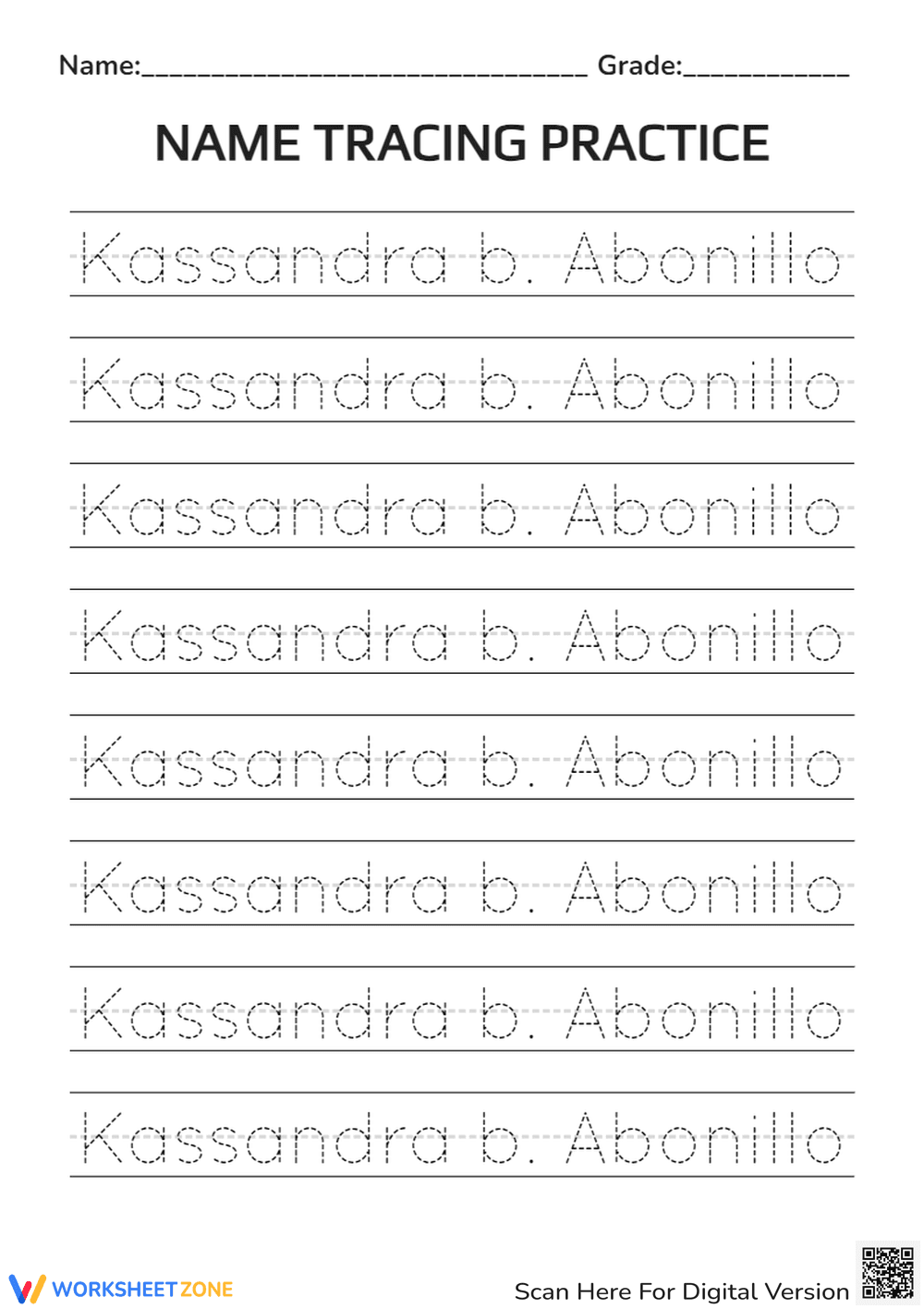
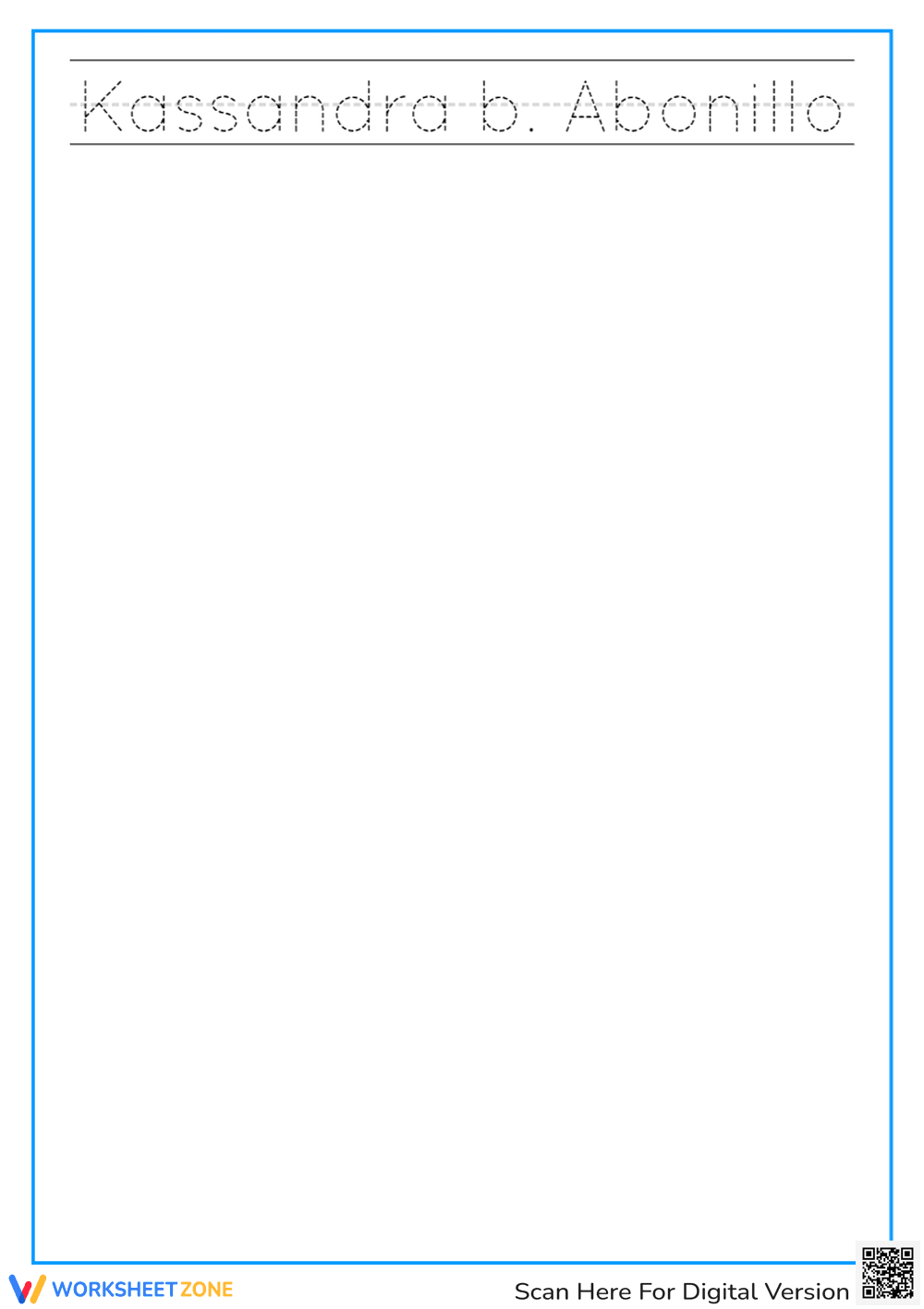
The download includes two distinct pages designed for a gradual release of responsibility. The first page features eight rows of dashed-line tracing for "Kassandra B. Abonillo," providing high-frequency repetition. The second page offers a single tracing prompt followed by a large, open workspace for independent practice, allowing the student to transition from guided tracing to freehand writing.
Teachers can implement this resource in under two minutes. First, print the two-page PDF (30 seconds). Second, distribute the sheets during morning arrival or center rotations (30 seconds). Finally, review the student's letter formation and pencil grip during a quick walk-around (60 seconds). This streamlined workflow makes it an ideal choice for busy classrooms or as a reliable sub-plan activity.
This worksheet aligns with CCSS.ELA-LITERACY.L.1.1.A, which requires students to print all upper- and lowercase letters. By practicing a specific name, the student engages with a variety of letter shapes and connections in a meaningful context. This standard code can be copied directly into lesson plans, IEP goals, or district curriculum mapping tools.
Use this worksheet during the independent practice phase of a handwriting lesson. It is particularly effective as a warm-up activity to settle students at the start of the day. For formative assessment, observe the student's stroke order to ensure they are following top-down formation patterns. Completion typically takes 10 to 15 minutes.
This resource is designed for Grade 1 and Grade 2 students who need focused practice on their specific name. It is an excellent tool for students requiring fine motor intervention or those working toward IEP handwriting goals. Pair this with a tactile alphabet anchor chart to help the student visualize letter relationships.
According to research by Fisher & Frey (2014), the gradual release of responsibility model—moving from heavy scaffolding to independent application—is critical for motor skill acquisition in early childhood. This worksheet applies that principle by providing 8 guided tracing rows before requiring the student to produce the name "Kassandra B. Abonillo" in a blank workspace. Aligned to CCSS.ELA-LITERACY.L.1.1.A, this practice helps solidify the fine motor control necessary for legible handwriting. Studies from the NAEP suggest that early mastery of name writing is a strong predictor of future literacy success. By providing 10 specific tasks across 2 pages, this resource ensures that students receive the high-repetition practice needed to move letter formation from conscious effort to automaticity. This targeted approach allows educators to provide meaningful, individualized instruction with zero preparation time.


