


























Views
Downloads

Name Tracing: Clarissa Lara — Printable Grade 1 Worksheet
Paste this activity's link or code into your existing LMS (Google Classroom, Canvas, Teams, Schoology, Moodle, etc.).
Students can open and work on the activity right away, with no student login required.
You'll still be able to track student progress and results from your teacher account.
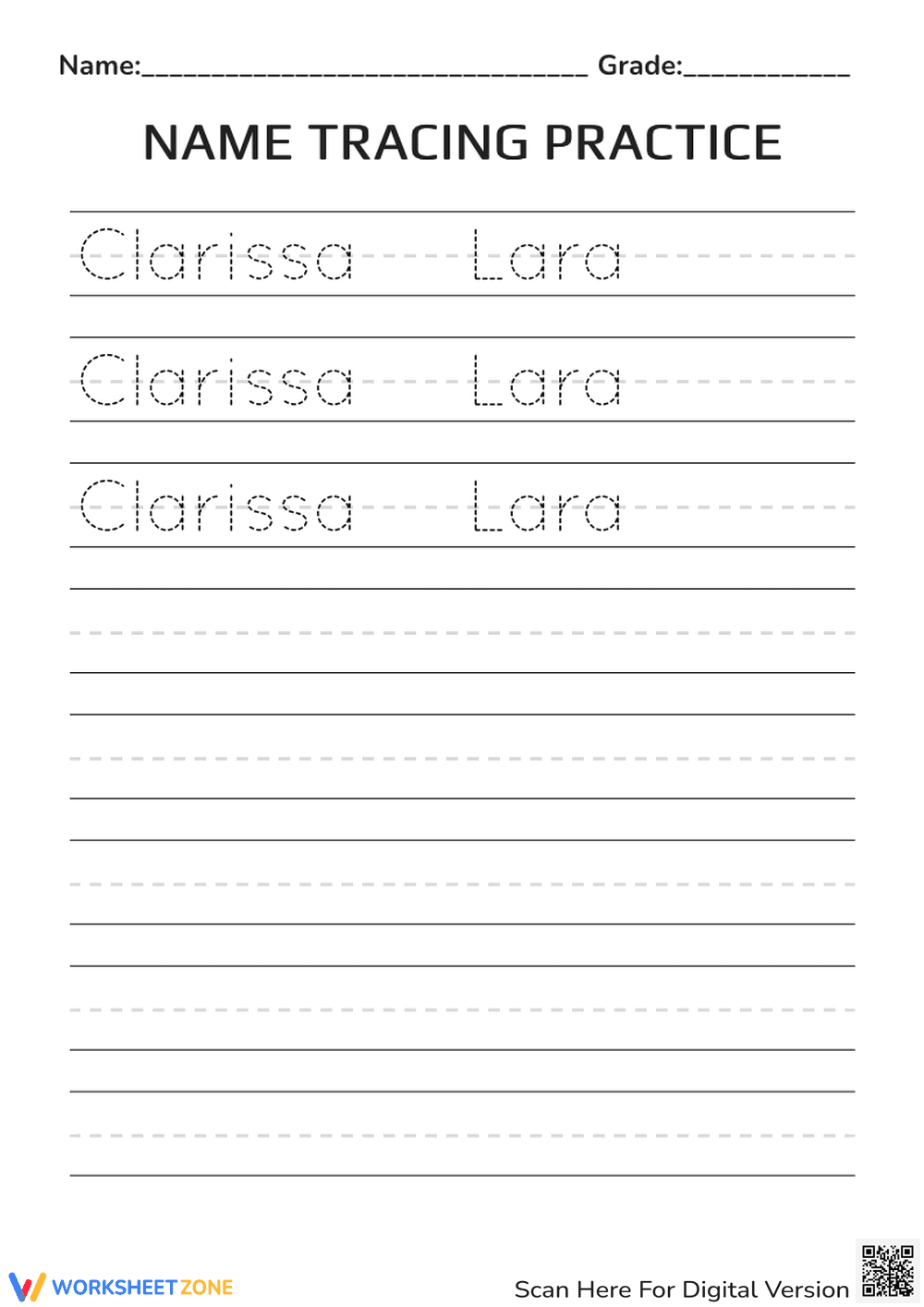
This Grade 1 name tracing worksheet helps students master the specific letter formations in the name Clarissa Lara while developing essential fine motor control. By combining guided tracing with independent writing lines, students transition from supported imitation to confident, neat handwriting. It provides a structured environment for early literacy and personal identification skills.
At a Glance
- Grade: 1 · Subject: Handwriting
- Standard:
CCSS.ELA-LITERACY.L.1.1.A— Print all upper- and lowercase letters correctly and legibly- Skill Focus: Name recognition and letter formation
- Format: 1 page · 10 lines · No answer key needed · PDF
- Best For: Morning work or daily handwriting practice
- Time: 5–10 minutes
Inside this resource, you will find a single-page layout designed for maximum clarity. The top section features three rows of the name Clarissa Lara in a dashed tracing font, allowing for repeated guided practice. Below the tracing section, seven sets of primary ruled lines provide ample space for students to attempt the name independently, reinforcing muscle memory and spatial awareness.
The zero-prep workflow for this worksheet is designed for busy educators. First, print the single-page PDF in under 30 seconds. Second, distribute the sheets to students during morning arrival or transition periods. Third, review the letter formation and spacing as students work, providing immediate verbal feedback. Total teacher preparation time is under two minutes, making it an ideal sub plan addition.
This resource aligns with `CCSS.ELA-LITERACY.L.1.1.A`, which requires students to print all upper- and lowercase letters. By focusing on a specific name, students practice a variety of letter shapes and connections. This standard code can be copied directly into lesson plans, IEP goals, or district curriculum mapping tools to document handwriting progress.
Use this worksheet as a bell-ringer activity to settle students at the start of the day. It also serves as an effective formative assessment tool; observe the student's pencil grip and stroke order during the tracing phase. Expected completion time is between 5 and 10 minutes, depending on the student's fine motor development and familiarity with the letters.
This worksheet is primarily for Grade 1 and Grade 2 students who need targeted practice with specific letter strings. It is particularly useful for students working on IEP goals related to legibility and letter sizing. Pair this resource with a letter formation anchor chart or a direct instruction lesson on proper pencil posture for the best results.
Handwriting instruction remains a cornerstone of early literacy, as evidenced by the Fisher & Frey (2014) framework for gradual release of responsibility. This worksheet utilizes that model by moving from guided tracing to independent production. Research from RAND AIRS 2024 suggests that consistent, short-burst practice of high-frequency words—such as a student's own name—significantly improves orthographic mapping and fine motor precision. By targeting CCSS.ELA-LITERACY.L.1.1.A, this resource ensures that students are meeting national expectations for legible letter formation. The 10-line structure provides enough repetition to build muscle memory without causing fatigue in young learners. Educators can use these practice lines to bridge the gap between letter recognition and fluid writing, providing a clear artifact of student progress for portfolios or parent-teacher conferences.


