


























Views
Downloads

Name Tracing Worksheet | Grade 1 Essential Practice
Paste this activity's link or code into your existing LMS (Google Classroom, Canvas, Teams, Schoology, Moodle, etc.).
Students can open and work on the activity right away, with no student login required.
You'll still be able to track student progress and results from your teacher account.
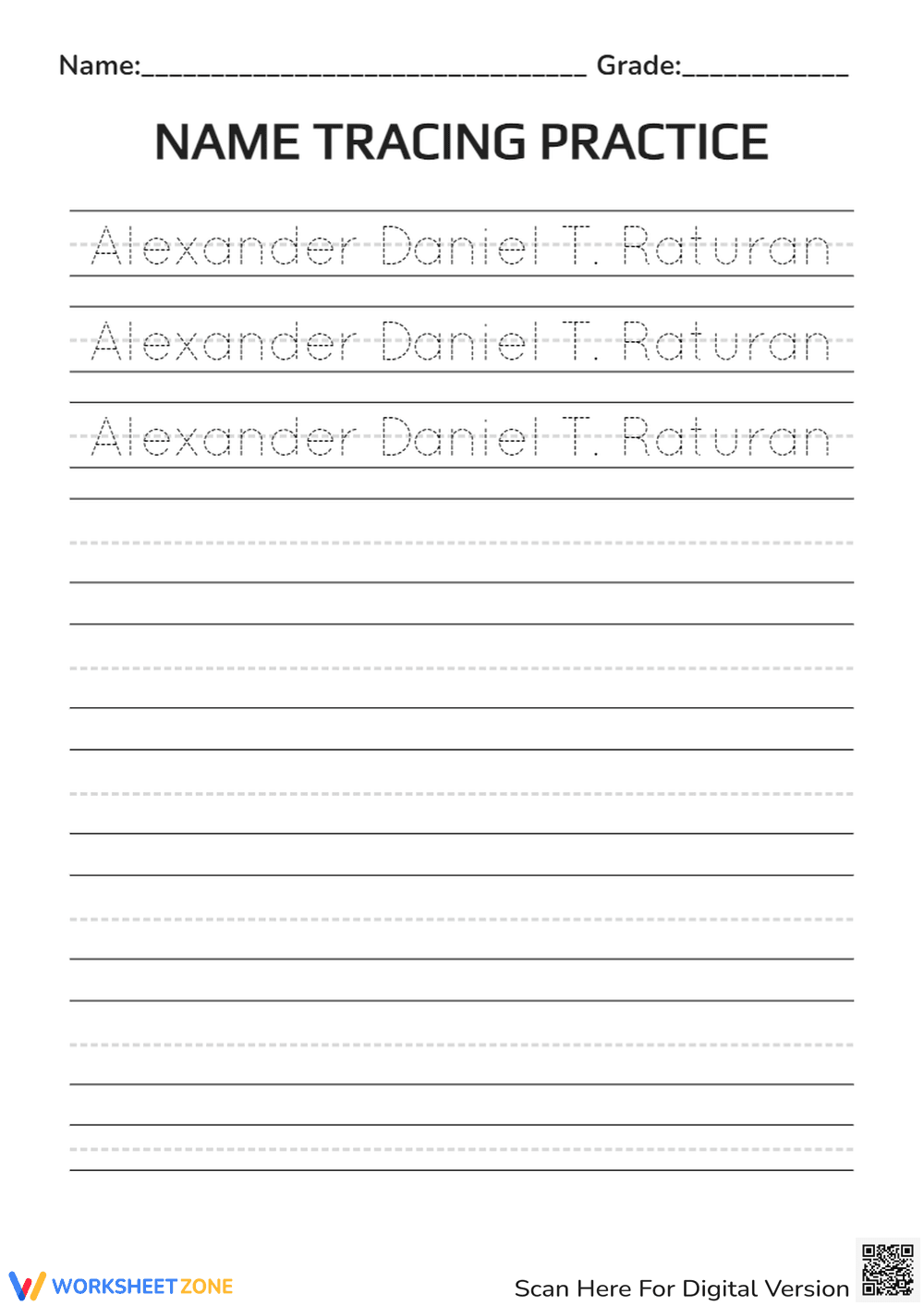
This Grade 1 name tracing worksheet helps students master the specific letter formations in the name Alexander Daniel T. Raturan. By combining guided tracing with independent writing lines, students develop the muscle memory and fine motor control necessary for legible handwriting. It provides a structured path toward writing confidence and personal identification.
At a Glance
- Grade: 1 · Subject: Handwriting
- Standard:
CCSS.ELA-LITERACY.L.1.1.A— Print all upper- and lowercase letters accurately and legibly- Skill Focus: Proper letter formation and spacing
- Format: 1 page · 13 practice lines · No answer key needed · PDF
- Best For: Morning work or daily handwriting warm-up
- Time: 10–15 minutes
This single-page PDF features three rows of guided tracing for the name "Alexander Daniel T. Raturan" using a clear, dotted font. Below the guided section, ten additional primary-ruled lines provide ample space for independent practice. The layout includes a standard header for the student's name and grade, ensuring easy organization for classroom portfolios.
Zero-Prep Workflow
The workflow for this resource is designed for maximum efficiency. First, print the single-page PDF (30 seconds). Next, distribute the sheets to students during morning arrival or transition periods (1 minute). Finally, conduct a quick visual review of letter height and baseline alignment as students work (30 seconds). This makes it an ideal choice for emergency sub plans or daily handwriting routines.
Standards Alignment
The primary focus is `CCSS.ELA-LITERACY.L.1.1.A`, which requires students to print all upper- and lowercase letters. This worksheet specifically targets the complex sequence of letters in a full name, ensuring students can maintain consistent letter size and spacing. This standard code can be copied directly into lesson plans, IEP goals, or district curriculum mapping tools.
How to Use It
Use this worksheet during the first ten minutes of the school day as a calming "bell-ringer" activity to settle the class. It also serves as an effective formative assessment tool; observe the student's pencil grip and stroke order during the independent writing phase. Expect most Grade 1 students to complete the full page in approximately 12 minutes.
Who It's For
This resource is designed for first and second-grade students who need targeted practice with specific name recognition and writing. It is particularly helpful for early learners developing fine motor strength. Pair this worksheet with a tactile alphabet anchor chart or a "Sky, Grass, Dirt" handwriting guide to reinforce letter placement.
According to the RAND AIRS 2024 report, consistent daily handwriting practice is a foundational component of early literacy development, directly impacting a student's ability to compose written text. This worksheet aligns with CCSS.ELA-LITERACY.L.1.1.A by providing the repetitive, structured practice required for students to print all upper- and lowercase letters with automaticity. Research from Fisher & Frey (2014) emphasizes that the gradual release of responsibility—moving from guided tracing to independent production—is critical for motor skill acquisition. By utilizing 13 lines of focused practice, this resource ensures that students move beyond simple imitation to mastery of letter formation. This specific name tracing activity supports the development of personal identity and fine motor control, making it a vital tool for early elementary classrooms seeking to meet rigorous state and national standards.


