




























Views
Downloads
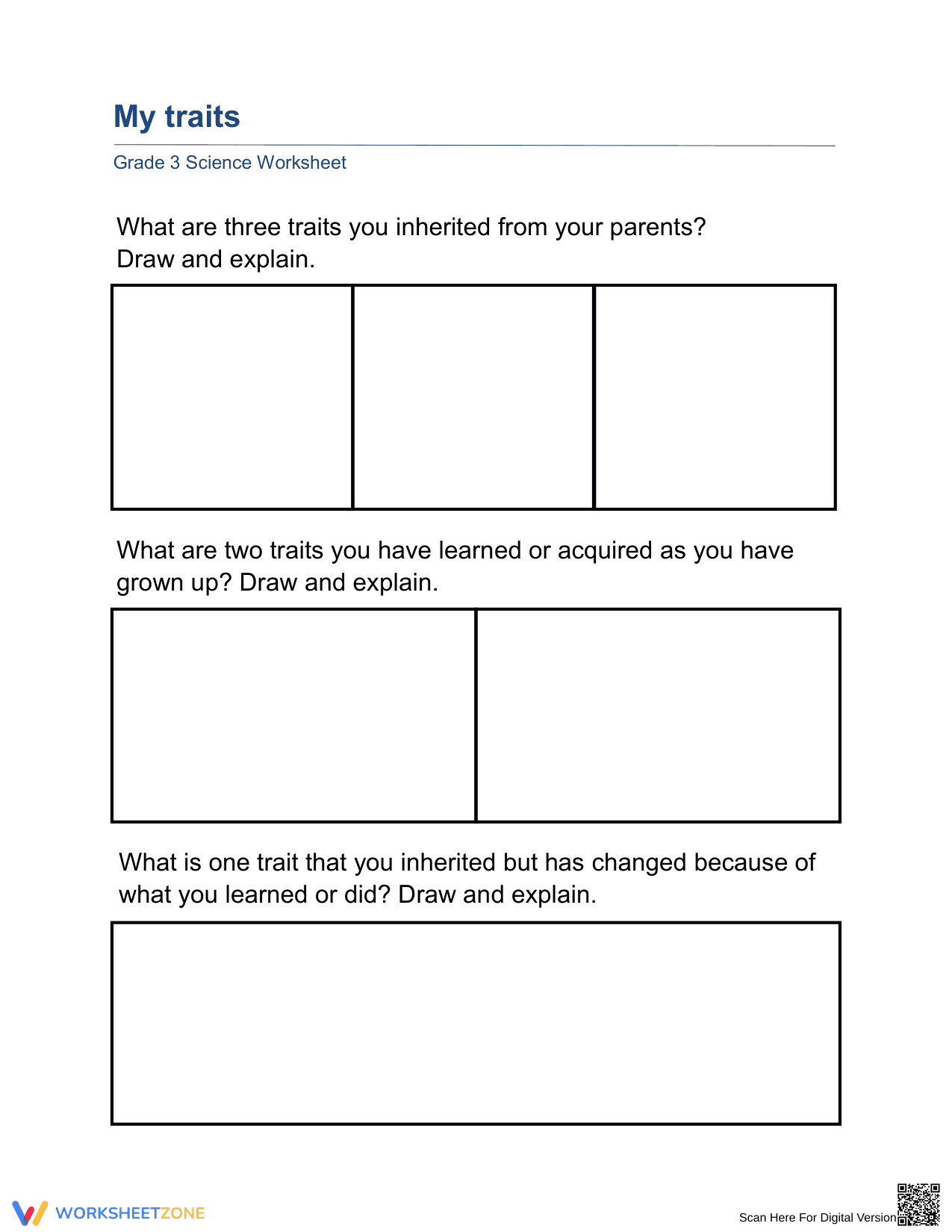

Grade 3 Inherited Traits — Printable No-Prep Worksheet

Paste this activity's link or code into your existing LMS (Google Classroom, Canvas, Teams, Schoology, Moodle, etc.).
Students can open and work on the activity right away, with no student login required.
You'll still be able to track student progress and results from your teacher account.
This Essential Inherited Traits worksheet helps students distinguish between characteristics passed down from parents and those learned from their environment. By drawing and explaining personal examples, learners build a concrete understanding of biological inheritance and environmental influence. This one-page activity ensures students can identify how traits change over time through learning and experience.
At a Glance
- Grade: 3 · Subject: Science
- Standard:
3-LS3-2— Use evidence to support how traits are influenced by the environment- Skill Focus: Inherited vs. Acquired Traits
- Format: 1 page · 6 problems · Answer key included · PDF
- Best For: Interactive science journals and homework
- Time: 20–30 minutes
What's Inside
This 1-page PDF includes three distinct sections prompting students to reflect on their own physical and behavioral characteristics. The worksheet features six structured drawing and writing boxes designed to capture three inherited traits, two acquired skills, and one modified trait. A comprehensive answer key provides teacher guidance for evaluating student responses based on scientific accuracy.
Zero-Prep Workflow
The zero-prep design allows for immediate classroom implementation in three simple steps. First, print the single-page PDF (30 seconds). Next, distribute the sheets for independent or small-group reflection (1 minute). Finally, review the completed drawings and explanations using the included key (5 minutes). This workflow makes it an ideal resource for substitute plans or quick formative assessments.
Standards Alignment
This resource is aligned to NGSS 3-LS3-2, which requires students to use evidence to support the explanation that traits can be influenced by the environment. It also supports 3-LS3-1 by encouraging the analysis of inherited characteristics. Both standard codes can be copied directly into lesson plans, IEP goals, or district curriculum mapping tools.
How to Use It
Use this worksheet as a concluding activity during a unit on heredity to assess student understanding of trait categorization. It serves as an excellent formative-assessment tool; teachers should observe if students can correctly distinguish between biological features (eye color) and learned behaviors (riding a bike). Completion typically takes 25 minutes depending on student detail.
Who It's For
This activity is designed for Grade 3 science students but is easily adapted for Grade 2 or Grade 4 enrichment. It supports English Language Learners and students with IEPs by providing visual drawing prompts alongside writing tasks. It pairs naturally with an anchor chart detailing the differences between nature and nurture in the animal kingdom.
According to research from Fisher & Frey (2014) on the gradual release of responsibility, scaffolded drawing tasks like those in this 3-LS3-2 worksheet help primary students internalize complex biological concepts. By connecting scientific theory to their own lived experience—identifying inherited vs. acquired traits—learners bridge the gap between abstract genetics and observable reality. The NAEP science framework emphasizes the importance of using multiple modes of representation, such as the drawing and explaining method used here, to demonstrate mastery of life science standards. This "My Traits" activity provides 6 specific opportunities for students to evidence their understanding of how environmental factors influence physical and behavioral development. This evidence-based approach ensures that the worksheet is not just a coloring activity, but a rigorous tool for scientific inquiry and personal reflection in the third-grade classroom.


