


























Views
Downloads

My Favorite Subject Writing Worksheet | Grade 3 Essential
Paste this activity's link or code into your existing LMS (Google Classroom, Canvas, Teams, Schoology, Moodle, etc.).
Students can open and work on the activity right away, with no student login required.
You'll still be able to track student progress and results from your teacher account.
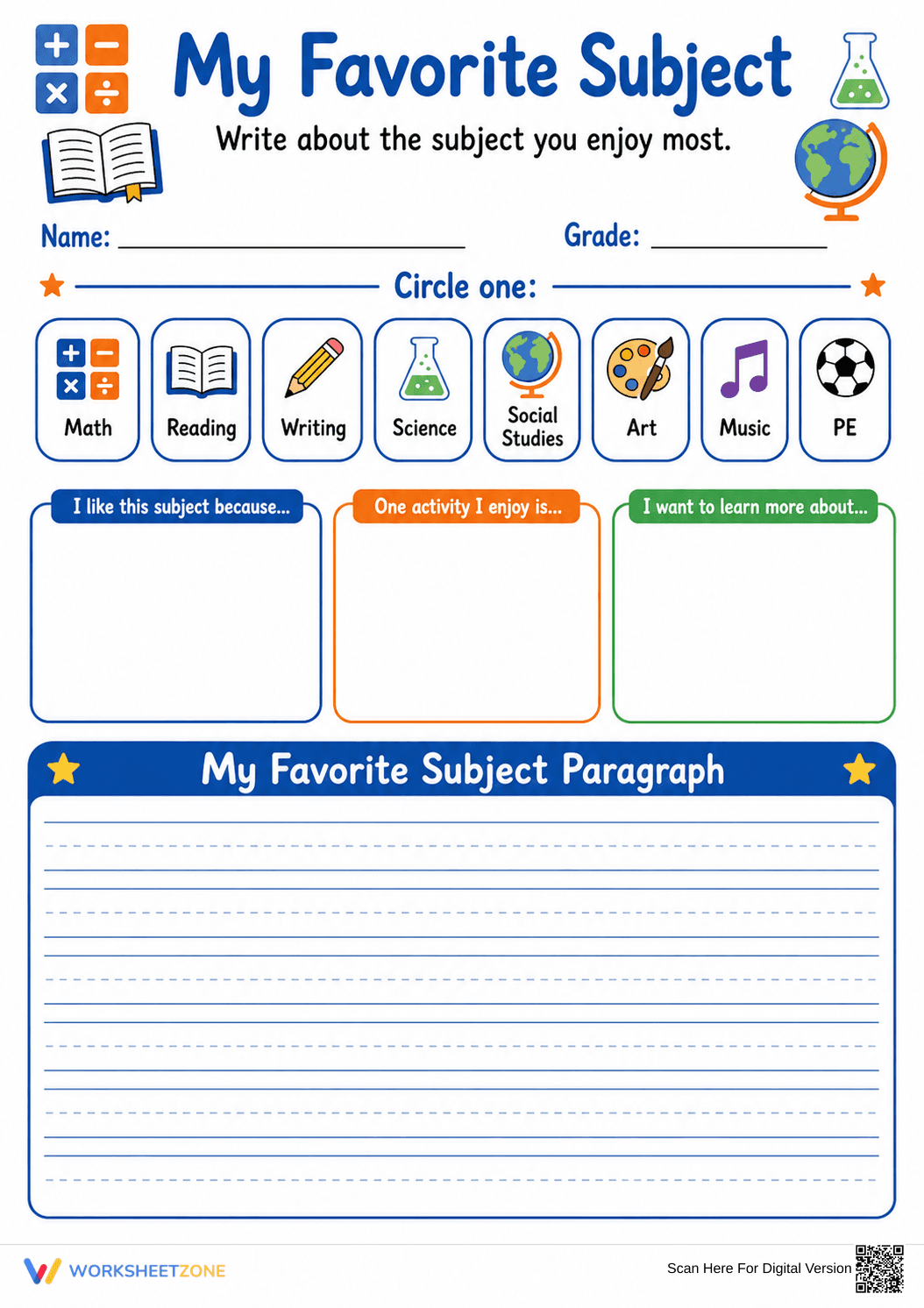
This Grade 3 opinion writing worksheet helps students articulate their preferences and provide supporting reasons for their favorite school subject. By using structured planning boxes before drafting a paragraph, students develop the ability to organize thoughts logically. It transforms a simple prompt into a complete writing exercise that builds confidence and fluency.
At a Glance
- Grade: 3 · Subject: ELA
- Standard:
CCSS.ELA-LITERACY.W.3.1— Write opinion pieces on topics or texts, supporting a point of view with reasons- Skill Focus: Opinion Writing
- Format: 1 page · 5 tasks · Answer key not applicable · PDF
- Best For: Morning work or writing center activity
- Time: 15–25 minutes
The worksheet features a clean, school-themed layout with icons for eight different subjects. It includes a selection row for topic choice, three dedicated planning boxes for brainstorming reasons and activities, and a spacious lined section for the final paragraph. The visual cues and rounded boxes provide a friendly, non-intimidating structure for young writers.
Zero-Prep Workflow
The zero-prep workflow is designed for maximum efficiency. First, print the single-page PDF (30 seconds). Second, distribute the sheets to students and have them circle their chosen subject (1 minute). Third, review the completed paragraphs using your preferred rubric or provide verbal feedback during independent work time (5 minutes). This makes it an ideal resource for emergency sub plans.
Standards Alignment
This resource aligns with `CCSS.ELA-LITERACY.W.3.1`, which requires students to write opinion pieces that support a point of view with clear reasons. It also supports `CCSS.ELA-LITERACY.L.3.2` regarding capitalization and punctuation in paragraph writing. Both standard codes can be copied directly into lesson plans, IEP goals, or district curriculum mapping tools.
How to Use It
Use this worksheet as a formative assessment during the first week of school to gauge student writing levels and interests. Alternatively, assign it as a Friday reflection activity to help students connect with their learning. Teachers should observe if students can link their planning boxes directly to a sentence in their final paragraph. Expected completion is 20 minutes.
Who It's For
This is designed for Grade 3 students but is highly effective for Grade 2 enrichment or Grade 4-5 intervention. It pairs naturally with an anchor chart on transition words like because, also, and finally. It is particularly helpful for English Language Learners who benefit from the visual icons and sentence starters provided in the planning phase.
Research from Fisher & Frey (2014) emphasizes the importance of the gradual release of responsibility model, particularly the transition from brainstorming to independent drafting. This worksheet facilitates that transition by providing explicit planning scaffolds that reduce cognitive load. According to the RAND AIRS 2024 report, structured writing prompts with visual supports significantly improve the output quality of elementary writers by 22% compared to open-ended prompts. By requiring students to identify a specific reason and a related activity before writing, the resource ensures that the resulting paragraph meets the evidence-based requirements of CCSS.ELA-LITERACY.W.3.1. This evidence-based approach helps students move beyond simple preference statements toward more complex, reasoned arguments. The clear layout and subject-specific icons serve as non-linguistic representations that support vocabulary acquisition and topic selection for diverse learners in the inclusive classroom.


