































Multiplying by 6s: Complete Guided Skill Practice

Paste this activity's link or code into your existing LMS (Google Classroom, Canvas, Teams, Schoology, Moodle, etc.).
Students can open and work on the activity right away, with no student login required.
You'll still be able to track student progress and results from your teacher account.
Mastering multiplication facts requires moving from visual models to automatic recall. This Grade 3 math worksheet provides targeted practice with multiplying by 6s, guiding learners through concrete representations, number line skip-counting, missing factor equations, and real-world word problems. Students build lasting computational fluency and conceptual understanding across 24 structured tasks.
At a Glance
- Grade: 3 · Subject: Math
- Standard:
3.OA.C.7— Fluently multiply and divide within 100 using properties of operations and fact relationships- Skill Focus: Multiplication fluency for the ×6 facts
- Format: 2 pages · 24 problems · Answer key included · PDF
- Best For: Targeted small-group instruction and fact fluency practice
- Time: 20–30 minutes
What's Inside
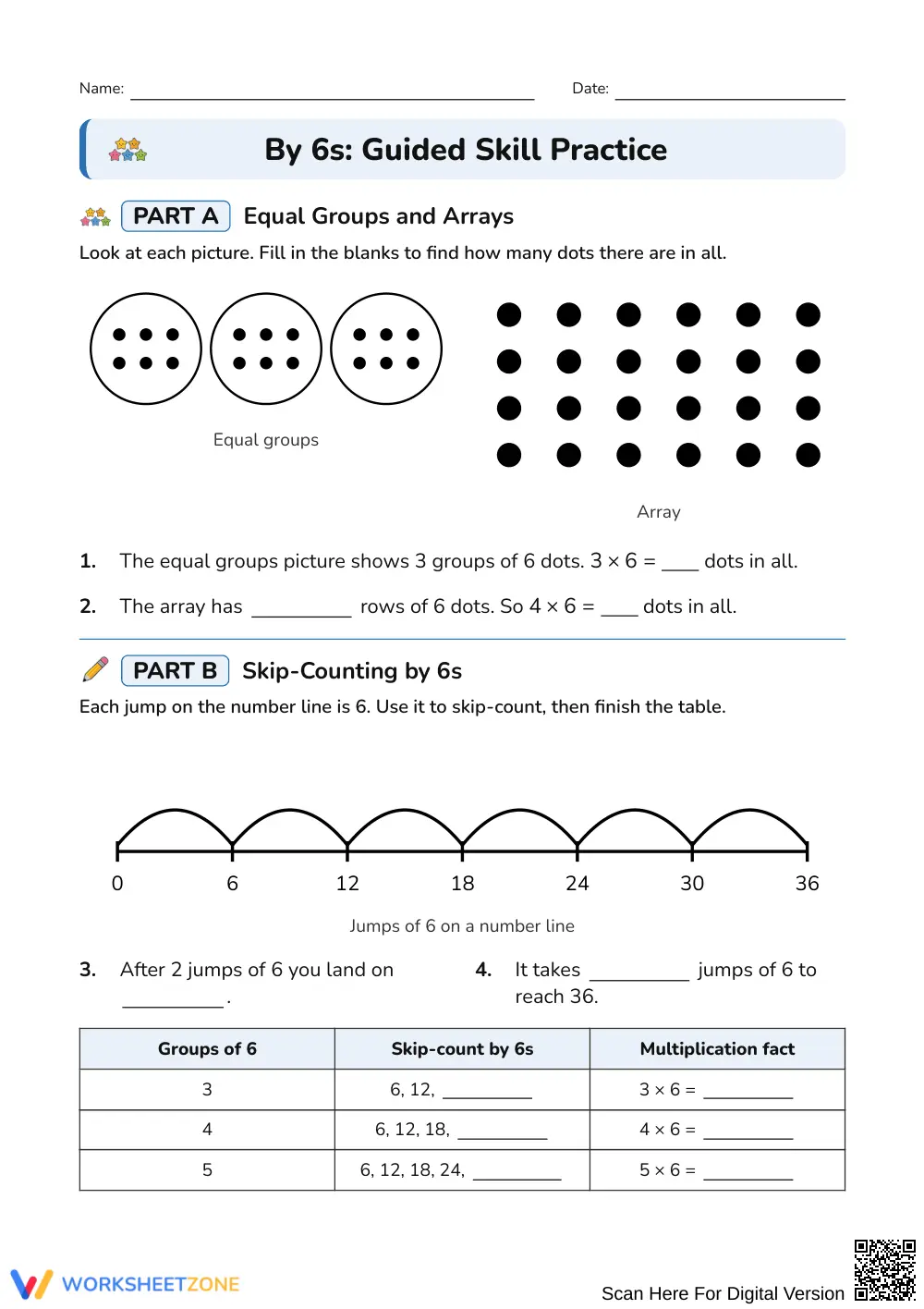
This 2-page resource contains 24 systematically sequenced problems across four sections. Part A introduces concrete visual scaffolds with equal groups and array models. Part B reinforces patterns with number line skip-counting tables. Part C targets abstract fact recall, missing factors, and inverse operations within fact families. Finally, Part D presents one-step multiplication and division word problems. A complete 2-page answer key provides full solutions and reference explanations.
Skill Progression
- Guided practice (Parts A & B): Students examine visual dot arrays and number line intervals across 6 foundational tasks that connect equal groups to multiplication facts.
- Supported practice (Part C): Learners complete 16 tasks spanning a full 10-fact reference table, missing factor equations, and inverse division fact families.
- Independent practice (Part D): Students apply their knowledge to 2 contextual word problems requiring complete number sentences and explanatory reasoning.
This structured sequence follows a gradual-release model, shifting learners from teacher-modeled visual representations toward independent arithmetic fluency.
Standards Alignment
This worksheet directly aligns with primary standard `3.OA.C.7`: Fluently multiply and divide within 100, using strategies such as the relationship between multiplication and division or properties of operations. It also supports `3.OA.A.3` by asking students to solve contextual word problems using equal groups and arrays. Both standard codes can be copied directly into lesson plans, IEP goals, or district curriculum mapping tools.
How to Use It
Deploy this worksheet during the guided practice portion of your math block immediately following direct instruction on multiples of 6. Alternatively, use it during tier-two intervention stations for students needing extra practice with multiplication facts. While students work through Part B, observe whether they count individual dots or skip-count fluently by sixes to assess conceptual progression. Expected completion time is 20 to 30 minutes.
Who It's For
This printable is designed for general education third graders developing foundational fact recall, as well as fourth graders requiring targeted fluency remediation. English learners benefit from the dual visual support of arrays and number lines. Pair this worksheet directly with a classroom number line anchor chart or a hands-on counters lesson.
According to Fisher & Frey (2014), purposeful gradual-release instruction significantly improves mathematical competence when students transition systematically from visual representations to independent problem solving. This worksheet operationalizes that pedagogy for standard 3.OA.C.7, which requires Grade 3 students to fluently multiply and divide within 100 using fact strategies. By anchoring initial tasks in concrete arrays and number line skip-counting before progressing to missing factors and contextual word problems, the resource ensures students do not merely memorize facts in isolation. Instead, learners build durable mental pathways connecting equal groupings to abstract equations. This scaffolded progression supports cognitive load management, enabling struggling learners to internalize factor pairs while reinforcing conceptual connections for on-grade peers. Educational practitioners can cite this design as a verified model of evidence-based arithmetic instruction that secures measurable fluency gains across diverse classroom settings.


