































Multiplying by 3s: Complete Prerequisite Check

Paste this activity's link or code into your existing LMS (Google Classroom, Canvas, Teams, Schoology, Moodle, etc.).
Students can open and work on the activity right away, with no student login required.
You'll still be able to track student progress and results from your teacher account.
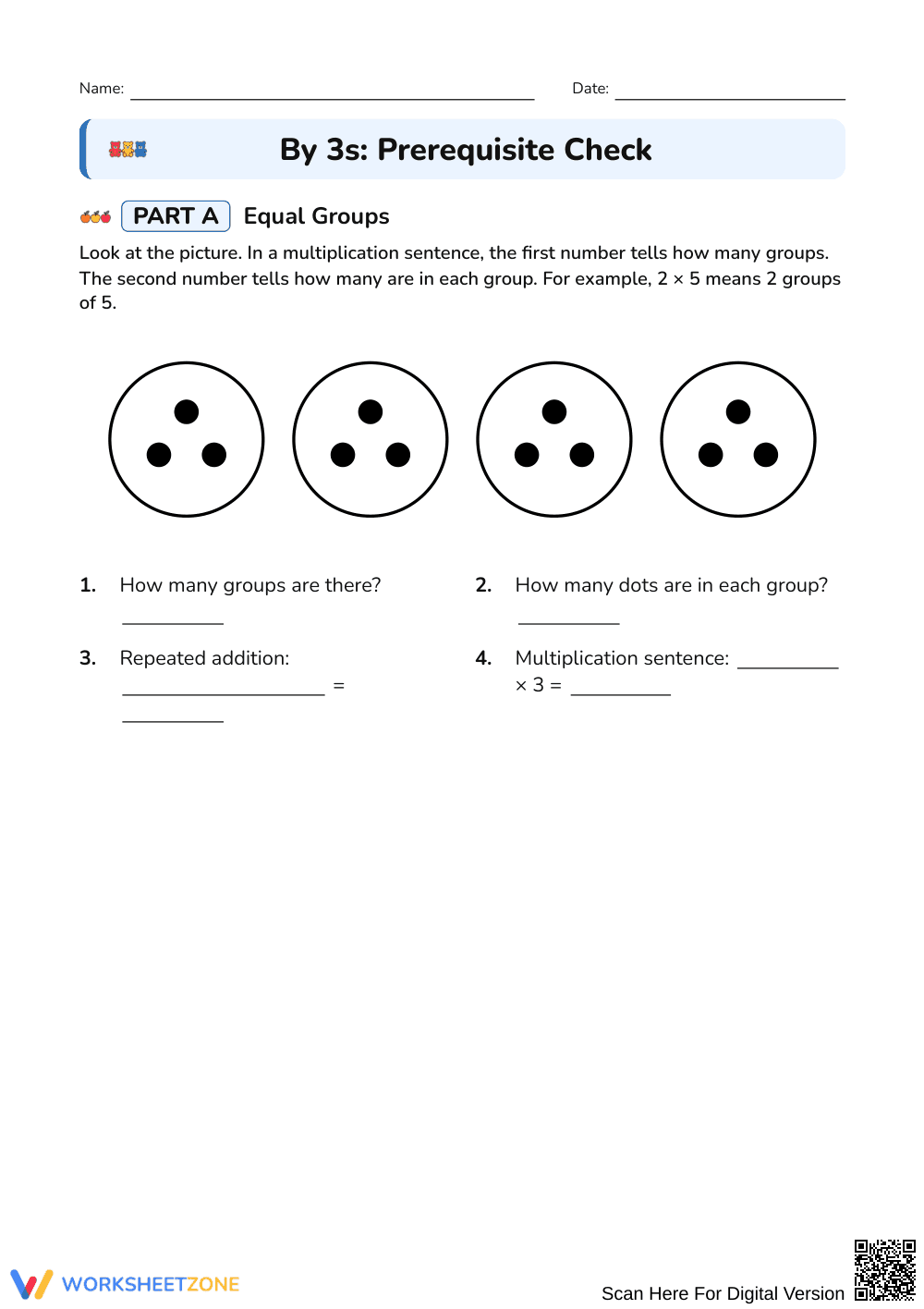
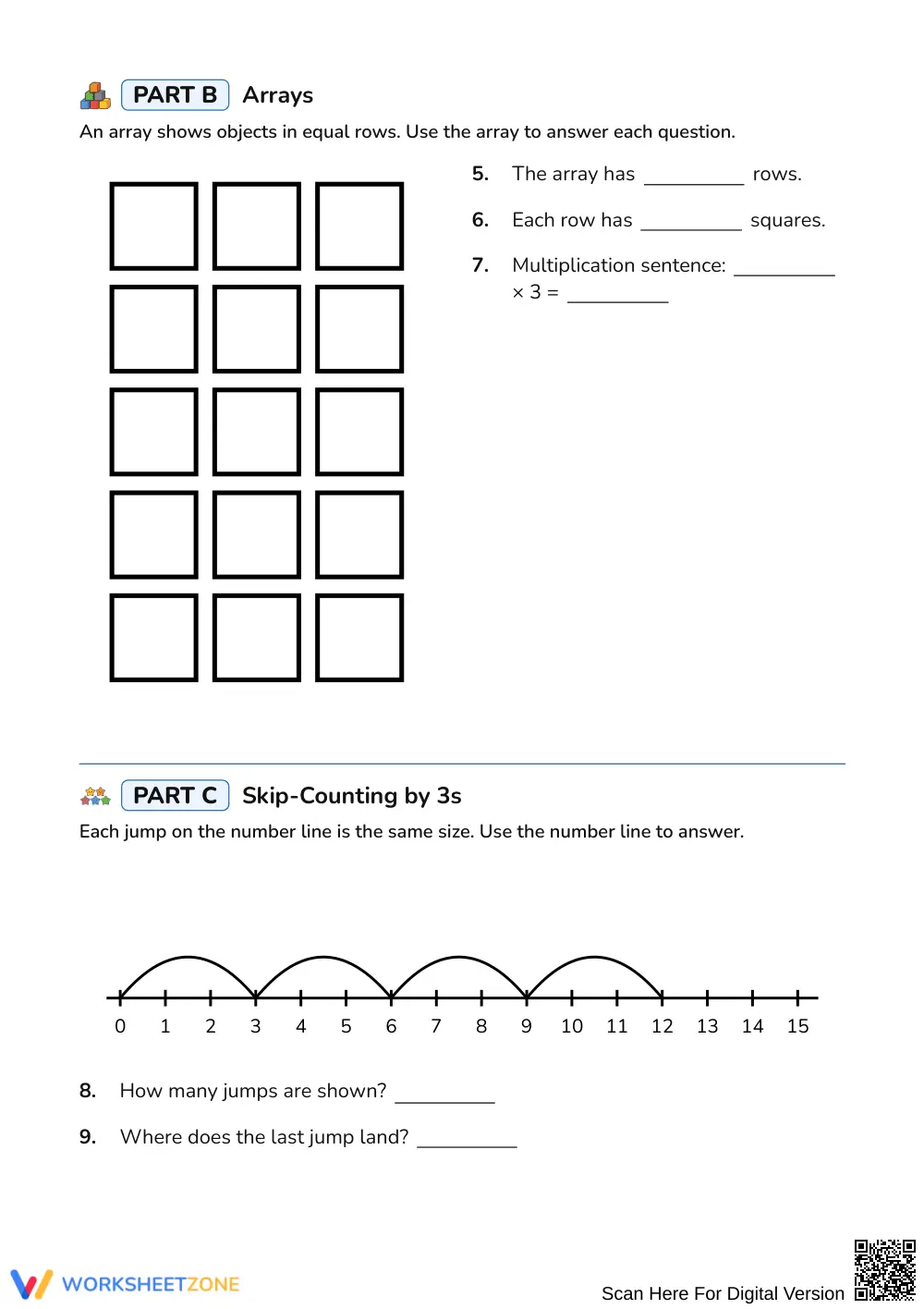
This Grade 3 math worksheet reviews prerequisite multiplication concepts and notation to prepare students for multiplication facts fluency with threes. Through concrete equal groups, visual arrays, number line jumps, and repeated addition, learners build the conceptual foundations needed to interpret products accurately before beginning fact memorization.
At a Glance
- Grade: 3 · Subject: Math
- Standard:
3.OA.A.1— Interpret products of whole numbers by modeling equal groups of objects.- Skill Focus: Prerequisite ideas and notation for multiplying by 3
- Format: 3 student pages · 22 problems · Answer key included · PDF document
- Best For: Diagnostic readiness check before unit instruction
- Time: 25–35 minutes
What's Inside
This 3-page diagnostic printout contains 22 tasks distributed across four progressive parts. Part A features a structured rule box and worked example illustrating group-by-size notation. Parts B and C present array analysis and number line skip-counting. Part D provides a repeated addition table, contextual word problem, and commutative reasoning item. A 3-page answer key provides complete visual models.
Skill Progression
- Guided practice (Part A, 4 tasks): Introductory modeling pairs a definition rule box with a worked example to define groups and items per group.
- Supported practice (Parts B & C, 6 tasks): Visual arrays and equal number line jumps prompt learners to match pictorial structures to equations.
- Independent practice (Part D, 12 tasks): Students complete addition tables, solve a word problem, and justify commutative equivalence independently.
This sequence follows a gradual-release framework, moving learners systematically from modeled examples to independent mathematical justifications.
Standards Alignment
This worksheet aligns directly to `3.OA.A.1`: Interpret products of whole numbers by modeling equal groups of objects. The reasoning items additionally reinforce `3.OA.B.5` by applying commutative properties to array rotations. Both standard codes can be copied directly into lesson plans, IEP goals, or district curriculum mapping tools.
How to Use It
Administer this worksheet before direct instruction on the 3s facts to evaluate prerequisite understanding, or during targeted intervention for students struggling with multiplication notation. During formative monitoring, observe whether students confuse rows with columns in arrays or skip jumps on the number line. Most learners finish all 22 tasks within 25 to 35 minutes.
Who It's For
Designed for third-grade math students beginning multiplication, this activity also supports fourth graders needing foundational intervention. Clear visual scaffolds assist English learners and students with IEP accommodations. Pair this diagnostic worksheet directly with an anchor chart illustrating equal groups, arrays, and skip-counting sequences.
Mastery of third-grade multiplication standard 3.OA.A.1 requires students to interpret products of whole numbers by connecting concrete equal groups, visual arrays, and linear skip-counting models to formal arithmetic expressions. According to Fisher & Frey (2014), intentional instructional scaffolding that guides learners across concrete visual representations prior to requiring abstract calculation builds resilient conceptual frameworks and prevents persistent operation errors. By grounding fact fluency in repeated addition equations and spatial arrays, this 22-task prerequisite check verifies that elementary pupils understand the foundational structure of multiplication rather than relying strictly on mechanical memory. The diagnostic sequence evaluates student readiness for multiplying by 3, providing teachers with immediate actionable evidence regarding group notation, array structures, and commutative equivalence prior to speed-focused fact drills. Structured visual practice thus establishes an indispensable pedagogical foundation for long-term mathematics achievement.


