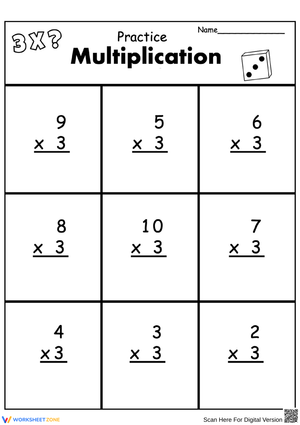
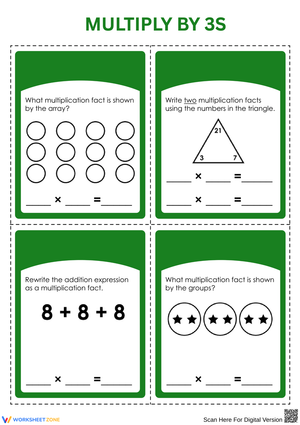
These Multiplication by 3s worksheets give 2nd and 3rd grade teachers a structured, print-ready path from skip counting through fluent fact recall — covering the full range from early number-line work to timed drills and multi-step word problems. The 3s table sits at an interesting instructional moment: students have usually locked down their 1s, 2s, and 5s, and the 3s are the first family that doesn't yield to simple doubling or counting by fives. That gap is exactly where this set works.
The Specific Skills Targeted
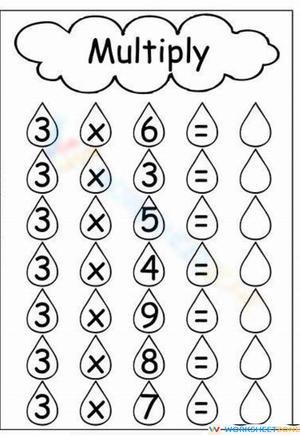
Each worksheet in the set isolates a distinct phase of the learning progression rather than mixing everything into undifferentiated drill. Early worksheets have students fill in skip-counting sequences and shade multiples of 3 on hundred charts — tasks that build the mental rhythm of 3, 6, 9, 12 before the multiplication symbol appears at all. A second tier pairs that sequence with formal notation: students see the skip-count chain alongside the matching equation, so 3 × 5 = 15 lands not as a memorized string but as the fifth stop on a path they already know.
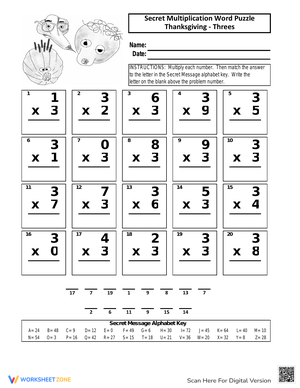
Later worksheets shift into flexible fact practice: missing-factor problems (3 × ___ = 27), arrays students draw and label, equal-group diagrams, and mixed reviews that fold 3s facts into problems alongside the 2s and 5s students already own. That last format matters because students who practice the 3s in isolation can develop a brittle fluency — they perform well on a 3s-only sheet but hesitate the moment a 3s fact appears inside a word problem with other numbers nearby.
Why This Format Works for This Skill at This Grade
The research framing here is straightforward: derived-fact strategies reduce cognitive load during early multiplication learning, and worksheets that make those strategies visible keep students from defaulting to inefficient finger-counting. One strategy the set builds explicitly is double-plus-one-group: because most 3rd graders have solid 2s facts, they can solve 3 × 7 by thinking "2 × 7 is 14, plus one more group of 7 is 21." A worksheet that prompts this in a two-column layout — solve the 2× fact first, then add one group — turns a drill sheet into a strategy scaffold. Over several sessions, students internalize the move and no longer need the prompt.
This design also supports the gradual-release model. Visual worksheets (arrays, number lines) do heavy lifting early; strategy-prompt worksheets bridge the middle phase; bare-fact drills come last, once conceptual hooks are in place. Running that sequence out of order — handing students a timed drill before they have a mental model — is where fluency stalls.
Frequent Student Errors Worth Watching For
The most predictable error in 3s practice is sequence slippage: students know the skip-count chain up to 3 × 5 or 3 × 6 and then lose the thread. In written work, this shows up as answers that are internally consistent but off by three — a student writes 3 × 8 = 22 because they miscounted one hop on the number line and then continued correctly from there. It's not a memorization failure; it's a tracking failure. Worksheet formats that ask students to fill in the full chain before solving equations surface this error in a low-stakes way.
A second pattern: students who have skip counting down cold will still write 3 × 0 = 3. Zero facts don't fit the skip-count rhythm intuitively, and the worksheets address this directly rather than burying 3 × 0 among other facts where it might slide by unnoticed.
Adjusting the Worksheets for a Range of Learners
Students who are still shaky on the skip-count sequence work best with worksheets that include a reference strip at the top — the multiples of 3 listed in order — so they can track their place while solving. Reducing the problem count per worksheet also helps here; a student who freezes looking at 40 problems will complete 15 without issue, and completion matters more than volume at this stage.
On-level students use the standard drill and word-problem sheets with one added expectation: they write their strategy (a small "2×" notation, a circled group count) beside each answer. That habit keeps the conceptual work visible even as students move toward automaticity.
For students ready for extension, the most effective challenge is not simply more problems but different problem structures. Two-step word problems — "There are 4 bags with 3 apples each; you eat 5. How many are left?" — require students to identify that the 3s fact is embedded in a larger situation, which is the actual transfer skill that matters on assessments.
Building These Worksheets Into Your Lesson Plans
Short daily contact beats longer infrequent sessions. A half-page drill in the first five minutes of math block, completed and self-corrected before the lesson begins, builds fluency incrementally without eating instructional time. Students graph their daily totals on a personal tracking sheet — a small detail that turns a routine exercise into visible progress.
In a station-rotation model, different worksheet types work well at separate tables: arrays at one, word problems at another, missing-factor sheets at a third. Eight-minute rotations are enough for a focused worksheet without students running out of runway or waiting for slower finishers. Homework packets of four short sheets sent home weekly let families support practice without requiring any explanation of new material — the worksheet format is self-contained enough that a parent or older sibling can help without knowing the current classroom strategy.
One underused slot: the transition window before specials or lunch dismissal. A two-minute oral skip-count from a worksheet sequence — the class reads the multiples together, then students answer the teacher's random 3s questions — takes no setup and reinforces the same number relationships students practiced in writing.
Standard Alignment
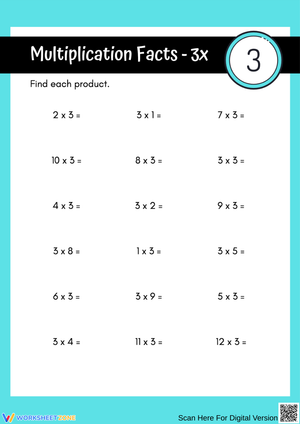
CCSS.MATH.CONTENT.3.OA.C.7 requires students to fluently multiply and divide within 100, which encompasses every 3s fact from 3 × 0 through 3 × 10. In classroom terms, this standard sits at the end of the 3rd grade instructional sequence, not the beginning — students work toward fluency benchmarks after conceptual groundwork is in place. The worksheets in this set span that full arc, from early conceptual models through the timed-fluency practice the standard describes. Teachers can use the timed drill sheets specifically as formative data points to document progress toward the fluency benchmark.
Frequently Asked Questions
At what point in the year do most 3rd grade teachers introduce the 3s facts?
Most 3rd grade pacing guides place the 3s table in the first trimester, after students have revisited the 2s and 5s from 2nd grade. The skip-counting worksheets can appear even earlier — late 2nd grade — as a bridge activity before formal multiplication notation is introduced.
Can these worksheets work for 2nd graders?
The skip-counting and number-line sheets are well-suited to 2nd grade, where the standard is to count within 1000 and skip count by 5s, 10s, and 100s. Extending that to 3s is an appropriate enrichment move. The multiplication-notation worksheets are better held for 3rd grade, when students have formally encountered the × symbol and the concept of equal groups.
How do I know when a student is ready to move off the visual worksheets?
Watch for students who fill in the array or number line after already writing the answer — they're using the visual to check, not to solve. That's a reliable signal that the model has been internalized and the student is ready for bare-fact drills. Keeping them on visual sheets past that point doesn't hurt, but it stops being the most efficient use of practice time.
Do these worksheets address division by 3 as well?
Missing-factor problems (3 × ___ = 18) function as division problems in multiplication clothing — students are essentially solving 18 ÷ 3 without the division symbol. This format gives teachers a bridge to division instruction without introducing new notation before students are ready for it.













 Interactive Worksheet Maker
 Quiz Maker
 Word Search Maker
 Crossword Puzzle Maker
 Word Scramble Generator
 Sentence Scramble Generator
 Handwriting Worksheet Generator
 Name Tracing Generator
 Fill In The Blank Generator