
































Essential Grade 4 Distributive Property Multiplication Guide

Paste this activity's link or code into your existing LMS (Google Classroom, Canvas, Teams, Schoology, Moodle, etc.).
Students can open and work on the activity right away, with no student login required.
You'll still be able to track student progress and results from your teacher account.
This Grade 4 distributive property worksheet helps students master complex multiplication by breaking down large factors into manageable tens and ones. By using a structured place value strategy, learners move beyond rote memorization to understand the mathematical mechanics of multi-digit operations. This printable resource ensures students build a concrete foundation for mental math and future algebraic thinking.
At a Glance
- Grade: 4 · Subject: Math
- Standard:
4.NBT.B.5— Multiply whole numbers using strategies based on place value and the properties of operations- Skill Focus: Distributive Property (Breaking apart factors)
- Format: 3 pages · 10 problems · Answer key included · PDF
- Best For: Small group instruction and independent practice
- Time: 25–35 minutes
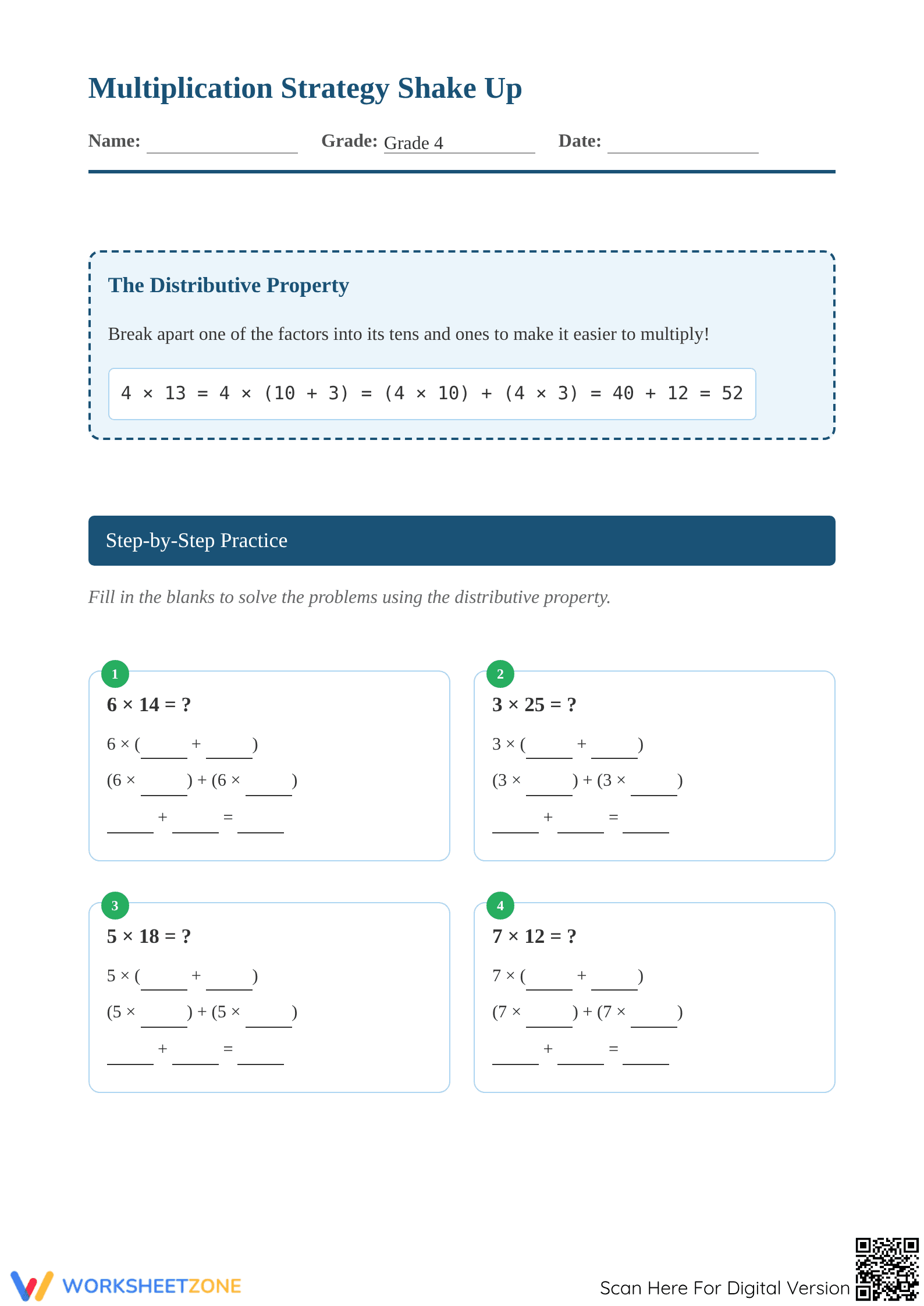
Inside this three-page PDF, you will find a comprehensive instructional sequence designed to move students from conceptual understanding to independent application. The first page features a clear worked example of the distributive property (e.g., 4 × 13), followed by scaffolded fill-in-the-blank problems. The second page removes the scaffolds for direct application, and the final page challenges students with real-world word problems to test their mastery of the strategy in context.
Skill Progression and Scaffolding
- Guided Practice: The first 4 problems provide a fill-in-the-blank structure that mirrors the distributive property formula, ensuring students correctly partition factors into tens and ones before calculating partial products.
- Supported Application: Problems 5 through 8 transition to open workspace boxes where students must organize their own distributive property equations without visual prompts, reinforcing the procedural steps.
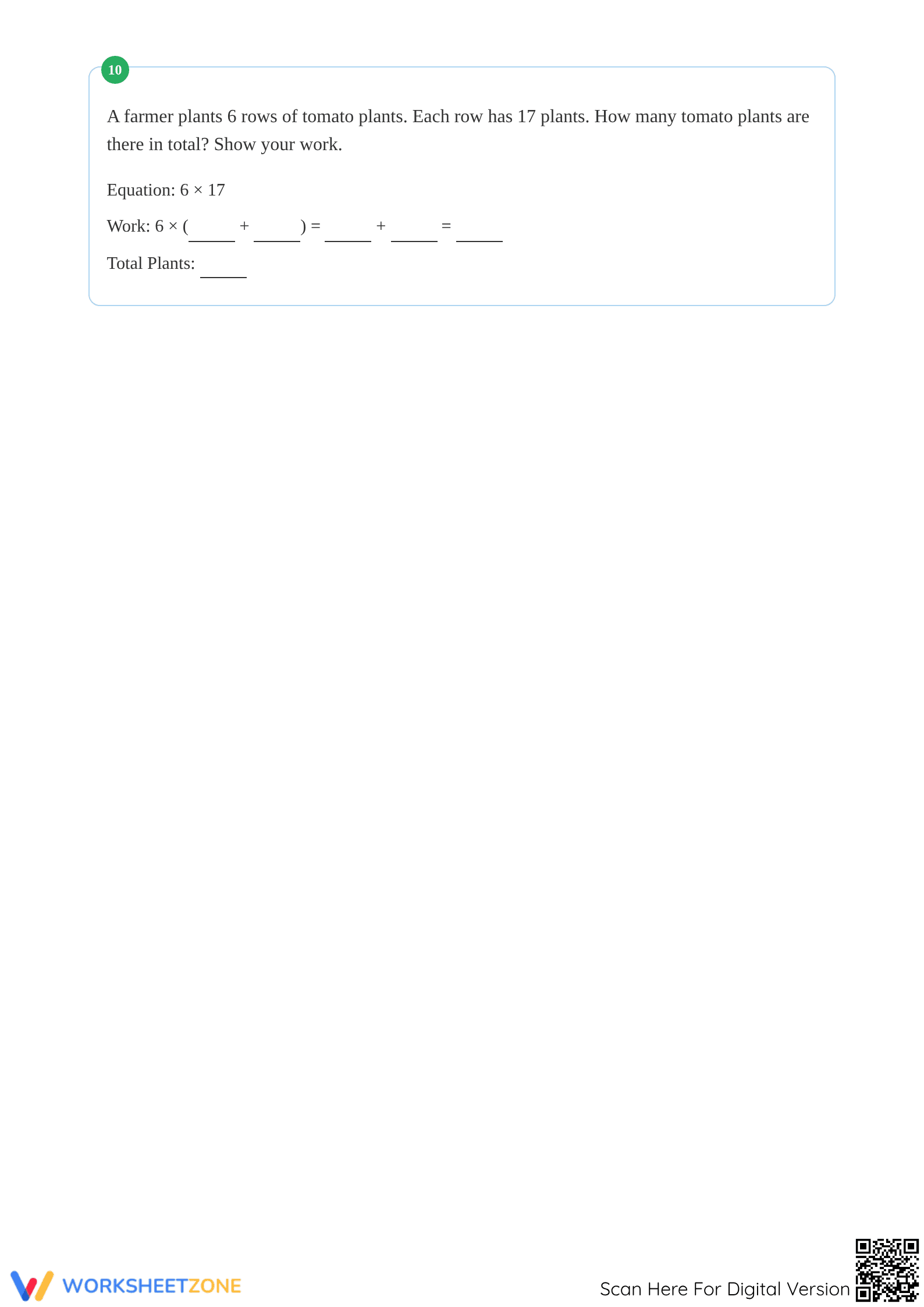
- Independent Problem Solving: Two multi-step word problems require students to identify the multiplication equation from a scenario and apply the learned strategy to find a solution. This gradual-release model follows the proven I Do, We Do, You Do instructional framework.
This resource is strictly aligned to CCSS.MATH.CONTENT.4.NBT.B.5, which requires students to multiply whole numbers using strategies based on place value and properties of operations. The worksheet specifically targets the distributive property. This standard code can be copied directly into lesson plans, IEP goals, or curriculum mapping tools to ensure instructional alignment.
How to Use This Worksheet
Use this worksheet as a primary teaching tool during a lesson on multiplication properties. After modeling the distributive property on a whiteboard, distribute the first page to check for understanding. During independent work, walk around and observe if students are correctly breaking the two-digit factor into (tens + ones); if a student struggles, point back to the worked example at the top of page one. This serves as an excellent formative assessment for identifying who needs additional place value intervention before moving to the standard algorithm.
This resource is designed for fourth-grade students but is also highly effective for third-grade enrichment or fifth-grade remediation. For students needing extra support, provide base-ten blocks alongside the worksheet to physically model the partial products. It pairs naturally with a math passage about arrays or an anchor chart displaying different multiplication strategies like area models and partial products.
Mathematical fluency is best achieved when students move from concrete representations to abstract strategy application. This worksheet facilitates that transition by providing clear structural cues that are slowly removed as the student progresses. By aligning with 4.NBT.B.5, this tool ensures students develop decomposition skills necessary for high-school algebra. The inclusion of word problems satisfies the demand for higher-order thinking, requiring learners to translate language into mathematical operations. This purposeful design supports long-term retention of multiplication facts and operational strategies. Research indicates partitioning strategies reduce cognitive load during multi-digit calculation, leading to higher accuracy and increased confidence in mathematics.


