


























Views
Downloads

Grade 3 9 Times Table — Printable No-Prep Worksheet
Paste this activity's link or code into your existing LMS (Google Classroom, Canvas, Teams, Schoology, Moodle, etc.).
Students can open and work on the activity right away, with no student login required.
You'll still be able to track student progress and results from your teacher account.
Mastering the 9 times table is a vital milestone for Grade 3 students, laying the groundwork for complex multiplication and division. This printable worksheet facilitates fluency through a three-step method: study, practice, and challenge. Students build confidence and automaticity in basic operations, ensuring readiness for higher-level math standards and assessments.
At a Glance
- Grade: 3 · Subject: Mathematics
- Standard:
CCSS.MATH.CONTENT.3.OA.C.7— Fluently multiply and divide within 100 using strategies such as relationships- Skill Focus: 9 Times Table Fluency
- Format: 2 pages · 24 problems · Answer key included · PDF
- Best For: Daily math drills and fact practice
- Time: 15–20 minutes
What's Inside
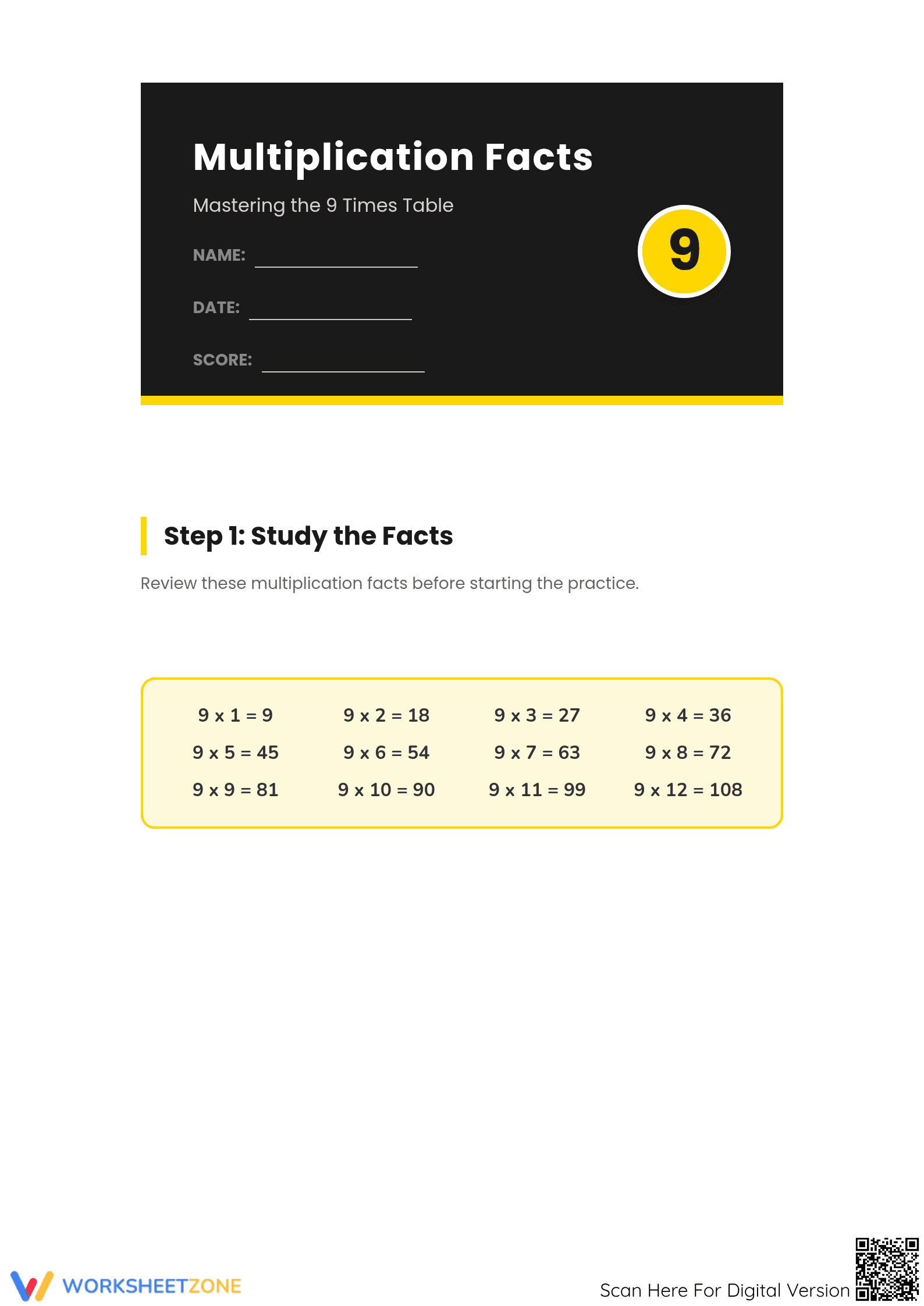
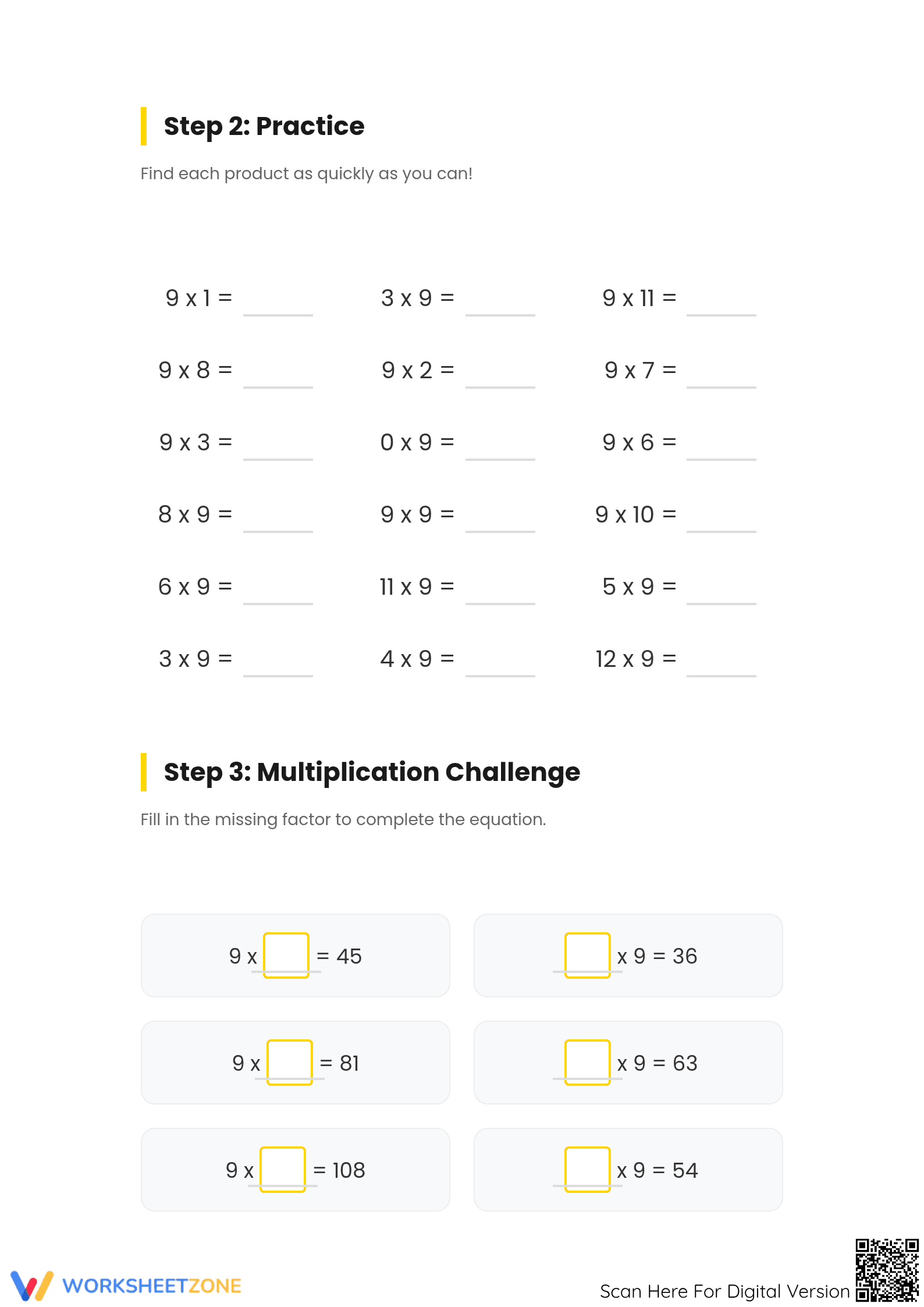
This two-page PDF is organized into three pedagogical stages. Page one includes a "Study the Facts" table ($9 \times 1$ to $9 \times 12$) as a reference. Page two features eighteen horizontal problems for practice, followed by a "Multiplication Challenge" with six missing-factor equations. This variety reinforces the relationship between factors and products. A full answer key is included for efficient checking and immediate feedback.
Zero-Prep Workflow
This resource ensures zero-prep efficiency. First, print the two-page document (30 seconds). Second, distribute it for morning work or independent drills (1 minute). Third, review using the provided key (5 minutes). Total preparation takes less than two minutes. It is ideal for substitute plans or fast-finisher activities where a structured, self-contained lesson is required to maximize student time on task.
Standards Alignment
Aligned to `CCSS.MATH.CONTENT.3.OA.C.7`, students fluently multiply within 100. It also supports 3.OA.A.4 by challenging learners to determine unknown numbers in equations. These tasks ensure students meet the end-of-year goal of knowing all single-digit products from memory. Both standard codes can be copied directly into lesson plans, IEP goals, or district curriculum mapping tools for easy documentation.
How to Use It
Use this as a timed drill to build automaticity or a formative assessment. Observe if students rely on the reference table or recall facts from memory. For the missing factor section, guide students to see the link between multiplication and division. The expected completion time is 15 minutes. It works well as a post-lesson wrap-up or a weekly maintenance task.
Who It's For
This is designed for Grade 3 students but works as an intervention for older learners needing fact reinforcement. It is ideal for homeschooling or tutoring. Pair this with a skip-counting passage or interactive chart for a multi-sensory approach. The clear layout accommodates diverse learners by providing a visual scaffold before asking for independent performance on basic 9s facts.
Fisher & Frey (2014) highlight the efficacy of the gradual release of responsibility model in mathematics, a framework utilized by this worksheet’s three-step progression. By scaffolding the 9 times table from study to independent challenge, the resource supports the cognitive development required for CCSS.MATH.CONTENT.3.OA.C.7 fluency. Automaticity in these facts is essential; NAEP data indicates that early mastery of single-digit multiplication correlates with success in middle school algebra and proportional reasoning. Moving from horizontal problems to finding the missing factor specifically builds the mental flexibility needed for higher-order mathematics. This PDF provides a structured environment for students to consolidate their understanding of multiplicative relationships. Educators can use this tool to bridge the gap between initial exposure and long-term retention, providing the evidence-based practice necessary for students to achieve mastery in core operational skills.


