


























Views
Downloads

Motion Word Problems Worksheet | Grade 9 Essential
Paste this activity's link or code into your existing LMS (Google Classroom, Canvas, Teams, Schoology, Moodle, etc.).
Students can open and work on the activity right away, with no student login required.
You'll still be able to track student progress and results from your teacher account.
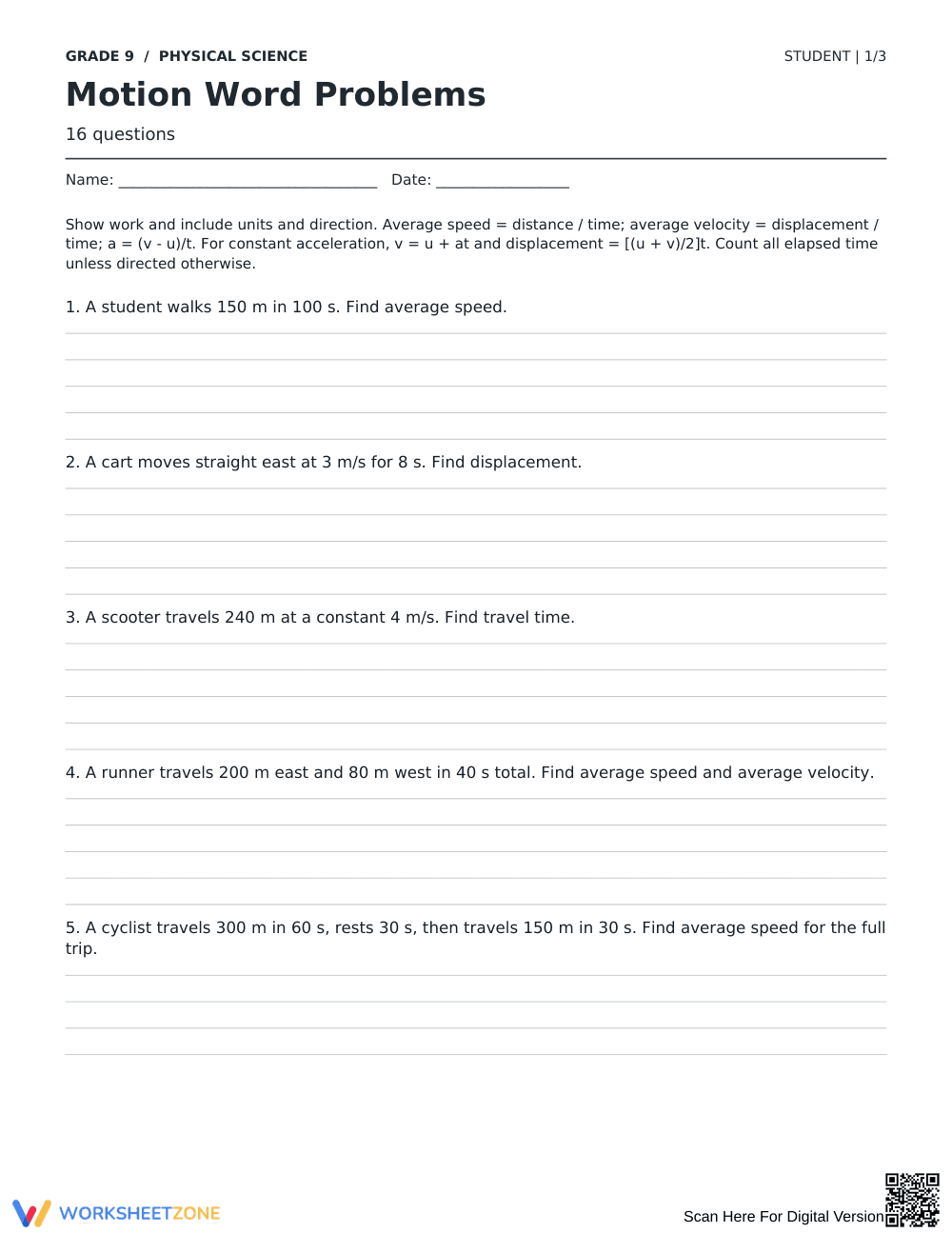
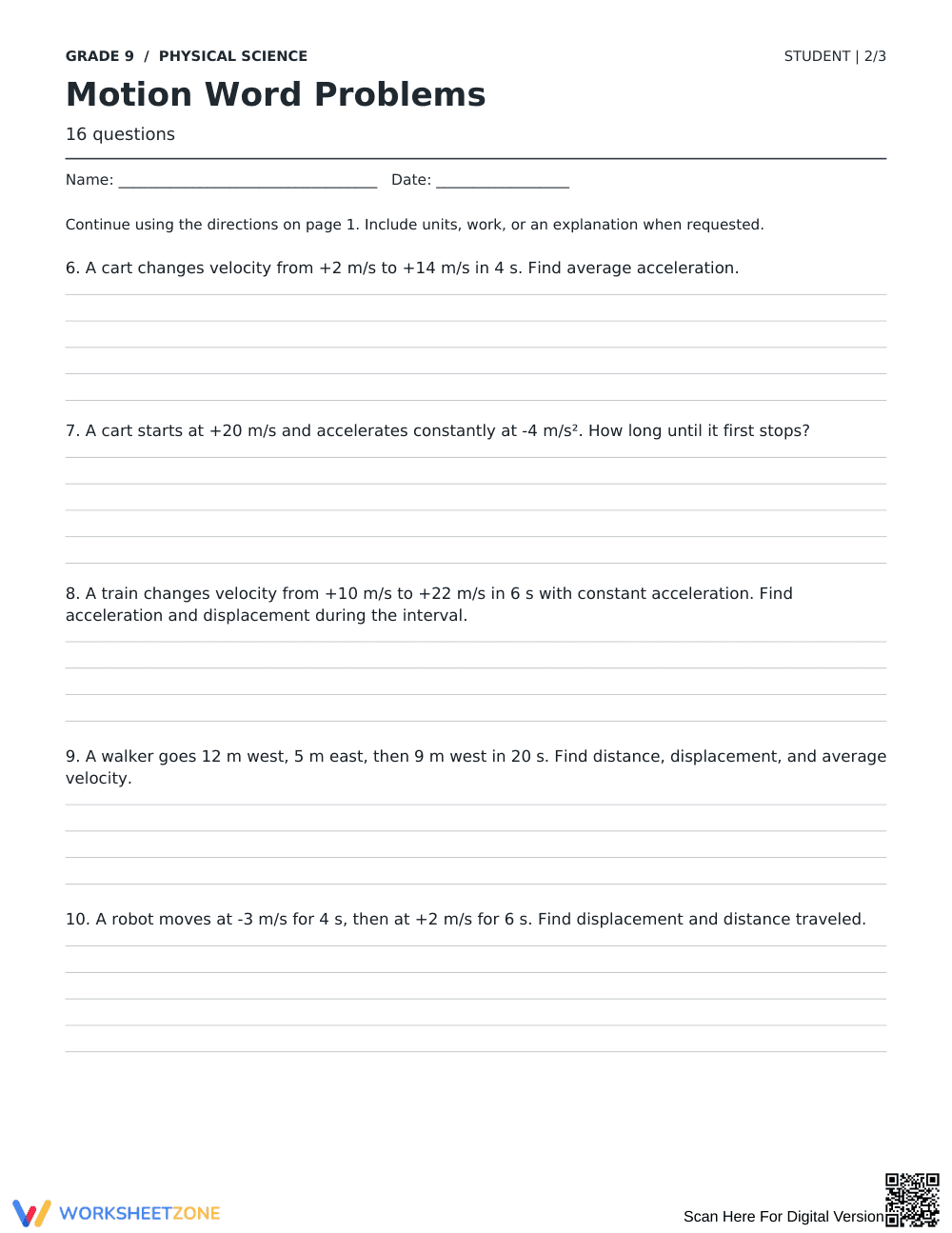
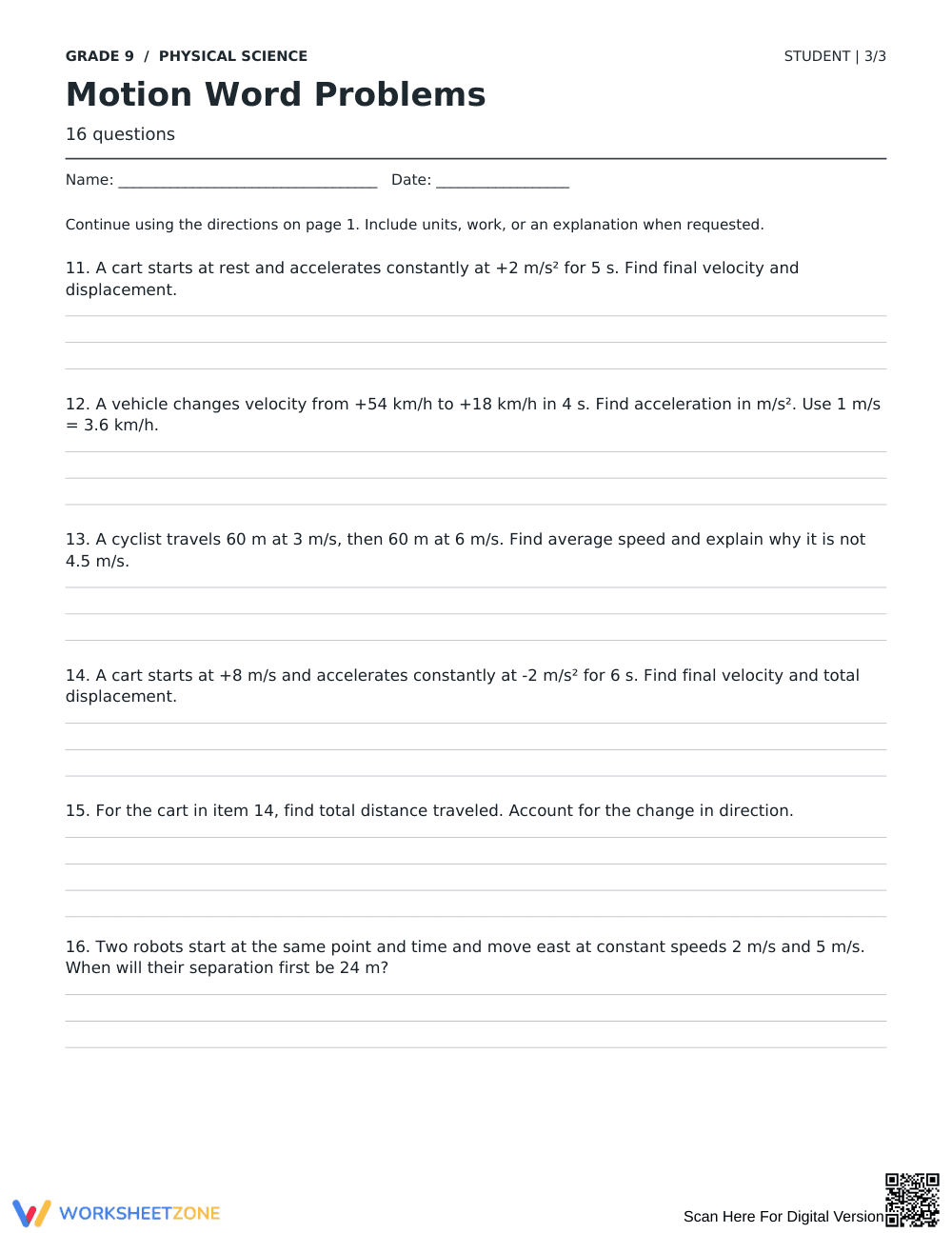
Master introductory kinematics with this physical science problem set. Students calculate speed, velocity, displacement, and constant acceleration across 16 real-world scenarios, reinforcing the relationships between distance, time, and direction. This worksheet prepares high school learners to represent motion quantitatively with precision.
At a Glance
- Grade: 9 · Subject: Physical Science
- Standard:
HS-PS2-1— Solve mathematical problems involving speed, velocity, displacement, and constant acceleration- Skill Focus: 1D Kinematics and motion calculations
- Format: 3 pages · 16 problems · Answer key included · PDF
- Best For: High school physics practice
- Time: 25–40 minutes
This 3-page worksheet provides 16 computational word problems with lined calculation space. A top-page formula reference guides equation selection for velocity and acceleration. The included 2-page answer key provides complete arithmetic, unit labels, direction vectors, and scoring suggestions.
Targeted Skill Progression
- Guided practice (Problems 1–5): One-step calculations of speed, displacement, and basic average velocity.
- Supported practice (Problems 6–10): Multi-step tasks distinguishing distance from displacement and computing negative acceleration.
- Independent practice (Problems 11–16): Complex scenarios involving metric unit conversions (km/h to m/s), time-weighted average speeds, and relative motion.
This sequence follows the gradual release of responsibility model, guiding students toward independent problem-solving.
Standards Alignment
This resource supports `HS-PS2-1`: Analyze data to support the claim that Newton's second law of motion describes the mathematical relationship among net force, mass, and acceleration. It builds foundational fluency in velocity and acceleration equations, while supporting CCSS.MATH.CONTENT.HSA.CED.A.4 through algebraic formula rearrangement. Both standard codes can be copied directly into lesson plans, IEP goals, or district curriculum mapping tools.
How to Use It
Use this worksheet following direct instruction on kinematics formulas as guided in-class practice or independent homework. During work time, check that students apply correct directional signs to displacement and include acceleration units (m/s²). Typical completion time is 25 to 40 minutes.
Who It's For
Designed for Grade 9 physical science students mastering motion equations. Support developing learners with the printed formula header, and challenge advanced students to sketch matching position-time graphs. Pair this resource with a velocity-time graphing lesson.
This physical science resource reinforces core mechanics skills aligned to standard HS-PS2-1 through 16 structured word problems targeting one-dimensional speed, velocity, displacement, and acceleration calculations. Grounded in the gradual release instructional framework documented by Fisher & Frey (2014), the problem set scaffolds student learning from direct variable substitution into multi-step kinematic analysis. Students learn to distinguish scalar quantities like total distance from vector quantities like directional displacement, while practicing unit conversions and algebraic isolation of variables. Detailed model answers and step-by-step arithmetic solutions enable educators to identify common misconceptions, including unweighted average speed errors and neglected directional signs. Ideal for ninth-grade physical science classrooms, introductory physics courses, and targeted intervention, this printable activity provides rigorous quantitative practice that builds necessary foundational competence for advanced Newtonian mechanics and force-motion modeling.


