




























Views
Downloads
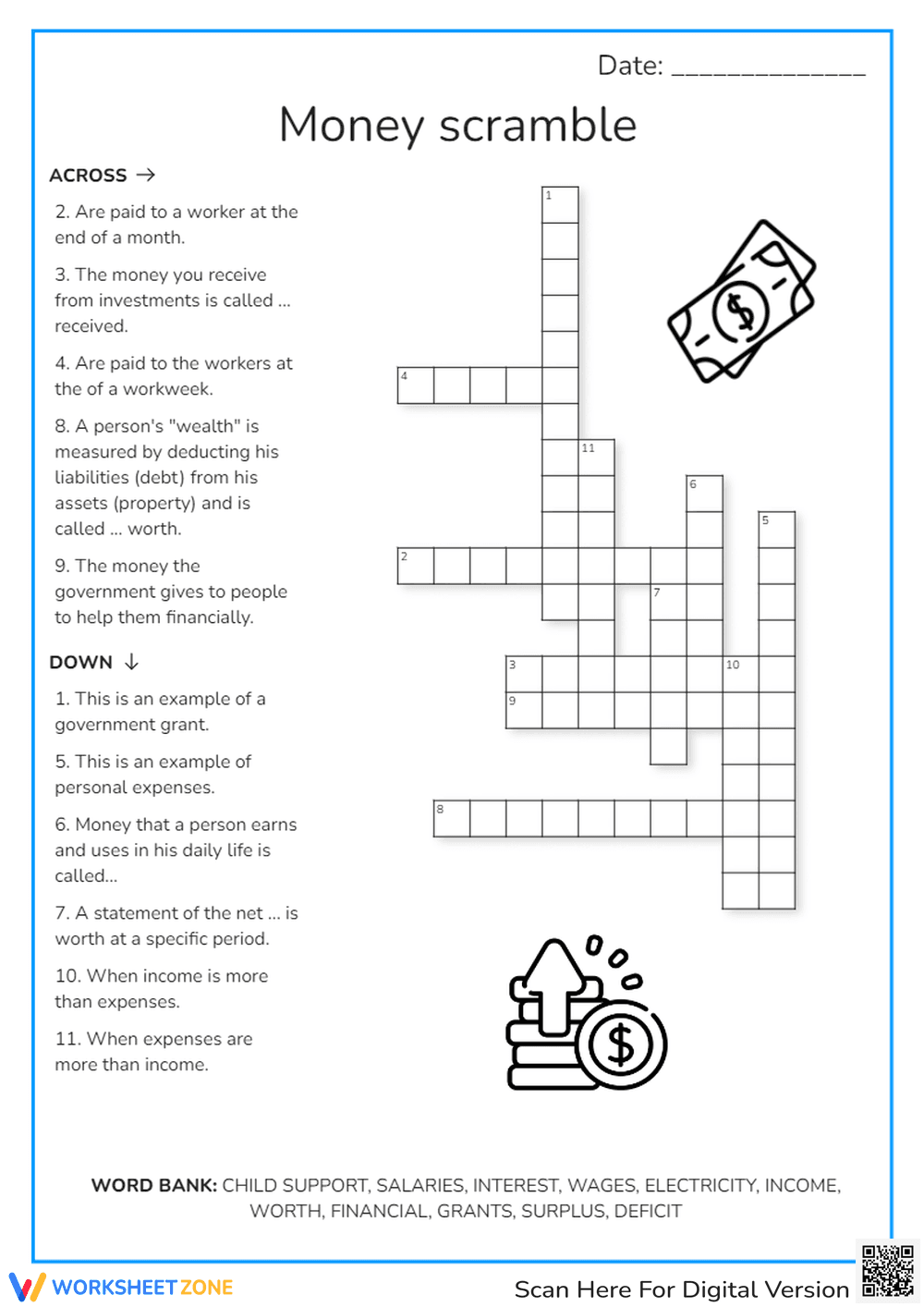

Grade 7 Money Scramble Crossword: Essential Finance

Paste this activity's link or code into your existing LMS (Google Classroom, Canvas, Teams, Schoology, Moodle, etc.).
Students can open and work on the activity right away, with no student login required.
You'll still be able to track student progress and results from your teacher account.
Mastering financial literacy begins with understanding the specific language of money management. This Grade 7 worksheet uses a crossword puzzle format to help students internalize 11 critical economic terms, including income, expenses, and net worth. By connecting definitions to a word bank, students build the confidence needed to discuss personal finance with precision.
At a Glance
- Grade: 7 · Subject: Financial Literacy
- Standard:
CCSS.ELA-LITERACY.L.7.6— Acquire and use accurately grade-appropriate general academic and domain-specific words and phrases- Skill Focus: Financial Vocabulary
- Format: 1 page · 11 problems · Answer key included · PDF
- Best For: Vocabulary reinforcement and bell-ringer activities
- Time: 15–20 minutes
Inside this printable PDF, you will find a professionally designed crossword puzzle featuring 11 clues that challenge students' understanding of financial concepts. The worksheet includes a helpful word bank containing terms such as Child Support, Salaries, Interest, and Deficit. This structure ensures that while the clues are rigorous, students have the necessary support to complete the task independently. A comprehensive answer key is provided.
Zero-Prep Workflow
- Print: Generate the single-page PDF in seconds for your entire class.
- Distribute: Hand out the worksheet as students enter the room or as a transition activity.
- Review: Use the included answer key to clarify misconceptions about complex terms like liabilities or grants.
This resource is an ideal solution for substitute folders or unexpected schedule changes.
Standards Alignment
This worksheet is primarily aligned with CCSS.ELA-LITERACY.L.7.6, which focuses on the acquisition and use of domain-specific words and phrases. By engaging with terms like assets and liabilities, students meet the requirement to use academic language accurately. It also supports Social Studies standards related to economic decision-making. Both standard codes can be copied directly into lesson plans, IEP goals, or district curriculum mapping tools.
How to Use It
Use this worksheet as a formative assessment at the end of a personal finance unit to gauge vocabulary retention. During the activity, circulate the room and observe if students can distinguish between wages and salaries, which provides a perfect opening for a brief direct instruction moment. The expected completion time is 15 to 20 minutes, making it a versatile tool for various instructional blocks.
Who It's For
This resource is tailored for Grade 7 students but is also highly effective for English Language Learners (ELL) and students in life skills programs who require explicit vocabulary support. It pairs naturally with an introductory lesson on budgeting or an anchor chart detailing the differences between assets and liabilities. The word bank provides essential differentiation for students who may struggle with retrieval.
The Money Scramble Crossword targets the acquisition of domain-specific vocabulary essential for economic independence. According to the RAND AIRS 2024 report, students who master financial terminology like surplus, deficit, and net worth in middle school demonstrate higher rates of financial literacy in adulthood. This worksheet aligns with CCSS.ELA-LITERACY.L.7.6 by requiring students to apply precise definitions to solve contextual clues. By utilizing a crossword format, the resource reduces cognitive load while reinforcing spelling and conceptual associations. Research from Fisher & Frey (2014) suggests that word-play activities serve as effective scaffolds for academic language, particularly when paired with a word bank to support diverse learners. This 11-task resource provides a structured pathway for Grade 7 students to internalize the language of personal finance, ensuring they can accurately describe economic relationships in both academic and real-world settings.


