


























Views
Downloads

Missing Digits Addition Worksheet | Grade 1 Math Printable
Paste this activity's link or code into your existing LMS (Google Classroom, Canvas, Teams, Schoology, Moodle, etc.).
Students can open and work on the activity right away, with no student login required.
You'll still be able to track student progress and results from your teacher account.
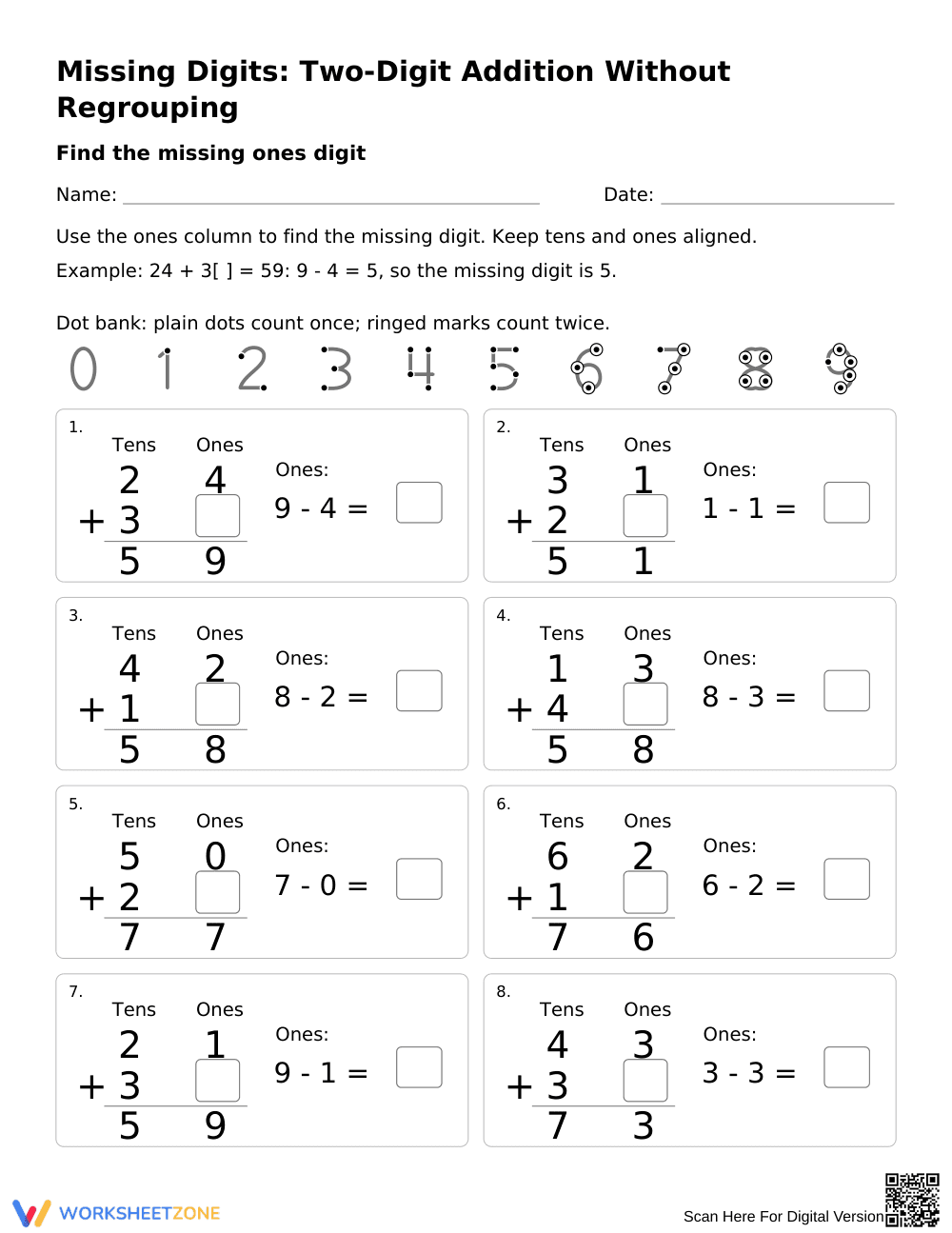
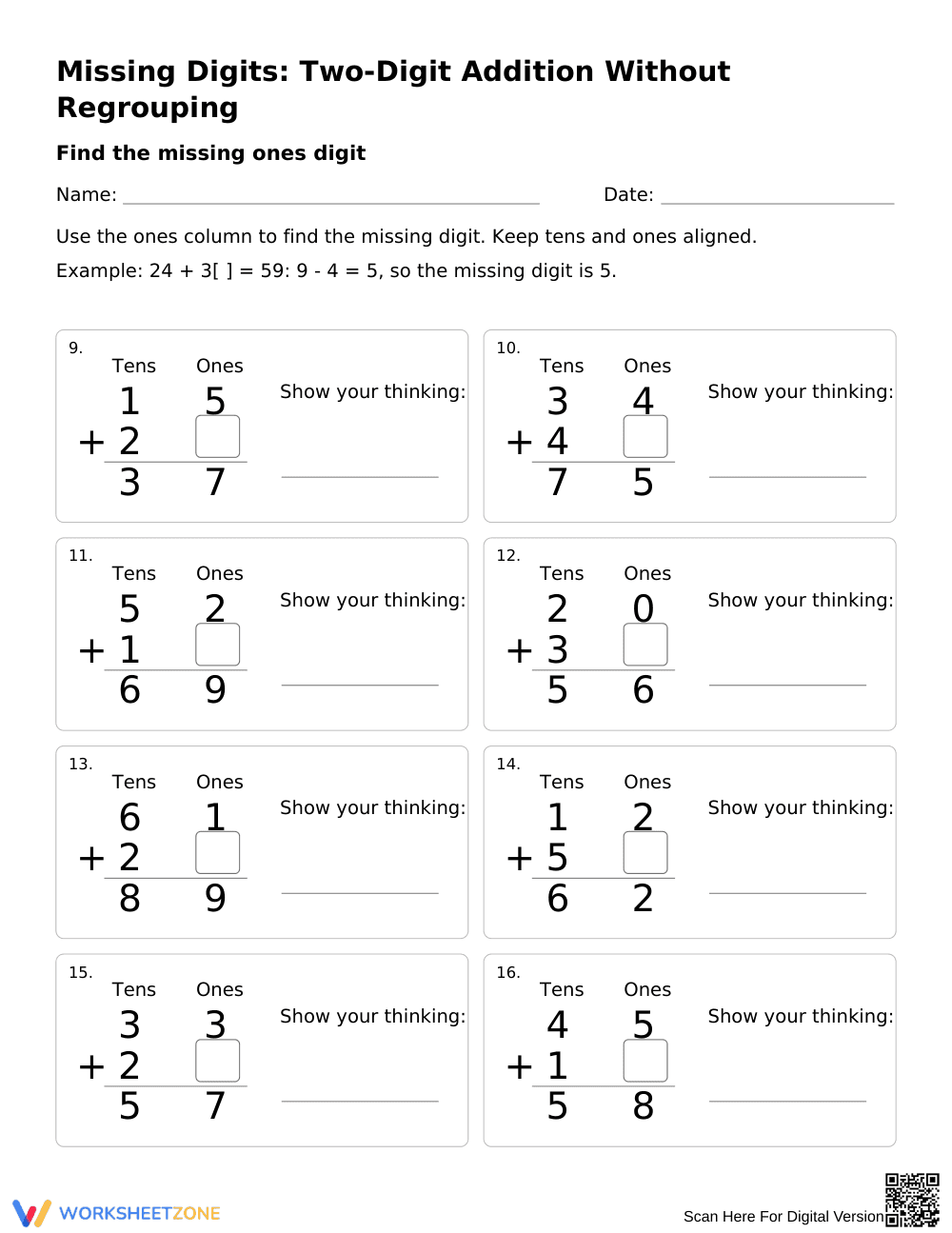
This missing digits worksheet helps first-grade students build algebraic thinking by finding the unknown ones digit in two-digit addition problems. By using subtraction as an inverse operation, learners develop a deeper understanding of place value and number relationships without the added complexity of regrouping.
At a Glance
- Grade: 1 · Subject: Math
- Standard:
CCSS.MATH.CONTENT.1.OA.D.8— Determine the unknown whole number in an equation- Skill Focus: Missing digits in addition
- Format: 2 pages · 16 problems · Answer key included · PDF
- Best For: Independent practice
- Time: 15–20 minutes
This resource includes two pages of focused student practice and a complete answer key. The first page features eight problems with a supportive dot bank and explicit subtraction equations to guide students in finding the missing addend. The second page removes the explicit equation, challenging students to show their thinking independently across eight additional problems. The included answer key provides all solutions for quick grading.
Skill Progression
- Guided practice: The first few problems introduce the concept using a visual dot bank, allowing students to count dots to find the difference.
- Supported practice: Page one provides the exact subtraction equation needed to solve for the missing ones digit, reinforcing the inverse relationship between addition and subtraction.
- Independent practice: Page two removes the provided equations, requiring students to apply the strategy and show their own thinking to find the missing digit.
This gradual-release approach ensures students confidently transition from I Do, to We Do, to You Do.
Standards Alignment
This worksheet is aligned to primary standard CCSS.MATH.CONTENT.1.OA.D.8: Determine the unknown whole number in an addition or subtraction equation relating three whole numbers. It also supports foundational place value understanding by keeping tens and ones aligned. Both standard codes can be copied directly into lesson plans, IEP goals, or district curriculum mapping tools.
How to Use It
Use this worksheet during independent math centers after direct instruction on inverse operations. It serves as an excellent formative assessment tool; teachers can observe whether students rely on the dot bank or fluently subtract to find the missing digit. The two-page format is designed to be completed in a single 15 to 20-minute session, making it ideal for morning work or a quick homework assignment.
Who It's For
This resource is designed for first-grade students mastering basic addition and subtraction relationships, as well as second graders needing review before tackling regrouping. The visual scaffolds make it highly accessible for visual learners and students receiving math intervention. Pair this worksheet with base-ten blocks or a place value anchor chart to further solidify the connection between the tens and ones columns.
Mastering the relationship between addition and subtraction is a critical milestone in early elementary mathematics. This worksheet specifically targets CCSS.MATH.CONTENT.1.OA.D.8, helping students determine the unknown whole number in an equation. According to a 2024 report by EdReports, instructional materials that explicitly connect addition and subtraction through inverse operations significantly improve students' algebraic reasoning and long-term mathematical fluency. By practicing with missing digits in a structured, vertical format, learners move beyond rote memorization and develop flexible problem-solving strategies. The gradual removal of visual scaffolds, such as the dot bank provided on the first page, encourages cognitive independence and builds mathematical confidence. Providing targeted, high-quality practice on these foundational skills ensures students are adequately prepared for more complex arithmetic, including multi-digit operations with regrouping in subsequent grade levels.


