


























Views
Plays


Food Microbiology Quiz | College Science Essential
Paste this activity's link or code into your existing LMS (Google Classroom, Canvas, Teams, Schoology, Moodle, etc.).
Students can open and work on the activity right away, with no student login required.
You'll still be able to track student progress and results from your teacher account.
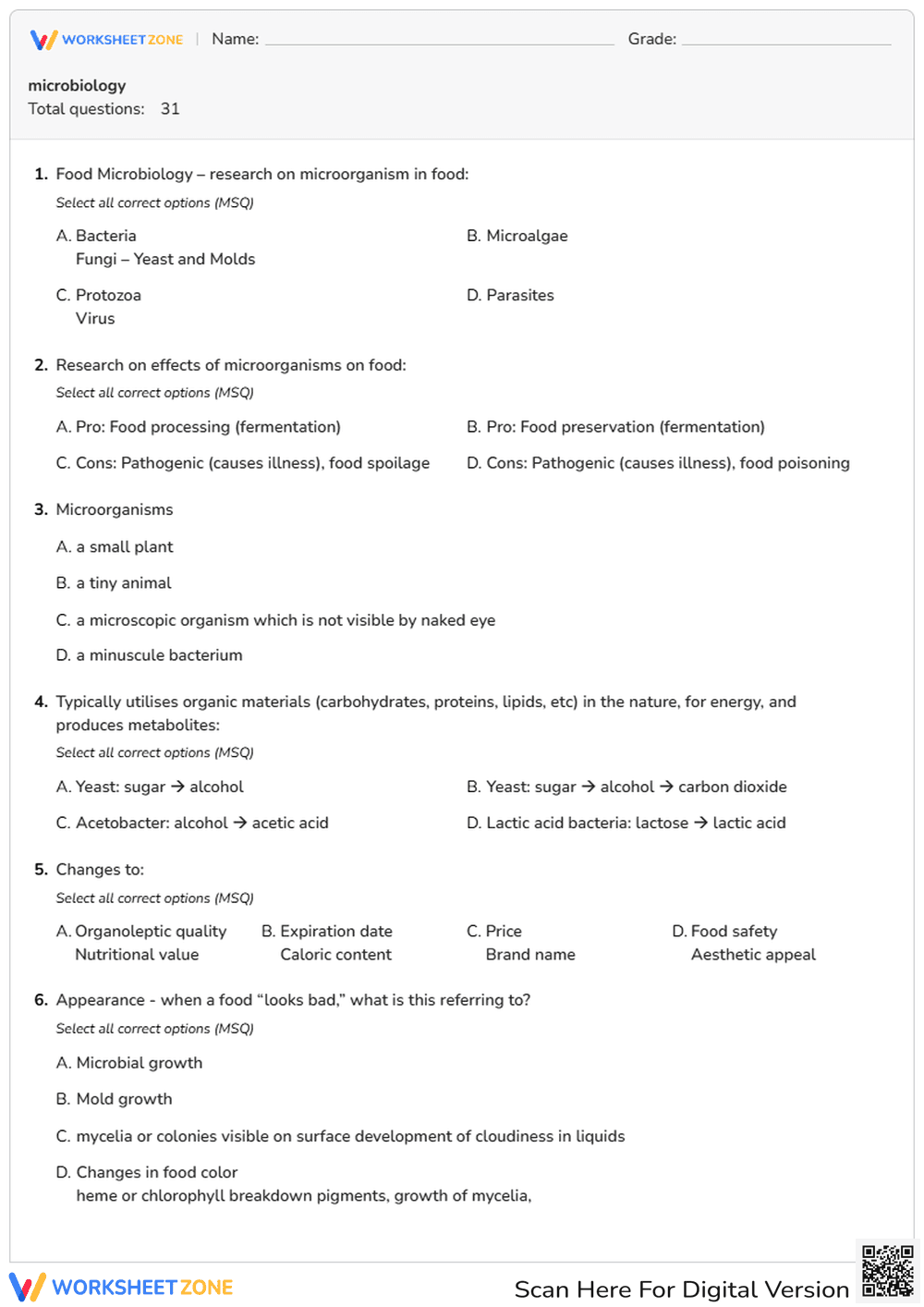
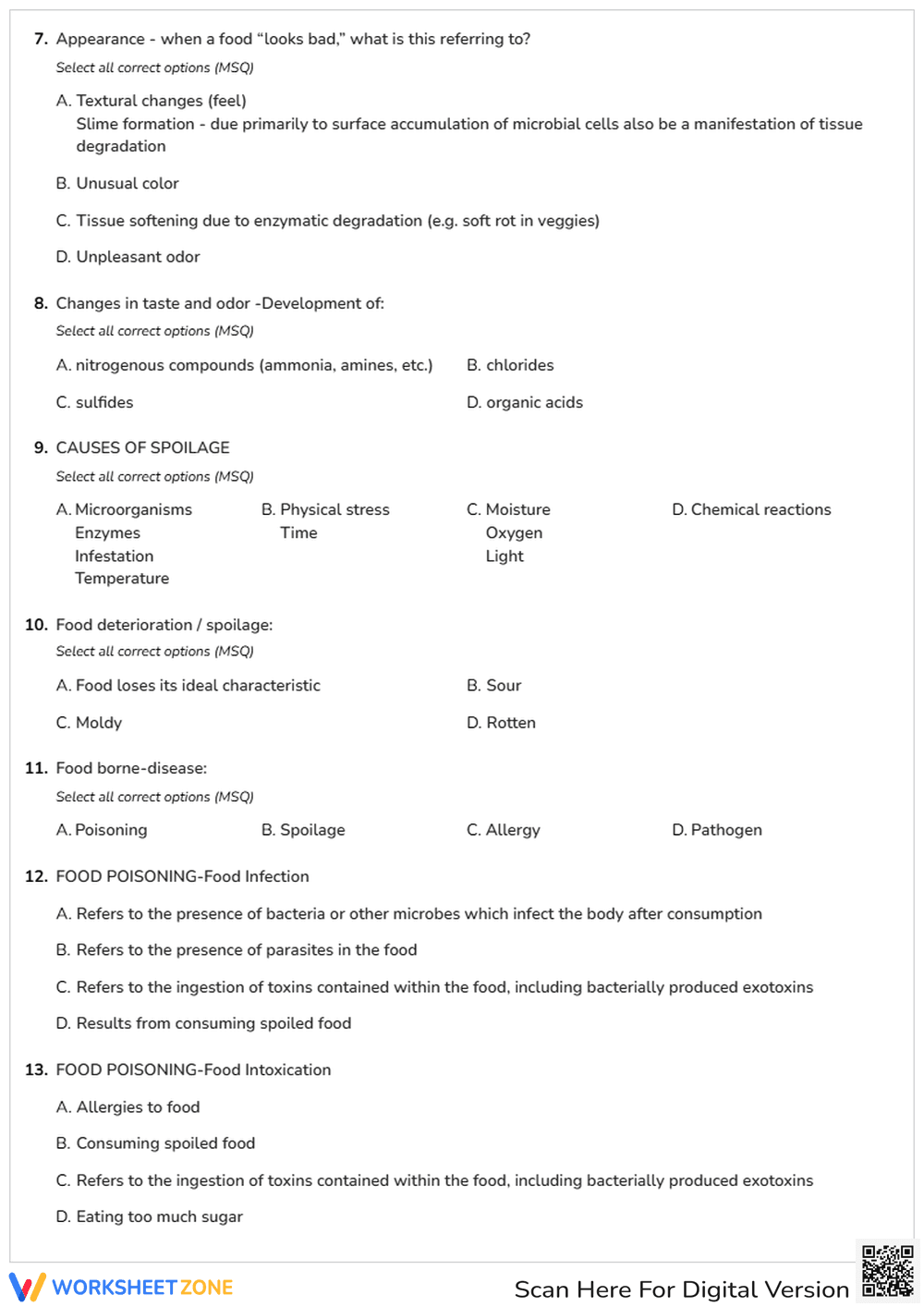
This microbiology assessment evaluates student understanding of microbial interactions within food systems, focusing on spoilage mechanisms and pathogenic risks. Students identify specific microorganisms, analyze the biochemical effects of fermentation versus decay, and distinguish between food infections and intoxications. It provides a rigorous check for undergraduate-level biology or food science courses.
At a Glance
- Grade: College · Subject: Microbiology
- Standard:
HS-LS1-2— Analyze how biological systems respond to environmental factors and maintain hierarchical organization- Skill Focus: Food Spoilage and Pathogens
- Format: 5 pages · 31 problems · Answer key included · PDF
- Best For: Midterm review or formative assessment
- Time: 45–60 minutes
The 5-page PDF contains 31 complex questions, many utilizing Multiple Selection Quiz (MSQ) formats to challenge higher-order thinking. It includes detailed sections on enzymatic degradation, mycotoxins like aflatoxin, and environmental growth factors such as pH and water activity. A comprehensive answer key is provided for immediate grading and feedback.
Skill Progression
- Guided Practice: Foundational questions define microorganisms and their roles in food processing, establishing a baseline for microbial identification.
- Supported Practice: Students analyze specific spoilage causes, including physical stress and chemical reactions, using structured multiple-selection prompts.
- Independent Practice: Learners evaluate advanced concepts like hurdle technology and enzymatic oxidation in fresh produce without external scaffolds.
This structure follows a gradual-release model to ensure students master basic terminology before tackling complex biochemical interactions.
Standards Alignment
Aligned to HS-LS1-2, this resource explores how biological systems interact with their environment. While designed for college-level rigor, it maps to the fundamental understanding of how microorganisms utilize organic materials for energy and produce metabolites. Both standard codes can be copied directly into lesson plans, IEP goals, or district curriculum mapping tools.
How to Use It
Use this as a summative quiz after a unit on food safety or as a collaborative group activity to spark discussion on food preservation. Instructors should observe student ability to differentiate between infection and intoxication during the review phase to identify common misconceptions. Expected completion time ranges from 45 to 60 minutes.
Who It's For
This resource is ideal for undergraduate microbiology students, food science majors, or vocational culinary programs. It pairs naturally with a lab on fermentation or a lecture on industrial food preservation. The MSQ format provides built-in differentiation by requiring students to identify all correct variables rather than a single answer.
According to research by Fisher & Frey (2014) on the gradual release of responsibility, structured assessments that move from definitional knowledge to complex system analysis are critical for long-term retention in the sciences. This worksheet applies these principles by requiring students to synthesize information about microbial growth factors and biochemical outcomes. By utilizing the HS-LS1-2 standard framework, the material ensures that students are not just memorizing facts but are understanding the underlying biological processes that govern food safety. Analysis of similar high-stakes science assessments suggests that exposure to multiple-selection formats improves student performance on professional certification exams. This 31-question set provides the necessary breadth to cover essential microbiology competencies while maintaining a focus on practical application in the food industry. It serves as a robust tool for measuring mastery in complex biological environments.


