































Metric System of Measurement: Complete Assessment

Paste this activity's link or code into your existing LMS (Google Classroom, Canvas, Teams, Schoology, Moodle, etc.).
Students can open and work on the activity right away, with no student login required.
You'll still be able to track student progress and results from your teacher account.
This Grade 4 metric measurement cumulative assessment evaluates student understanding of units of length, mass, and liquid volume. Across 25 structured problems, students demonstrate procedural fluency converting metric units, interpret visual measurement scales, and apply mathematical reasoning to solve multi-step real-world problems.
At a Glance
- Grade: 4 · Subject: Math
- Standard:
4.MD.A.1— Express larger measurement units in terms of smaller metric units- Skill Focus: Metric units, conversions, scale reading, and reasoning
- Format: 3 pages · 25 problems · Answer key included · PDF
- Best For: End-of-unit cumulative assessment
- Time: 40–50 minutes
What's Inside
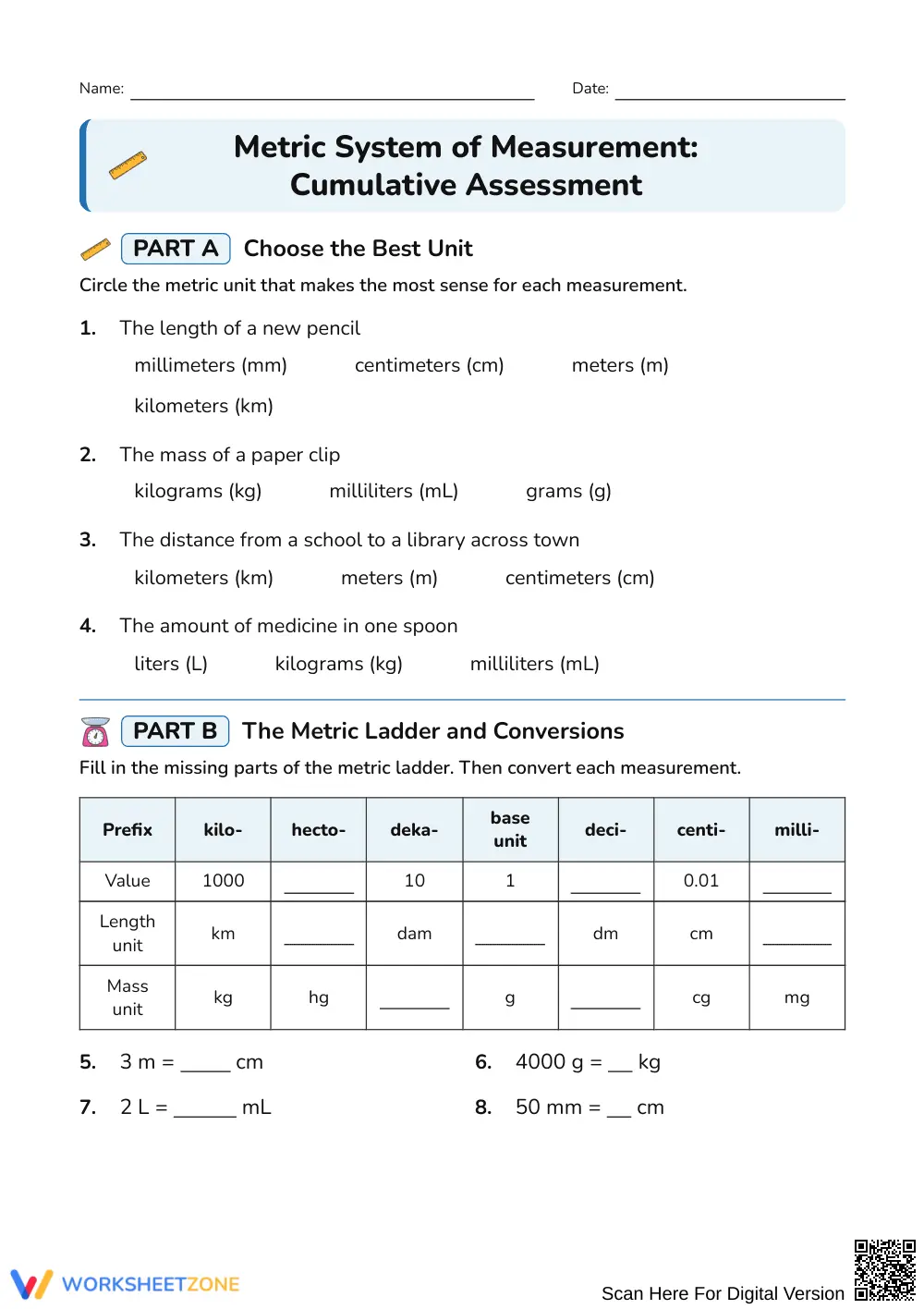
This 3-page assessment features multiple-choice, table completion, scale-reading, and constructed-response tasks. Part A targets benchmark units, Part B provides a metric prefix ladder with conversion drills, Part C includes visual ruler and beaker scales, and Part D presents multi-step word problems with explanation lines. A complete 3-page answer key is included.
Skill Progression
- Guided practice (Part A & Part B, 8 items): Students identify benchmark units from given options and complete a metric prefix ladder reinforcing base-ten relationships.
- Supported practice (Part B & Part C, 8 items): Learners execute direct unit conversions and read visual measurement scales on illustrated rulers and beakers.
- Independent practice (Part D, 5 items): Students solve multi-step word problems, analyze calculation errors, and explain mathematical reasoning.
This structure follows the gradual-release model, guiding students from foundational recall to independent problem-solving mastery.
Standards Alignment
The primary standard addressed is `4.MD.A.1`: Know relative sizes of measurement units within one system of units (km, m, cm; kg, g; L, mL) and express larger units in terms of smaller units. The assessment also supports 4.MD.A.2 through measurement word problems involving distances, liquid volumes, and masses. Both standard codes can be copied directly into lesson plans, IEP goals, or district curriculum mapping tools.
How to Use It
Administer this assessment after direct instruction on metric prefixes to evaluate mastery at the conclusion of your measurement unit. For formative assessment during testing, check whether students refer to the metric ladder or rely on mental multiplication when converting units. Expect students to complete the 25 items in 40 to 50 minutes.
Who It's For
This resource is designed for Grade 4 general math classes, intervention groups, and test preparation. Differentiate by providing highlighters for multi-step prompts or allowing extra time for written explanations. Pair this assessment naturally with a classroom metric conversion anchor chart.
Effective measurement instruction requires a purposeful balance of procedural fluency, visual representation, and constructed reasoning. According to Fisher & Frey (2014), structured instructional progressions that move intentionally from foundational concept identification to independent problem solving significantly strengthen long-term mathematical retention. Aligned directly to standard 4.MD.A.1, this cumulative assessment operationalizes this instructional framework across 25 focused tasks. Grade 4 students begin by demonstrating recognition of relative metric units for length, mass, and liquid volume before executing two-step conversions using place-value structures. By integrating visual scale interpretation alongside constructed-response error analysis, the assessment ensures learners do not merely apply algorithmic conversion rules, but deeply comprehend the base-ten magnitude differences separating metric prefixes. Educators gain precise diagnostic data regarding student readiness for complex measurement problem solving, making this resource an indispensable instrument for standards-based documentation, intervention planning, and curriculum-aligned progress monitoring.


