


























Views
Downloads

Metals, Nonmetals & Metalloids Worksheet | Grade 8 Ready
Paste this activity's link or code into your existing LMS (Google Classroom, Canvas, Teams, Schoology, Moodle, etc.).
Students can open and work on the activity right away, with no student login required.
You'll still be able to track student progress and results from your teacher account.
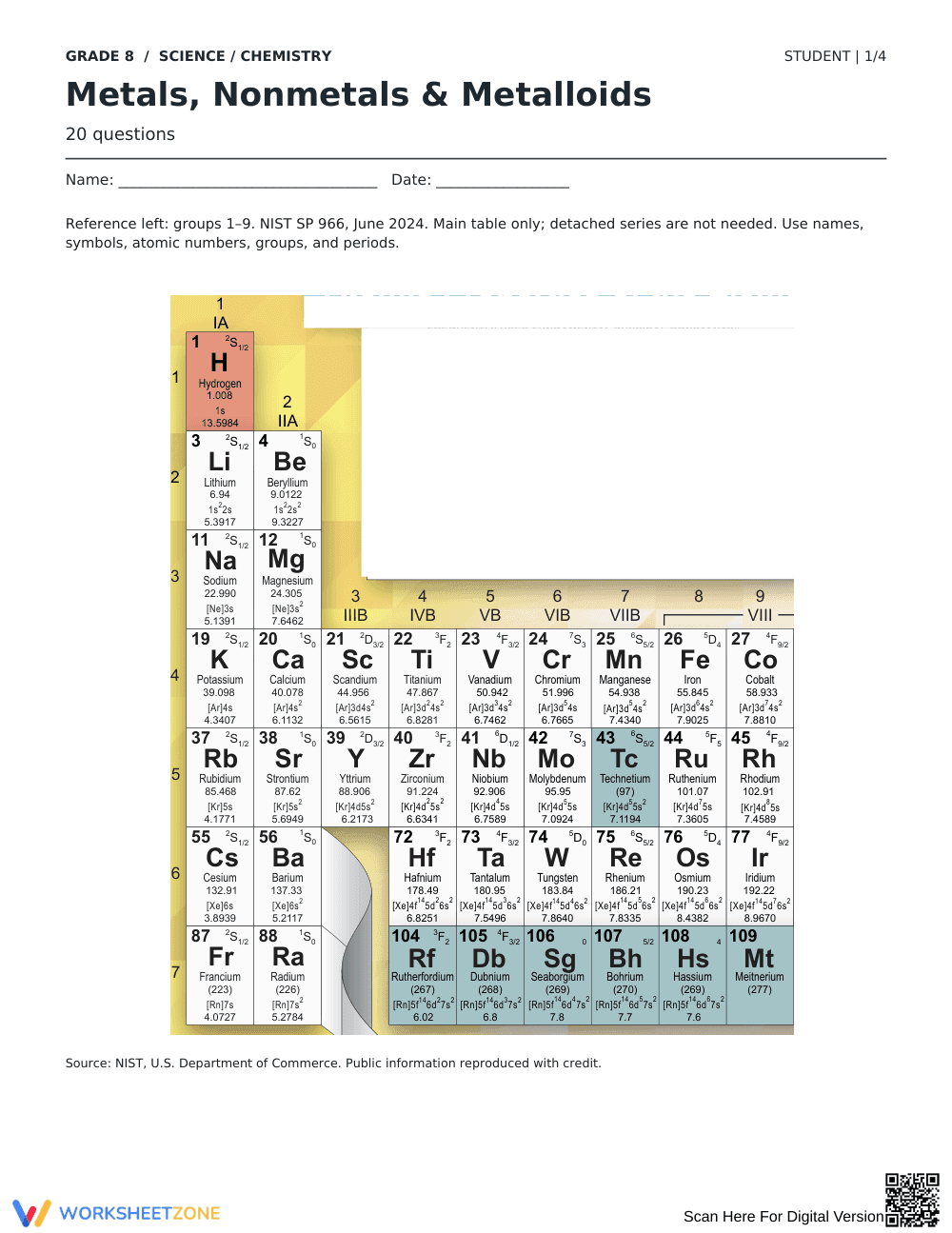
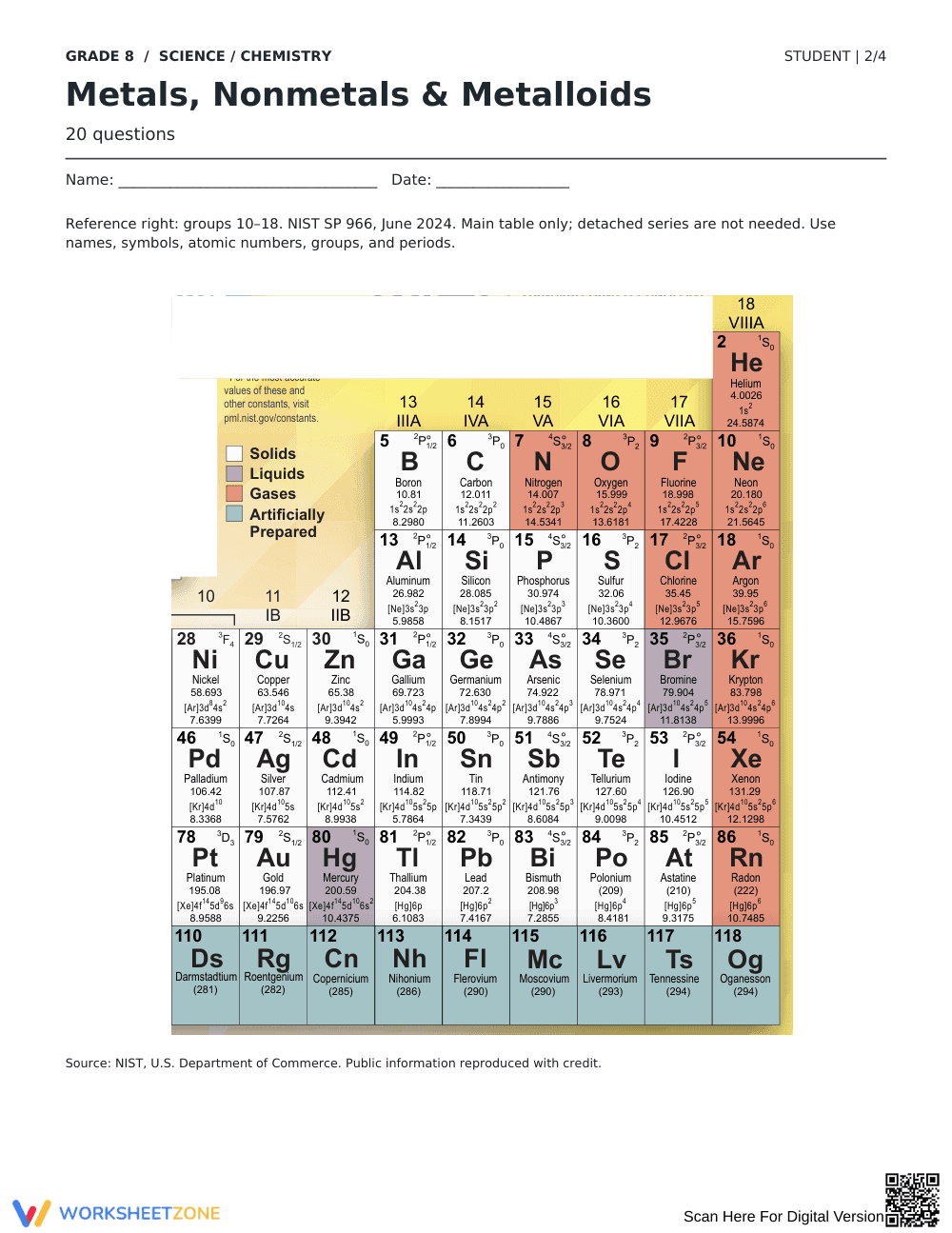
This physical science worksheet equips Grade 8 students to identify and classify elements as metals, nonmetals, or metalloids using periodic table trends. Students practice locating elements by name, chemical symbol, and atomic number, building foundational chemistry literacy essential for modeling atomic structure and predicting chemical behavior.
At a Glance
- Grade: 8 · Subject: Science (Chemistry)
- Standard:
MS-PS1-1— Classify elements and use periodic properties to understand atomic structure and matter- Skill Focus: Element classification and periodic table navigation
- Format: 4 student pages · 20 problems · Answer key included · PDF
- Best For: Independent practice or small-group chemistry remediation
- Time: 25–35 minutes
The resource includes two pages of high-resolution NIST reference charts displaying groups 1 through 18, followed by two pages of structured student questions. Across 20 distinct prompts, learners locate specific elements, deduce classifications using step-by-step rules, and distinguish between physical states of matter and elemental categories. A complete two-page answer key provides clear solutions and scoring criteria for quick grading.
Skill Progression
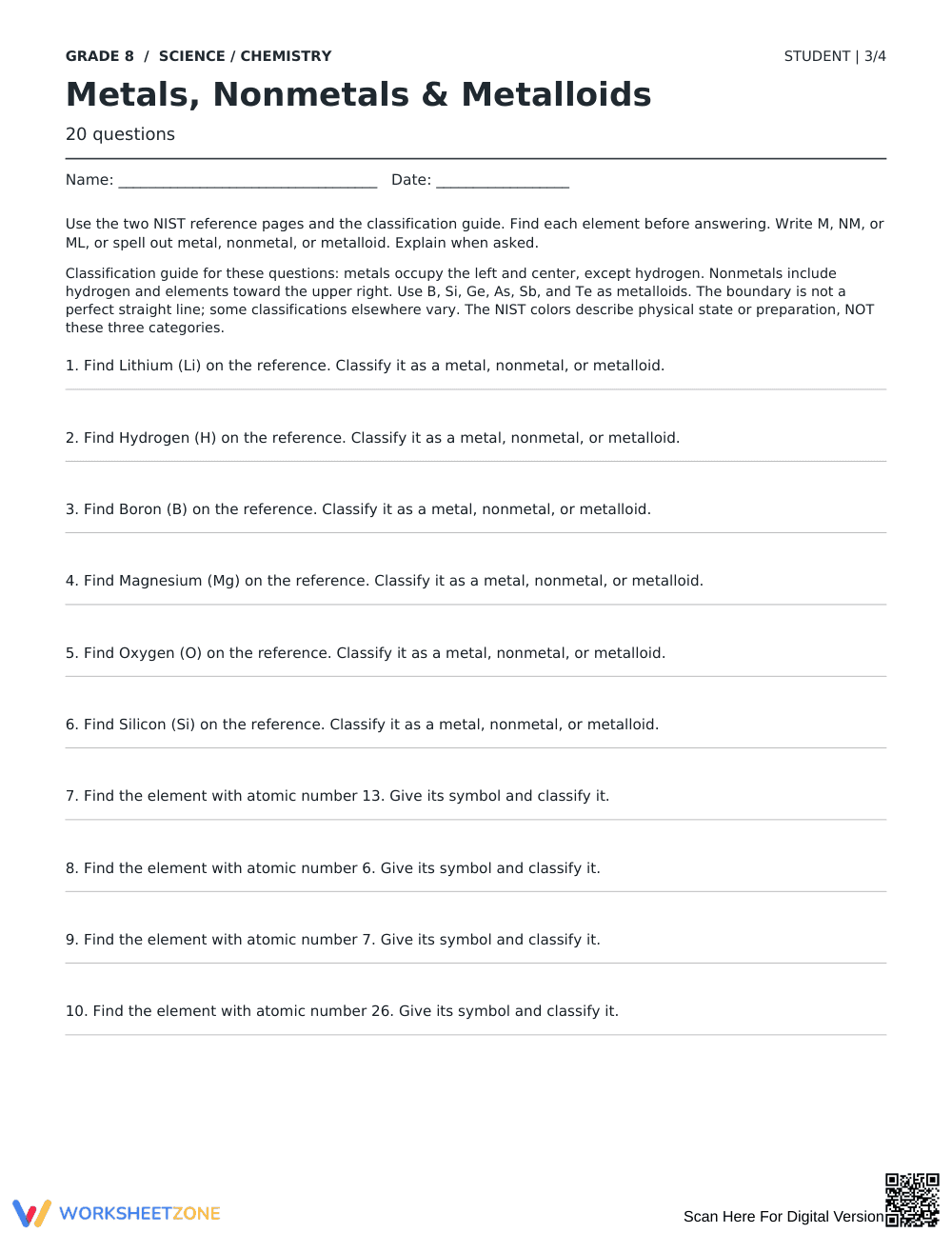
- Guided practice (Questions 1–6): Direct elemental lookups by common name and symbol to establish baseline familiarity with metals, metalloids, and nonmetals.
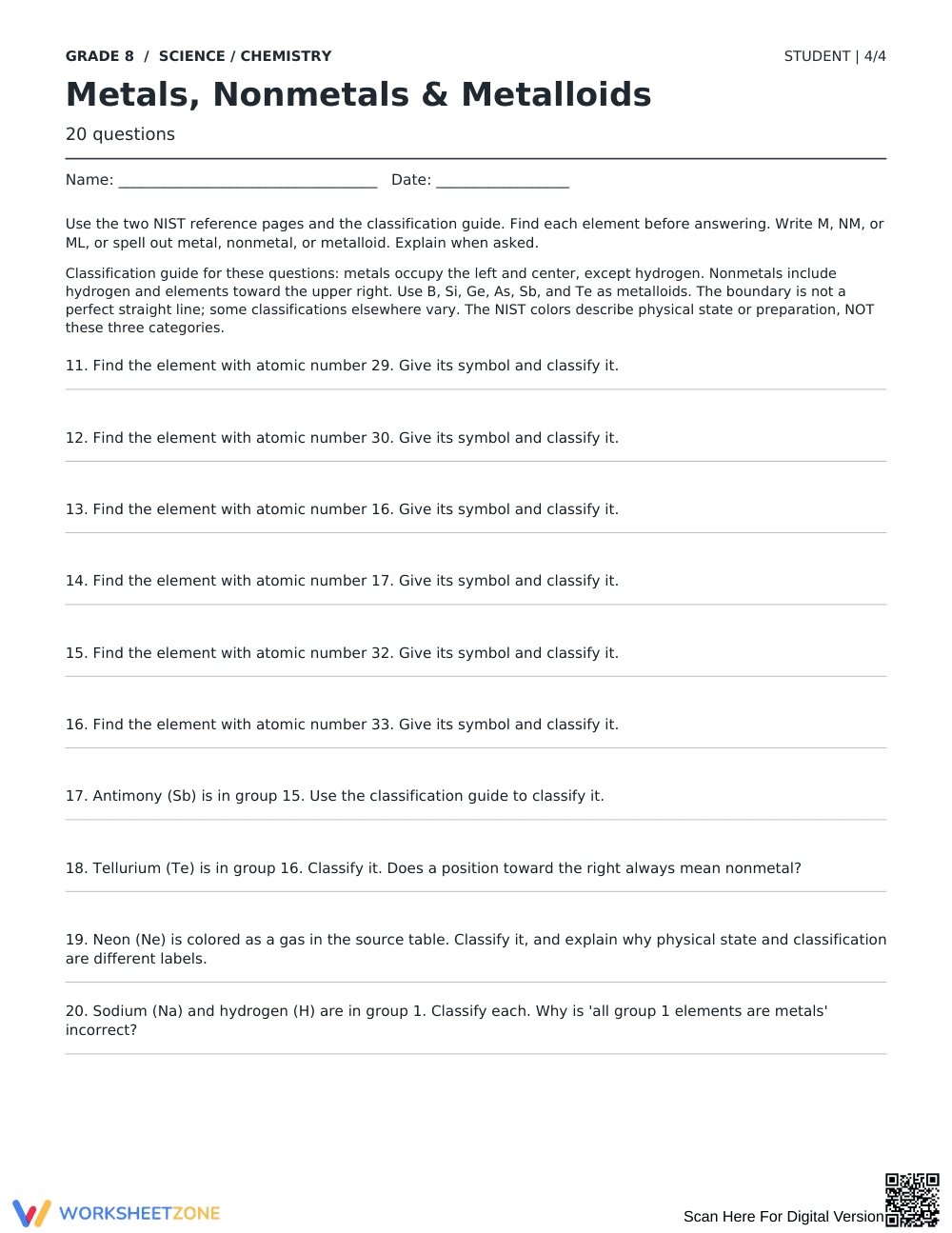
- Supported practice (Questions 7–16): Identification by atomic number requiring multi-step reference scanning before recording symbols and classifications.
- Independent practice (Questions 17–20): Critical analysis tasks exploring boundary metalloids, state-of-matter distinctions, and Group 1 exceptions like hydrogen.
This structured sequence reflects the gradual release of responsibility model, ensuring students master basic element retrieval before analyzing periodic anomalies independently.
Standards Alignment
This worksheet aligns directly to `MS-PS1-1`: Develop models to describe the atomic composition of simple molecules and extended structures. It builds prerequisite mastery of matter organization while supporting high school transition standard `HS-PS1-1` regarding periodic table patterns. Both standard codes can be copied directly into lesson plans, IEP goals, or district curriculum mapping tools.
How to Use It
Deploy this worksheet after direct instruction on the periodic table of elements. During class, monitor how students approach questions 18 through 20 to check whether they conflate physical states like gases with elemental categories. The activity takes approximately 25 to 35 minutes and works well for partner collaboration or independent seatwork.
Who It's For
Designed for Grade 8 physical science and introductory chemistry classes, this resource accommodates general education students, English language learners using visual periodic cues, and intervention groups. Pair this printable with a hands-on element sample sorting lab or a periodic table anchor chart to reinforce physical properties.
Mastery of element classification under standard MS-PS1-1 establishes the foundational conceptual schema students require to interpret chemical formulas, periodic trends, and molecular interactions. According to research on structured instructional design by Fisher & Frey (2014), purposeful scaffolding that moves systematically from direct retrieval of element names to the analytical evaluation of periodic exceptions substantially enhances long-term retention of specialized science vocabulary. By actively navigating authentic NIST periodic table reference charts across 20 targeted classroom tasks, Grade 8 learners bridge abstract textbook definitions of metals, nonmetals, and metalloids with concrete atomic data. This rigorous practice helps students resolve common misconceptions regarding physical states of matter versus elemental categories, directly reinforcing analytical inquiry skills and preparing middle school learners for high school chemistry standards. The structured workflow ensures equitable access for all emerging science students.


