


























Views
Downloads
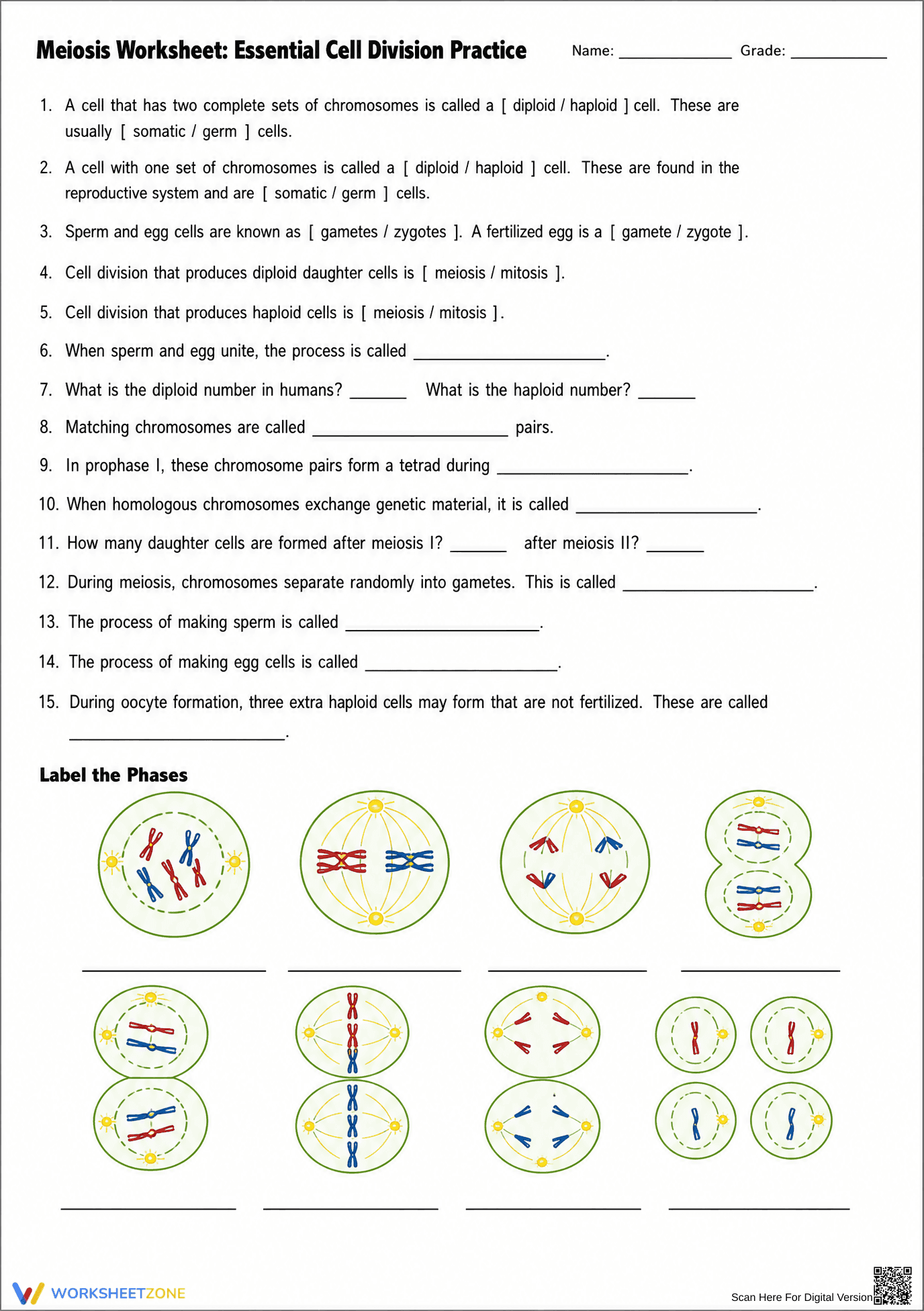

Essential Meiosis Worksheet | Grade 9-10 Biology
Paste this activity's link or code into your existing LMS (Google Classroom, Canvas, Teams, Schoology, Moodle, etc.).
Students can open and work on the activity right away, with no student login required.
You'll still be able to track student progress and results from your teacher account.
This Grade 9-10 biology worksheet provides a comprehensive review of meiosis, ensuring students can distinguish between haploid and diploid cells while identifying specific phases of division. By completing these structured activities, learners build the foundational knowledge necessary to understand genetic variation and inheritance patterns in complex organisms.
At a Glance
- Grade: 9-10 · Subject: Biology
- Standard:
HS-LS3-2— Explain how meiosis results in inheritable genetic variation through new combinations- Skill Focus: Meiosis Phases & Terminology
- Format: 1 page · 23 tasks · Answer key included · PDF
- Best For: Independent practice or formative assessment
- Time: 20–30 minutes
What's Inside
This single-page PDF contains 15 rigorous fill-in-the-blank and multiple-choice questions covering essential vocabulary such as homologous chromosomes, tetrads, and crossing over. The second half of the worksheet features 8 high-quality cell diagrams representing the stages of Meiosis I and Meiosis II, requiring students to visually identify and label each phase accurately.
Zero-Prep Workflow
- Print: Generate copies of the single-page document in seconds.
- Distribute: Hand out to students as a quiet-work activity, homework assignment, or partner review session.
- Review: Use the included answer key to conduct a rapid whole-class check or peer-grading session in under five minutes.
This streamlined workflow makes it an ideal resource for emergency sub plans or end-of-unit reviews where teacher prep time is limited.
Standards Alignment
This resource is specifically aligned to HS-LS3-2, which requires students to demonstrate how meiosis leads to genetic diversity. It covers the mechanics of chromosome segregation and the distinction between somatic and germ cells. Both standard codes can be copied directly into lesson plans, IEP goals, or district curriculum mapping tools.
How to Use It
Use this worksheet as a formative assessment immediately following a lecture on cell division to identify misconceptions about chromosome counts. Alternatively, assign it as a pre-lab activity before students observe prepared slides of onion root tips or lily anthers under a microscope. Expected completion typically takes 20 to 30 minutes depending on prior knowledge.
Who It's For
This activity is designed for high school biology students, including those in Honors or AP tracks who need a quick refresher on terminology. It pairs naturally with a digital animation of crossing over or a physical modeling activity using pipe cleaners to represent homologous pairs.
According to the RAND AIRS 2024 report on secondary science instruction, high-quality visual aids and labeling tasks significantly improve the retention of complex biological processes like meiosis. This worksheet addresses the HS-LS3-2 standard by requiring students to synthesize their understanding of haploid and diploid states with the physical movement of chromosomes across 23 distinct tasks. Research from Fisher & Frey (2014) suggests that the gradual release of responsibility, supported by clear diagrams and vocabulary scaffolds, allows students to move from basic identification to higher-order analysis of genetic variation. By providing a structured environment for identifying phases and defining germ cell characteristics, this resource ensures that 9th and 10th-grade learners meet the rigorous demands of modern science frameworks while maintaining high engagement through visual learning.


