































Measurement Conversion: Complete Worked Examples

Paste this activity's link or code into your existing LMS (Google Classroom, Canvas, Teams, Schoology, Moodle, etc.).
Students can open and work on the activity right away, with no student login required.
You'll still be able to track student progress and results from your teacher account.
This Grade 5 math worksheet builds procedural fluency and conceptual understanding in converting measurement units within customary and metric systems. Students examine step-by-step worked examples, explain the underlying mathematical reasoning for multiplying or dividing, and apply those principles across 15 structured practice problems to calculate accurate measurement conversions independently.
At a Glance
- Grade: Grade 5 · Subject: Math
- Standard:
5.MD.A.1— Convert different-sized standard measurement units within a given measurement system.- Skill Focus: Measurement conversion steps with worked reasoning examples
- Format: 2 student pages · 15 total problems · Answer key included · PDF format
- Best For: Independent math practice, skills remediation, and targeted review
- Time: 25–35 instructional minutes
What's Inside
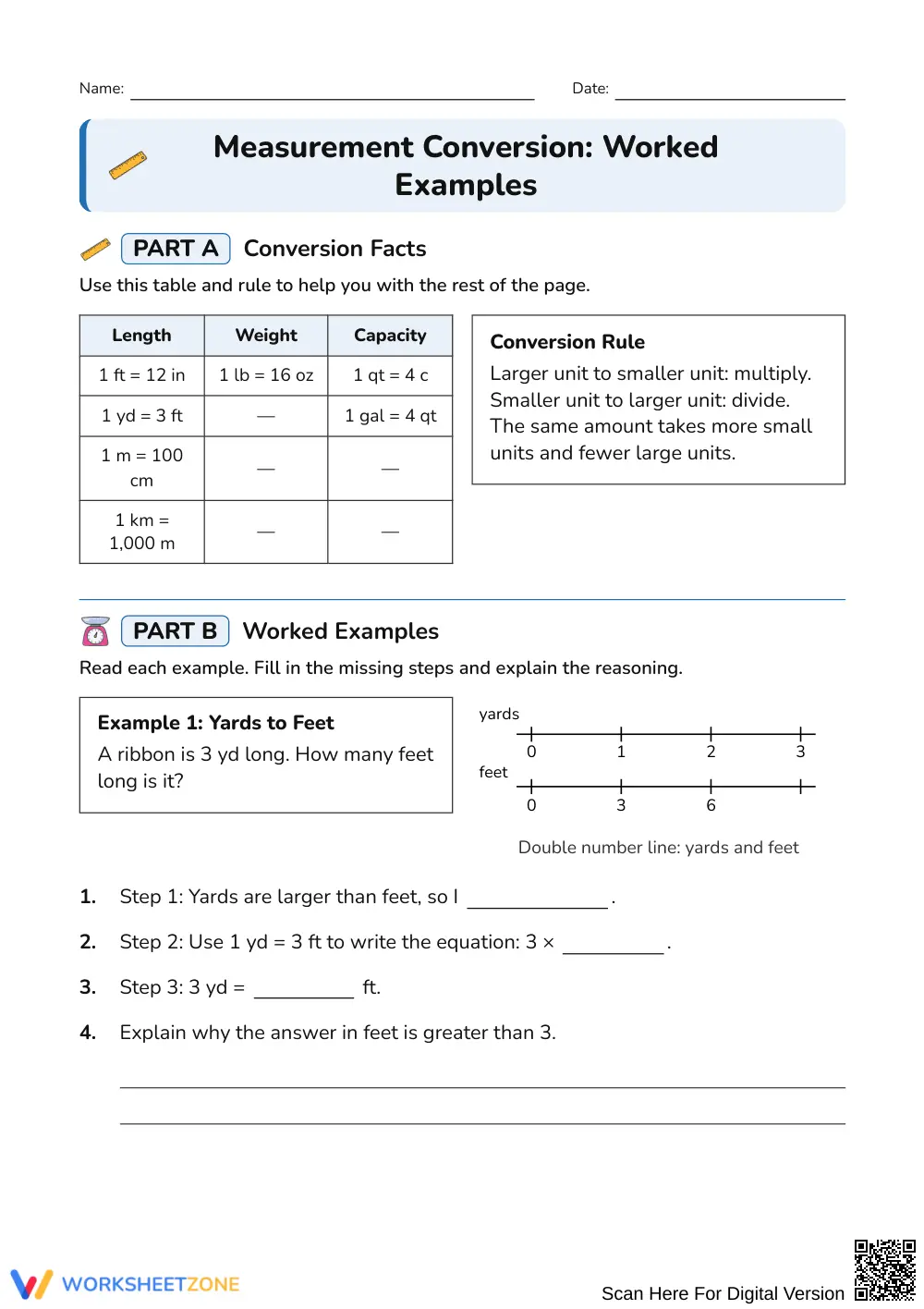
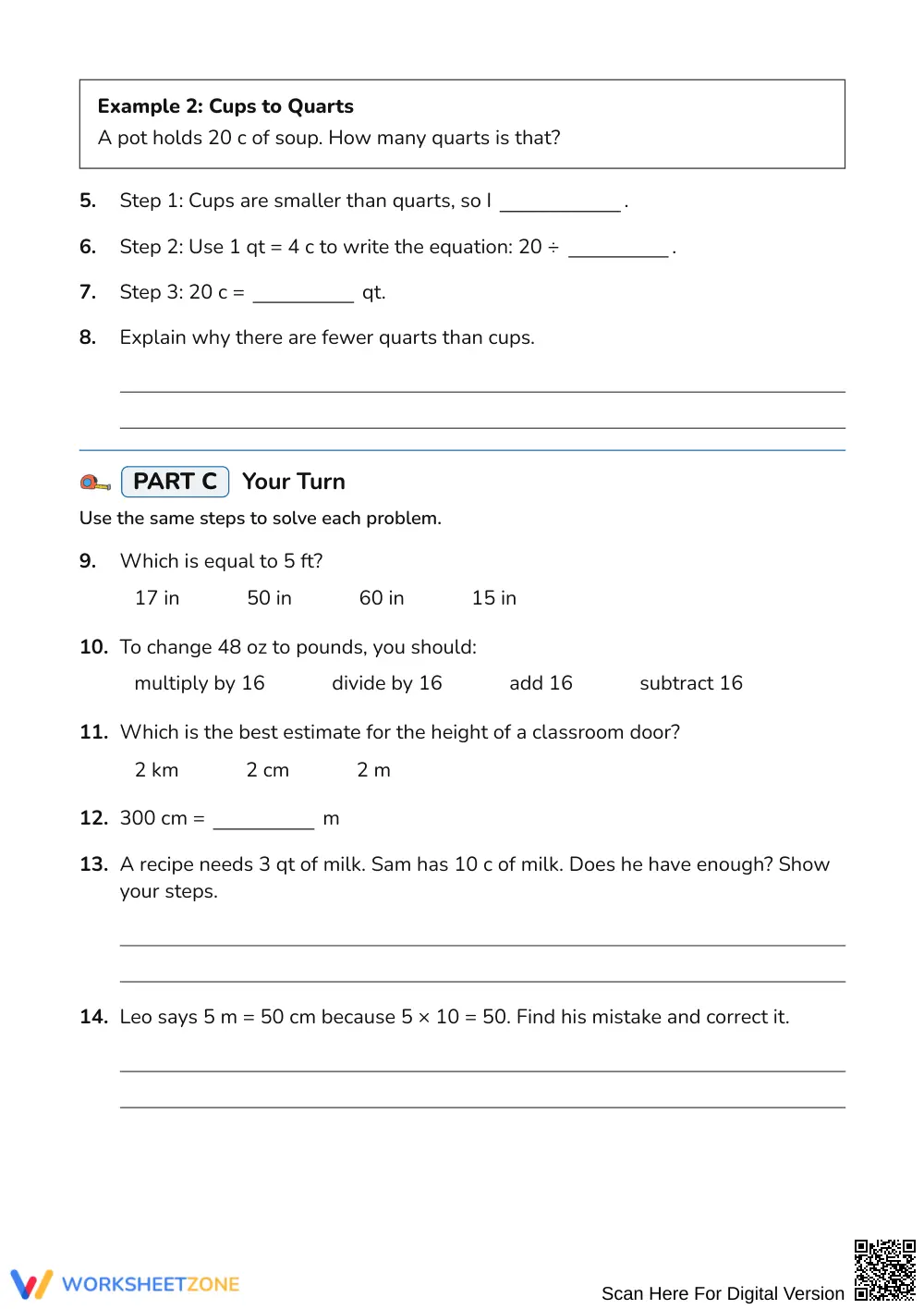
The 2-page student worksheet features an explicit reference table containing customary and metric equivalents alongside an actionable core conversion rule. Learners analyze scaffolded model problems featuring double number lines before tackling varied task formats, including multiple-choice identification, direct conversion calculations, contextual word problems, and error-analysis tasks. A complete 2-page answer key provides step-by-step solutions and model written explanations.
Skill Progression
- Guided practice: Students review modeled solutions with double number lines to articulate why changing to smaller units requires multiplication while converting to larger units requires division (2 scaffolded examples).
- Supported practice: Learners apply explicit conversion rules to identify correct operations, select equivalent units, and evaluate realistic metric estimates (5 structured items).
- Independent practice: Students calculate conversions, evaluate multi-step word problems involving capacity, and correct common student misconceptions using written mathematical explanations (8 application problems).
This sequence follows a gradual-release instructional model that transitions students from guided analysis to independent mathematical reasoning.
Standards Alignment
This resource directly aligns with `5.MD.A.1`: Convert among different-sized standard measurement units within a given measurement system (e.g., convert 5 cm to 0.05 m), and use these conversions in solving multi-step, real-world problems. Supporting alignment includes `5.NBT.B.7` for operations with multi-digit numbers during unit conversions. Both standard codes can be copied directly into lesson plans, IEP goals, or district curriculum mapping tools.
How to Use It
Deploy this worksheet after direct instruction on measurement benchmarks to solidify conversion rules. During guided small-group instruction, observe whether students identify relative unit sizes before calculating to verify conceptual grasp rather than rote operation selection. Alternatively, assign the activity as targeted partner practice during math workshop, requiring 25 to 35 minutes for completion and review.
Who It's For
This activity is designed for fifth-grade general education students, while the conversion reference chart and worked models provide built-in scaffolding for English learners and students receiving Tier 2 math intervention. Pair this worksheet naturally with an anchor chart comparing customary and metric units or an interactive measurement conversion lesson.
According to Fisher & Frey (2014), structured worked examples reduce cognitive load by demonstrating expert problem-solving pathways before students attempt independent work. This Grade 5 mathematics worksheet aligns with standard 5.MD.A.1, requiring students to convert measurement units within customary and metric systems. By embedding explanatory prompts alongside step-by-step conversions, the resource guides learners to connect mathematical operations to relative unit magnitude. Students evaluate whether a measurement requires multiplication or division based on unit scale, addressing a frequent point of conceptual confusion in elementary mathematics. The combination of reference charts, visual double number line models, and targeted error-analysis tasks ensures students develop both computational accuracy and conceptual understanding. Educators can implement this resource during guided practice, small-group instruction, or intervention to build procedural fluency while documenting student progress toward state measurement benchmarks and grade-level curriculum goals.


