


























Views
Downloads
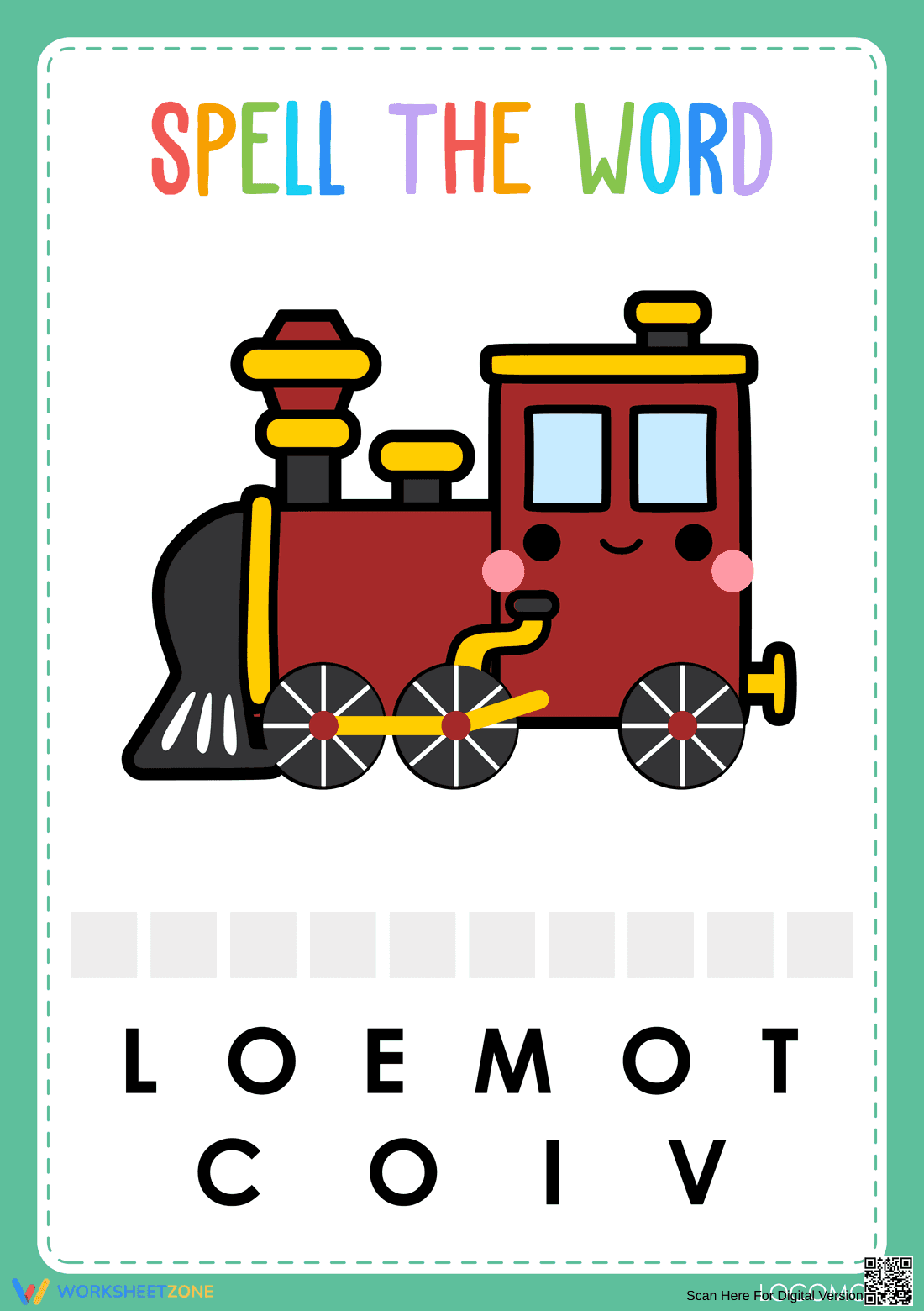

Transportation Spelling Worksheet | Essential Preschool ELA
Paste this activity's link or code into your existing LMS (Google Classroom, Canvas, Teams, Schoology, Moodle, etc.).
Students can open and work on the activity right away, with no student login required.
You'll still be able to track student progress and results from your teacher account.
This Preschool transportation spelling worksheet helps young learners master letter recognition and word construction through a fun vehicle theme. By identifying the letters needed to spell "locomotive," students build foundational literacy skills and phonemic awareness. This activity provides a clear visual prompt to support early writing and vocabulary development in a structured format.
At a Glance
- Grade: Preschool · Subject: ELA
- Standard:
CCSS.ELA-LITERACY.L.PK.2.d— Recognize and name some upper-case and lower-case letters of the alphabet- Skill Focus: Spelling & Letter Recognition
- Format: 1 page · 1 complex task · Answer key included · PDF
- Best For: Early literacy centers and morning work
- Time: 5–10 minutes
This single-page PDF features a high-quality illustration of a locomotive to engage visual learners. Below the image, students find 10 empty letter boxes and a scrambled bank of 10 uppercase letters. The layout is designed for clarity, ensuring that preschool-aged children can focus on the specific task of letter sequencing without overwhelming visual clutter.
Zero-Prep Workflow
- Print: Select the single-page PDF and print in color or grayscale in under 30 seconds.
- Distribute: Hand out the sheet along with a pencil or crayons for letter tracing and coloring.
- Review: Spend 1 minute checking the letter order against the provided answer key or the small reference text at the bottom. Total teacher preparation time is less than 2 minutes.
Standards Alignment
This resource aligns with `CCSS.ELA-LITERACY.L.PK.2.d`, which focuses on recognizing and naming letters. By manipulating the letters to form a specific word, students also practice `CCSS.ELA-LITERACY.RF.PK.1.b`, recognizing that spoken words are represented in written language by specific sequences of letters. Both standard codes can be copied directly into lesson plans, IEP goals, or district curriculum mapping tools.
How to Use It
Use this worksheet during a "Transportation" unit as a quiet-time activity or a formative assessment for letter identification. Teachers can observe if students can identify the first letter "L" and the final letter "E" to gauge their understanding of word boundaries. It typically takes 5 to 10 minutes for a preschooler to complete with adult guidance.
Who It's For
This worksheet is ideal for preschool students, English Language Learners (ELLs) building basic vocabulary, and special education students working on fine motor control and letter matching. It pairs naturally with a transportation-themed picture book or a classroom anchor chart featuring different modes of travel.
Research from RAND AIRS 2024 emphasizes that early exposure to structured letter-sound correspondence activities significantly predicts later reading fluency. This worksheet addresses the foundational need for letter recognition within a meaningful context—in this case, the word "locomotive." By using a high-interest vehicle theme, the activity increases student engagement while reinforcing the CCSS.ELA-LITERACY.L.PK.2.d standard. Fisher & Frey (2014) note that visual scaffolds, such as the large train image provided here, help bridge the gap between concrete objects and abstract symbols (letters). Providing students with a finite set of letters to arrange reduces cognitive load, allowing them to focus on the sequence and shape of the characters. This targeted approach ensures that even the youngest learners can experience success in spelling, building the confidence necessary for more complex literacy tasks in Kindergarten.


