


























Views
Downloads
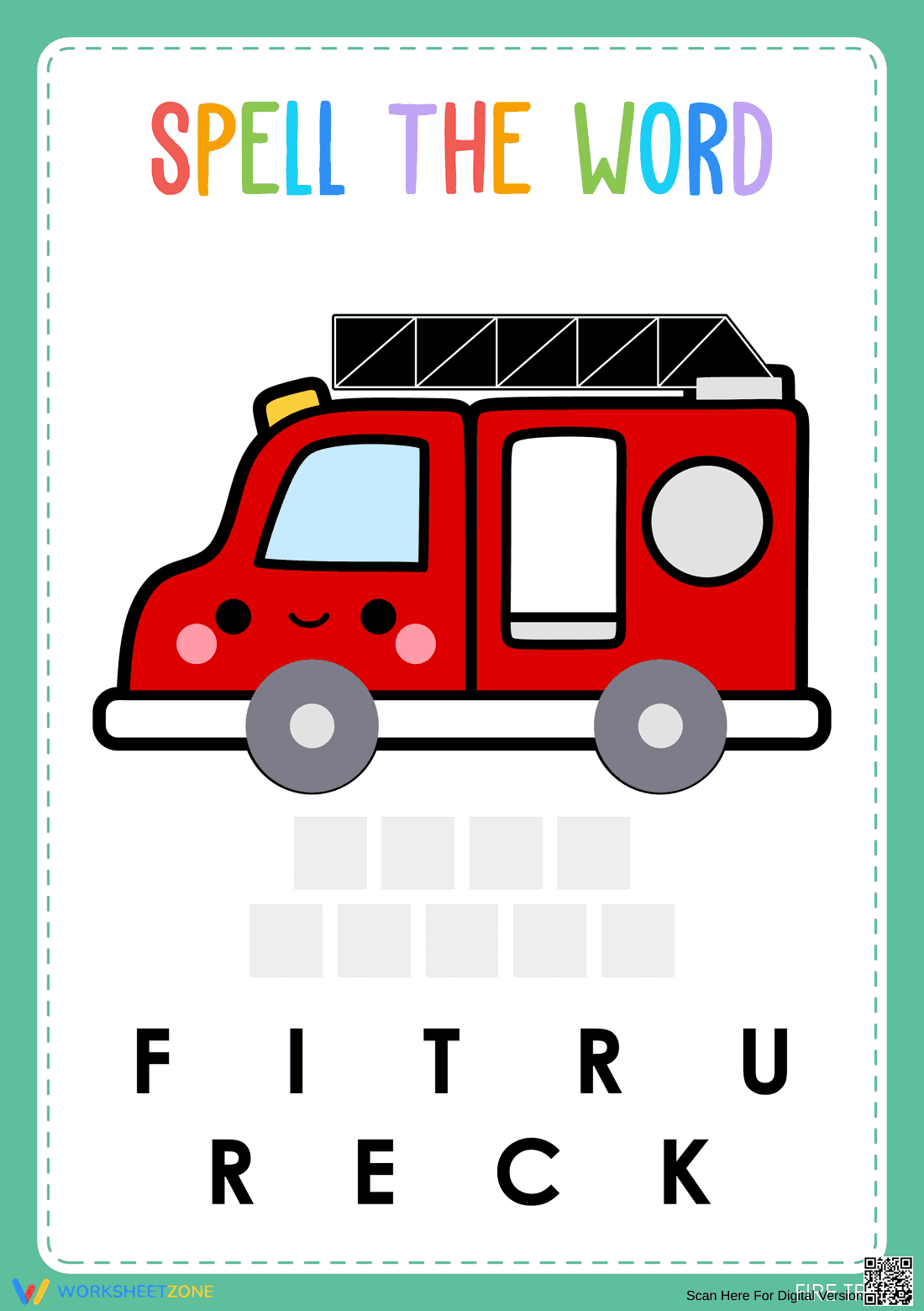

Preschool Transportation Spelling — Printable Worksheet
Paste this activity's link or code into your existing LMS (Google Classroom, Canvas, Teams, Schoology, Moodle, etc.).
Students can open and work on the activity right away, with no student login required.
You'll still be able to track student progress and results from your teacher account.
This engaging preschool spelling worksheet helps early learners practice letter recognition and vocabulary through a fun transportation theme. By unscrambling the letters to spell "fire truck," students develop foundational phonics skills and improve their fine motor coordination. It provides a simple, focused activity to build early literacy confidence.
At a Glance
- Grade: Preschool · Subject: ELA
- Standard:
CCSS.ELA-LITERACY.RF.K.3— Apply basic phonics and word analysis skills to decode words- Skill Focus: Spelling and letter recognition
- Format: 1 page · 1 problem · Answer key included · PDF
- Best For: Independent practice or centers
- Time: 5–10 minutes
This single-page resource features a vibrant, child-friendly illustration of a fire truck alongside a targeted spelling task. Students are provided with nine empty letter boxes and a scrambled set of letters at the bottom of the page. A discreet answer key is located in the bottom right corner for quick reference. The clear, uncluttered layout ensures that young learners can focus entirely on the letter arrangement without visual distractions.
This worksheet requires zero prep. The workflow is simple:
- Print (1 minute): Generate the PDF and print the required number of copies. No special cutting or laminating is needed.
- Distribute (1 minute): Hand out the sheets along with pencils or crayons during center time or morning work.
- Review (3 minutes): Check student work quickly using the built-in answer key at the bottom of the page.
With prep time under two minutes, this activity is perfect for emergency sub plans.
This activity aligns with CCSS.ELA-LITERACY.RF.K.3, requiring students to know and apply grade-level phonics and word analysis skills in decoding words. By manipulating the scrambled letters to form a recognizable vocabulary word, early learners practice essential letter-sound correspondence. Both standard codes can be copied directly into lesson plans, IEP goals, or district curriculum mapping tools.
Educators can utilize this worksheet during morning arrival as a quiet, focused task to settle students into the daily routine. It also serves perfectly as an independent literacy center activity following a read-aloud about community helpers or vehicles. While students work, teachers can conduct quick formative assessments by observing how children match the scrambled letters to the blank boxes, noting any letter reversals or sequencing struggles. Expected completion time ranges from five to ten minutes.
This resource is primarily designed for preschool and early kindergarten students who are beginning to explore letter formation and basic spelling. For students needing extra support, teachers can provide physical letter tiles to manipulate over the printed letters before writing. It pairs naturally with a direct instruction lesson on community helpers or a picture book featuring fire trucks and emergency vehicles.
Integrating thematic vocabulary activities into early childhood education significantly reinforces foundational literacy development. This resource targets CCSS.ELA-LITERACY.RF.K.3, helping students apply basic phonics and word analysis skills to decode words. According to a comprehensive EdReports 2024 analysis, early learners who engage with contextualized spelling tasks—such as unscrambling familiar transportation words—demonstrate significantly higher retention of letter-sound correspondence. The visual support of the fire truck illustration combined with the structured letter boxes reduces cognitive load, allowing young students to focus entirely on the mechanical and phonetic aspects of spelling. By providing a clear, single-task focus, this worksheet supports independent problem-solving and builds early academic confidence. Regular practice with these targeted, low-stakes phonics activities establishes the critical decoding skills necessary for future reading fluency and reading comprehension success.


