


























Views
Downloads

Preschool Spelling Printable | Transportation Word Practice
Paste this activity's link or code into your existing LMS (Google Classroom, Canvas, Teams, Schoology, Moodle, etc.).
Students can open and work on the activity right away, with no student login required.
You'll still be able to track student progress and results from your teacher account.
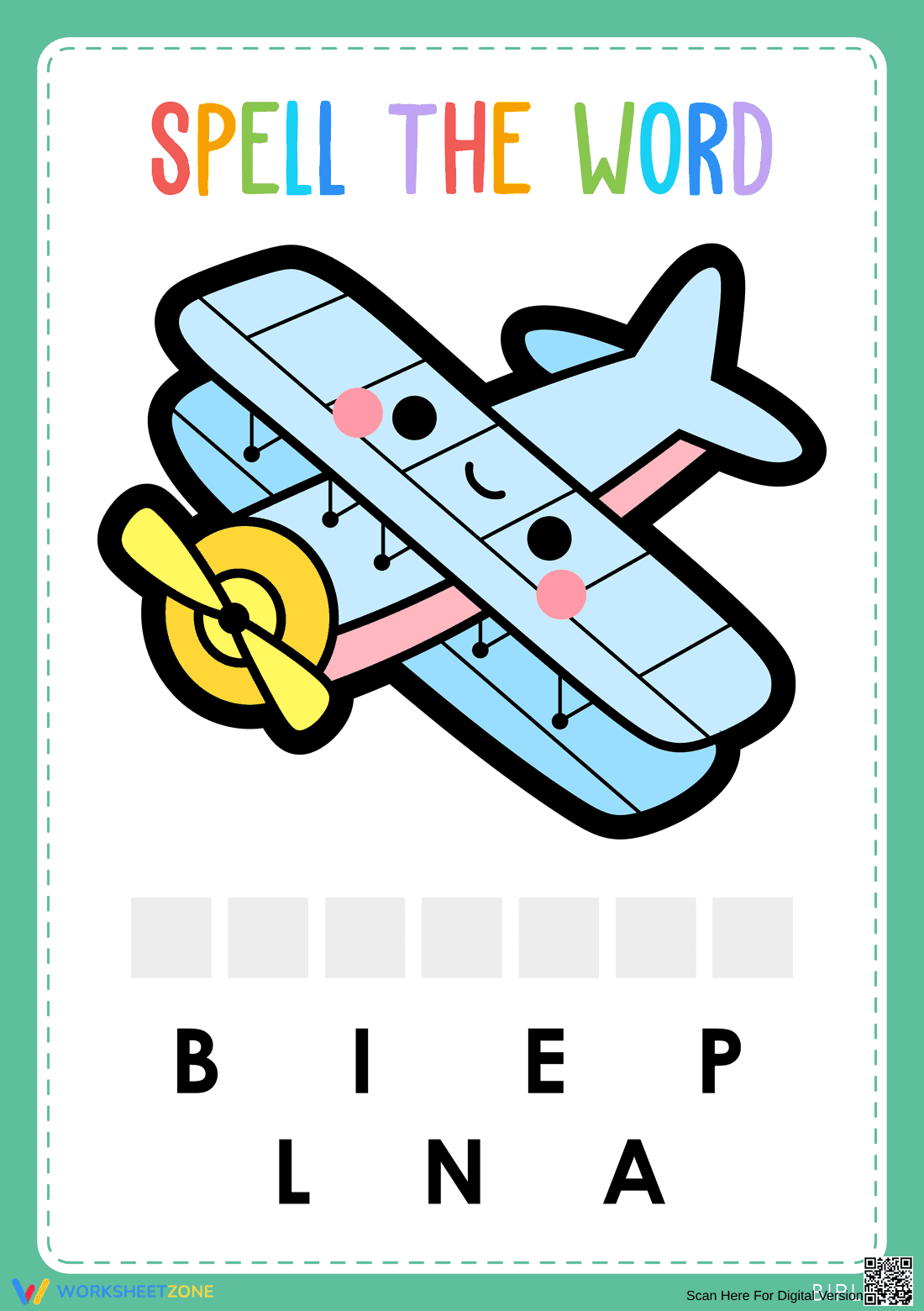
This engaging preschool spelling worksheet introduces early learners to transportation vocabulary while building foundational letter recognition skills. Students practice unscrambling letters to spell the word "biplane," reinforcing phonics and visual-spatial awareness. The colorful design captures attention, making early literacy practice an enjoyable and productive experience for young children.
At a Glance
- Grade: Preschool · Subject: ELA
- Standard:
CCSS.ELA-LITERACY.RF.K.3— Apply early phonics and word analysis skills to decode simple words- Skill Focus: Spelling and letter recognition
- Format: 1 printable page · 1 visual spelling problem · No answer key · PDF
- Best For: Independent morning work or literacy centers
- Time: 5–10 minutes of focused practice
This single-page resource features a vibrant illustration of a biplane alongside a targeted spelling task. Children are presented with seven empty letter boxes and a scrambled set of letters to arrange correctly. A subtle text hint provides built-in scaffolding, allowing students to self-correct. The clear font and distinct letter tiles are designed for developing visual tracking.
Zero-Prep Workflow
- Print (1 min): Download and print the single page.
- Distribute (1 min): Hand out the worksheet with pencils. No complex teacher setup is required.
- Review (1 min): Check the completed word boxes. The built-in hint allows rapid visual confirmation.
With total teacher prep time under two minutes, this resource is perfect for sub plans or quick transitions.
Standards Alignment
This activity aligns with CCSS.ELA-LITERACY.RF.K.3, requiring students to apply early phonics and word analysis skills. By manipulating scrambled letters to form a transportation term, early learners practice sequencing. Both standard codes can be copied directly into lesson plans, IEP goals, or district curriculum mapping tools.
How to Use It
This worksheet serves as an excellent morning work activity before direct instruction begins, settling students into a focused learning routine. Alternatively, place it in a literacy center during small group rotations where children can use physical letter blocks to match the printed letters before writing them down. As a formative assessment observation tip, watch how students approach the scrambled letters—note whether they search for the initial consonant sound first or rely entirely on the visual hint. Expected completion time ranges from five to ten minutes.
Who It's For
This resource is primarily designed for preschool and early kindergarten students developing basic literacy and spelling capabilities. The visual scaffolding makes it highly accessible for English Language Learners (ELLs) who are building their transportation vocabulary. For differentiation, advanced students can be challenged to write a short sentence about the biplane on the back of the page. It pairs naturally with a read-aloud book about airplanes or a broader transportation-themed direct instruction lesson.
Integrating visual aids with early spelling tasks significantly reinforces letter recognition and vocabulary acquisition in young learners. According to Fisher & Frey (2014), providing structured, scaffolded literacy activities helps students transition from guided practice to independent problem-solving. This worksheet directly supports CCSS.ELA-LITERACY.RF.K.3 by requiring children to apply early phonics and word analysis skills to decode and construct words. By combining a high-interest topic like transportation with a clear, single-focus task, educators can effectively sustain student engagement during foundational literacy instruction. The inclusion of scrambled letters encourages cognitive flexibility, prompting children to analyze individual letter shapes and their sequential order. Utilizing targeted, visually appealing materials ensures that early learners build the necessary confidence and competence to tackle more complex reading and writing challenges as they progress through their educational journey.


