


























Views
Plays

Past Perfect vs Past Simple Worksheet | Essential Grammar
Paste this activity's link or code into your existing LMS (Google Classroom, Canvas, Teams, Schoology, Moodle, etc.).
Students can open and work on the activity right away, with no student login required.
You'll still be able to track student progress and results from your teacher account.
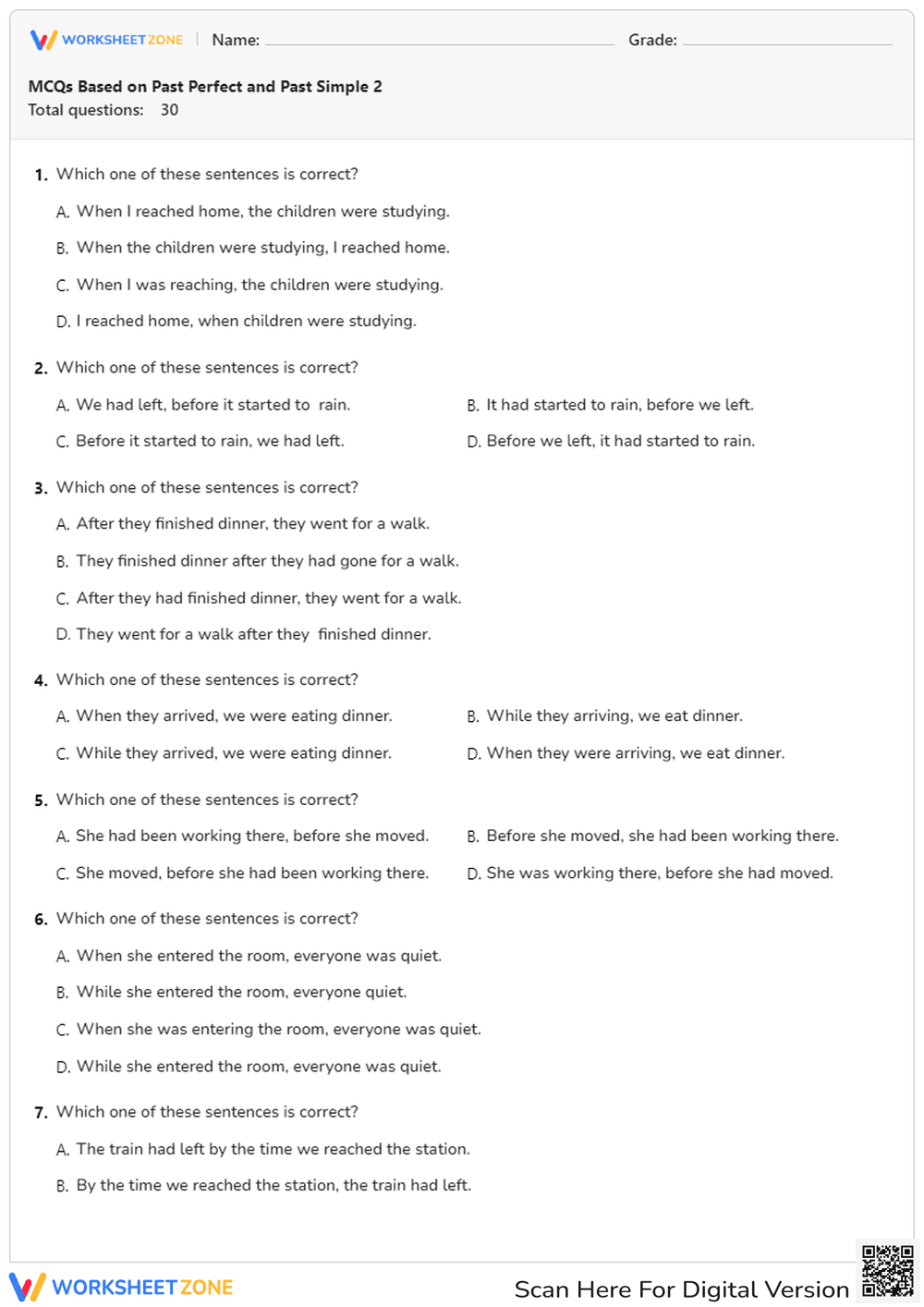
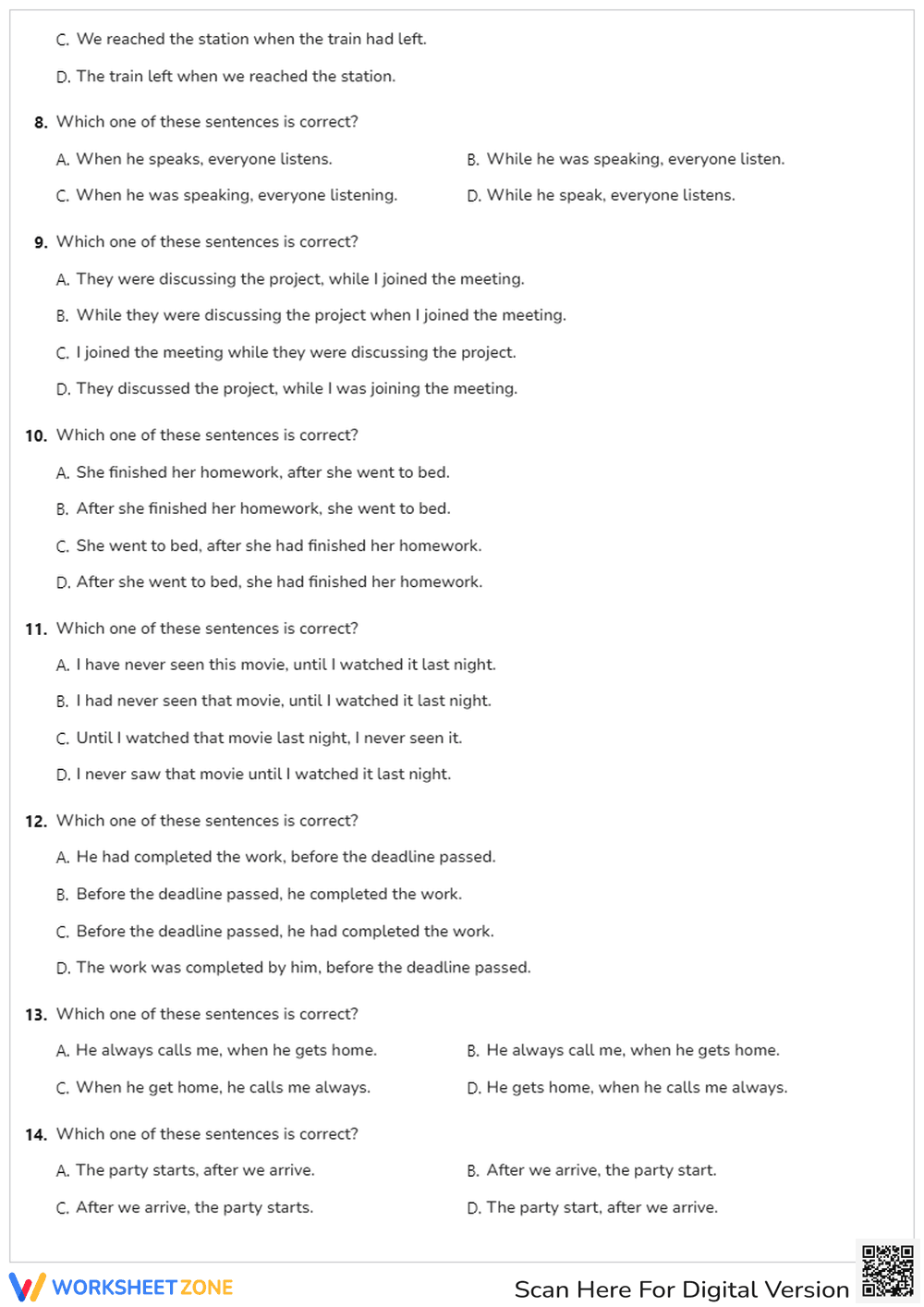
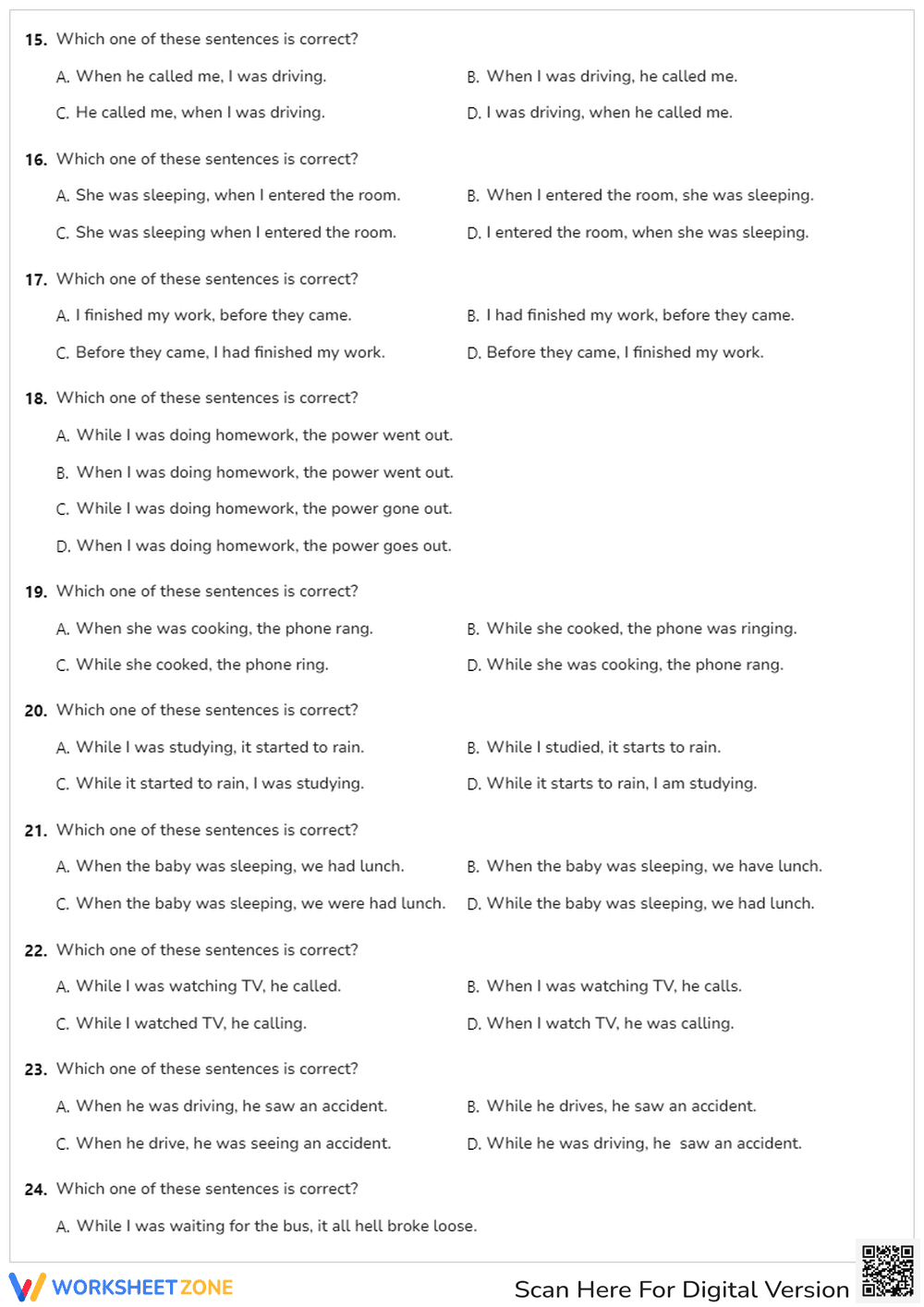
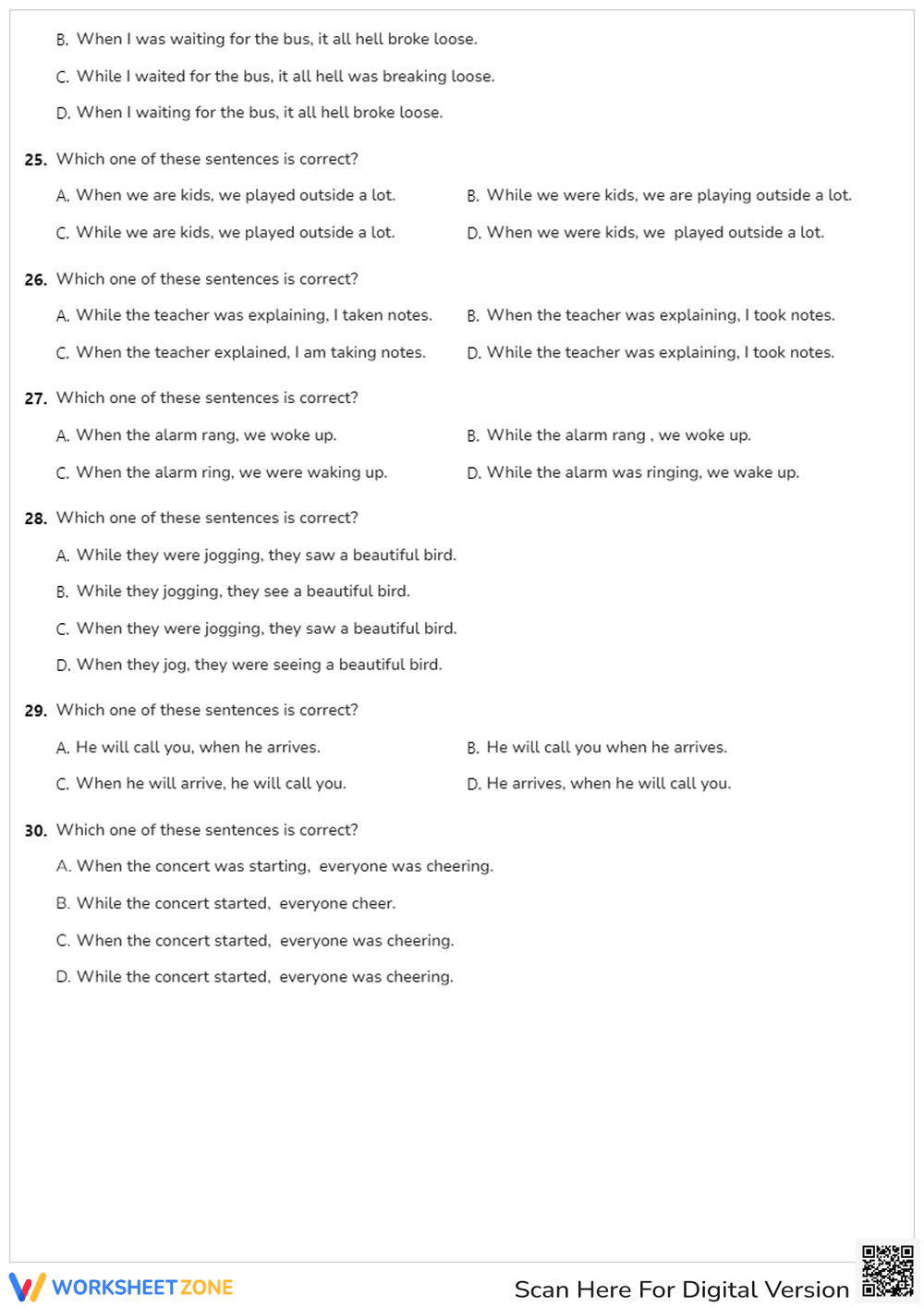
This Grade 11-12 grammar worksheet provides intensive practice in distinguishing between the past perfect and past simple tenses. Students analyze 30 complex sentences to identify correct grammatical structures and temporal relationships. By completing these multiple-choice questions, learners refine their ability to communicate sequential events in the past with precision and clarity.
At a Glance
- Grade: 11-12 · Subject: ELA
- Standard:
CCSS.ELA-LITERACY.L.11-12.1— Demonstrate command of standard English grammar and usage in complex sentences- Skill Focus: Past Perfect vs. Past Simple Tense
- Format: 4 pages · 30 problems · Answer key included · PDF
- Best For: Advanced grammar review and test prep
- Time: 25–35 minutes
The resource contains four pages of rigorous multiple-choice questions. Each of the 30 items presents four sentence variations, requiring students to evaluate subtle differences in verb conjugation and conjunction usage (such as "before," "after," and "while"). The layout is clean and professional, featuring a header for student names and grades, making it suitable for formal assessments or independent study.
- Guided practice: The initial 10 questions focus on basic temporal markers like "before" and "after" to establish the fundamental relationship between two past actions.
- Supported practice: Questions 11-20 introduce more complex scenarios involving the past continuous and "until," challenging students to identify overlapping timeframes.
- Independent practice: The final 10 questions require high-level analysis of nuanced sentence structures where multiple tenses interact within a single complex sentence.
This progression follows a gradual-release model, moving from clear chronological markers to sophisticated syntactical choices.
This worksheet is aligned with CCSS.ELA-LITERACY.L.11-12.1, which requires students to demonstrate command of the conventions of standard English grammar and usage when writing or speaking. Specifically, it addresses the use of various verb tenses to convey specific meanings and timeframes. This standard code can be copied directly into lesson plans, IEP goals, or district curriculum mapping tools.
Use this worksheet as a summative assessment after a unit on advanced verb tenses to gauge student mastery. Alternatively, assign it as a diagnostic tool before direct instruction to identify specific misconceptions regarding past-tense sequencing. During the activity, observe if students are relying on "ear" or applying specific grammatical rules. Expected completion typically takes 25 to 35 minutes.
This resource is designed for high school seniors, college-level English learners, or advanced ESL students preparing for proficiency exams. It serves as an excellent companion to a comprehensive grammar handbook or a direct instruction lesson on narrative tenses. The high task count provides ample data for identifying individual student needs in writing and editing.
According to the RAND AIRS 2024 report, targeted grammar practice that focuses on specific linguistic features, such as the distinction between past perfect and past simple, significantly improves student writing accuracy in academic contexts. This worksheet addresses CCSS.ELA-LITERACY.L.11-12.1 by providing 30 structured opportunities for students to demonstrate command of standard English conventions. Research by Fisher & Frey (2014) emphasizes that multiple-choice analysis helps students develop the metalinguistic awareness necessary for self-correction during the drafting process. By isolating the skill of tense selection, this resource allows for high-frequency practice that builds the cognitive fluency required for complex narrative construction. Educators can utilize this tool to provide evidence-based intervention for students struggling with temporal sequencing in their formal essays or creative writing assignments.


