


























Views
Downloads

Matter Classification Worksheet | Grade 7 Essential
Paste this activity's link or code into your existing LMS (Google Classroom, Canvas, Teams, Schoology, Moodle, etc.).
Students can open and work on the activity right away, with no student login required.
You'll still be able to track student progress and results from your teacher account.
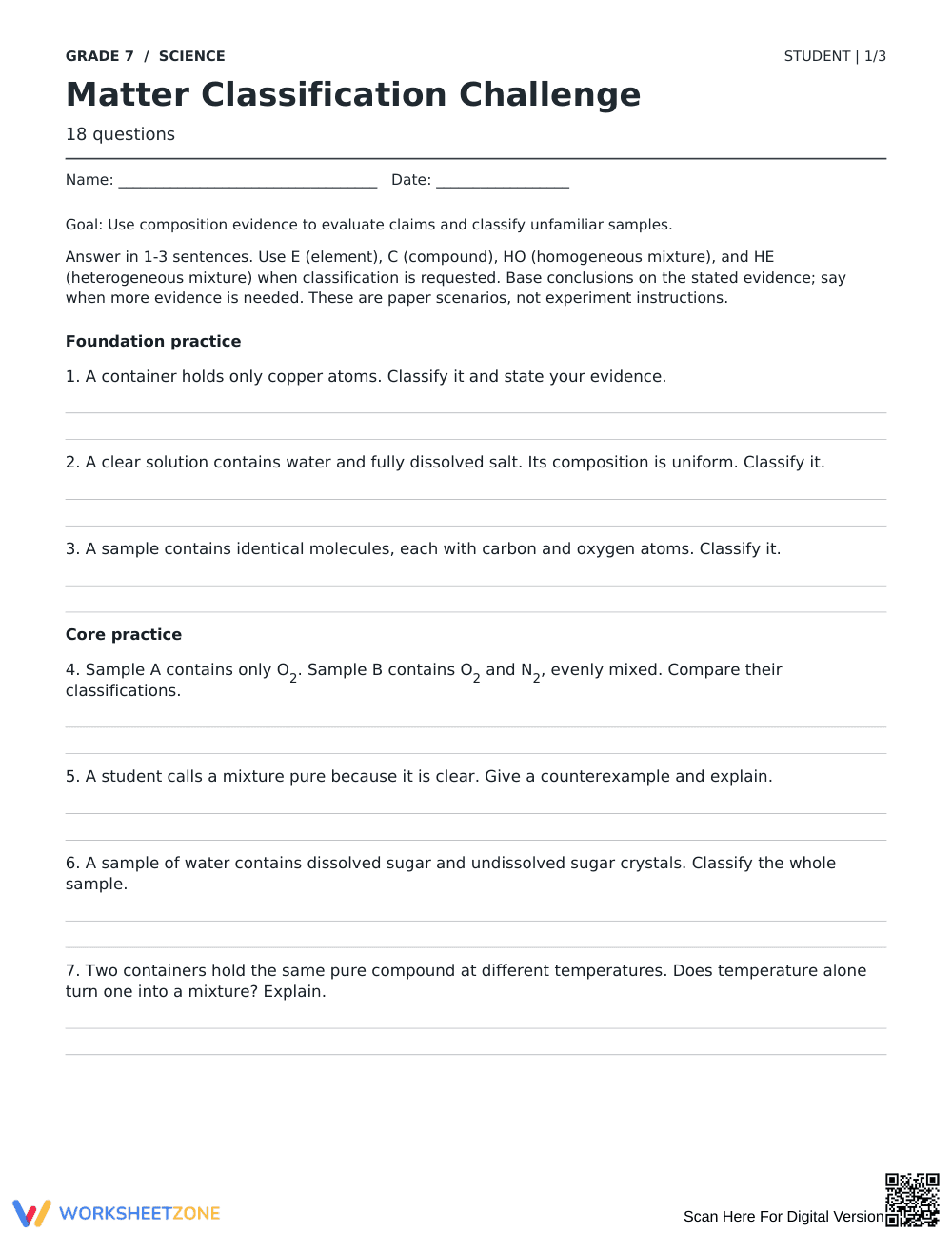
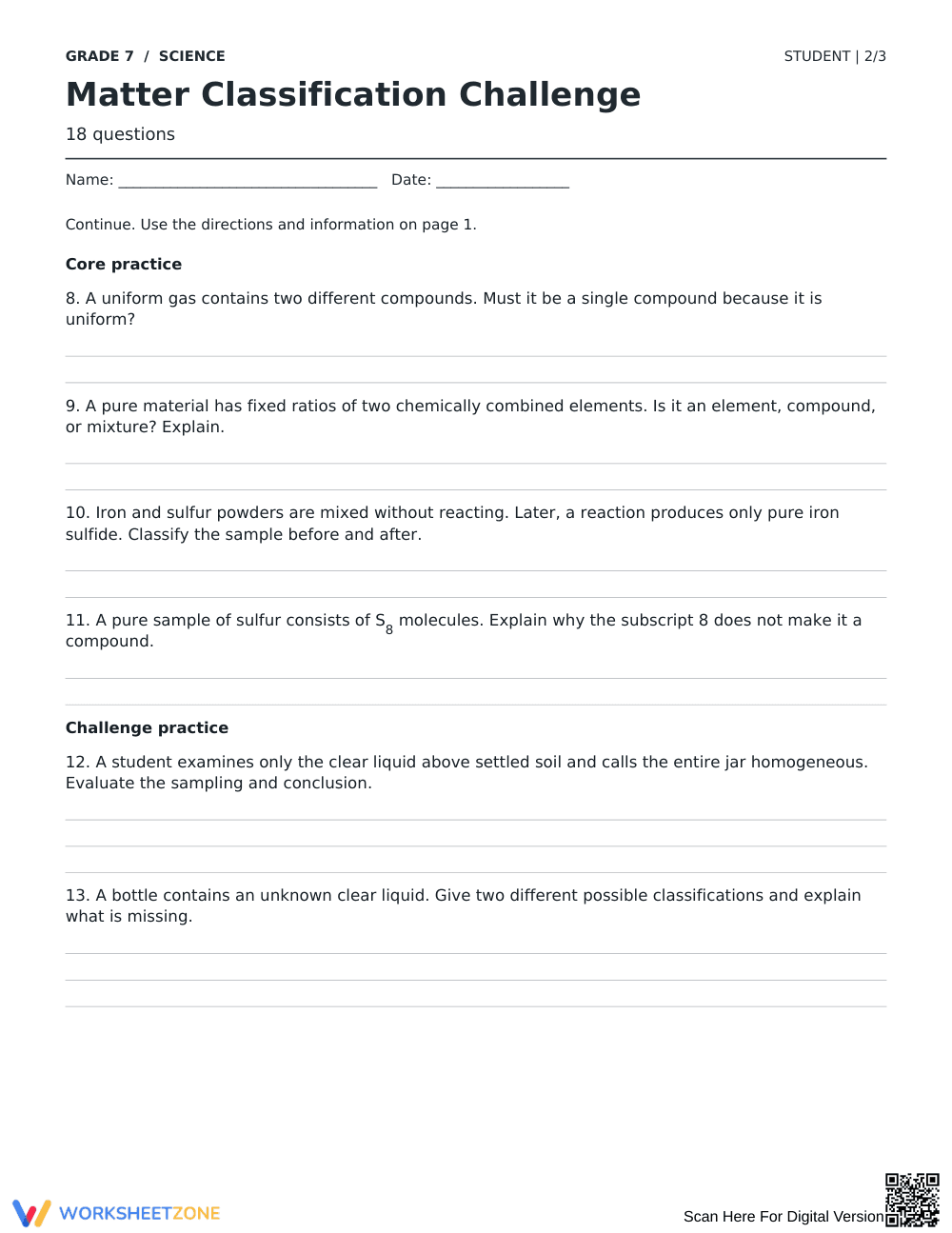
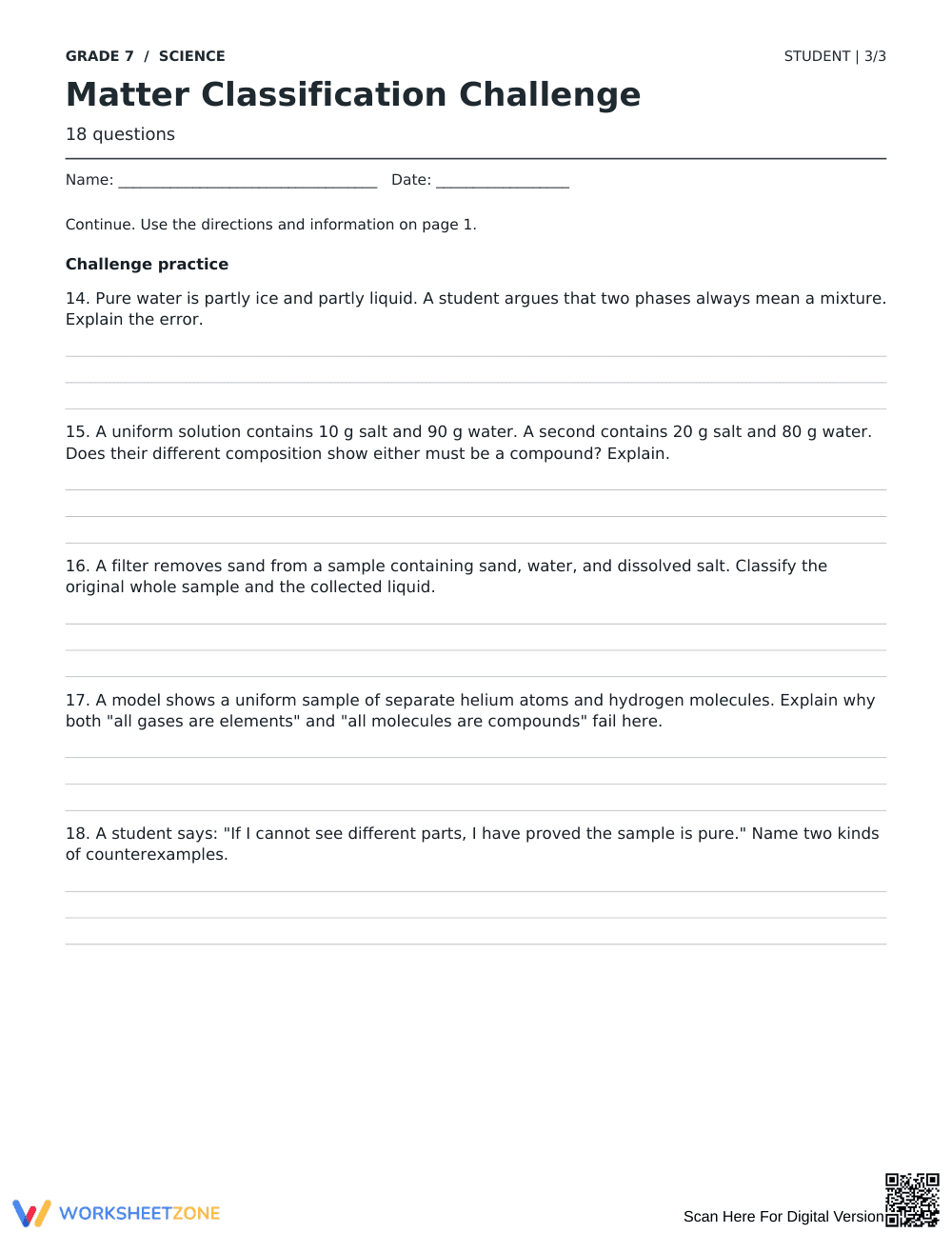
This physical science worksheet equips Grade 7 students to classify unfamiliar samples of matter into elements, compounds, homogeneous mixtures, and heterogeneous mixtures. Learners analyze atomic and molecular descriptions, evaluate student claims, and support their conclusions with evidence rather than surface-level observations.
At a Glance
- Grade: 7 · Subject: Science
- Standard:
MS-PS1-1— Develop models to describe the atomic composition of simple molecules and extended structures- Skill Focus: Matter classification and evidence-based scientific reasoning
- Format: 3 pages · 18 problems · Answer key included · PDF
- Best For: Mid-unit formative assessment and review
- Time: 30–40 minutes
What's Inside
The 3-page student activity contains 18 short-answer and scenario analysis questions arranged into three progressive tiers. A comprehensive 2-page answer key provides specific explanations, common counterexamples, and a 61-point scoring guide for targeted evaluation.
Skill Progression
- Guided practice (Foundation practice, questions 1–3): Students identify single-component samples, such as pure copper atoms or uniform salt solutions, establishing baseline classification vocabulary.
- Supported practice (Core practice, questions 4–11): Learners distinguish molecular elements from compounds, analyze physical mixing versus chemical bonding, and address common misconceptions regarding clarity and temperature.
- Independent practice (Challenge practice, questions 12–18): Students evaluate multi-phase systems, critique faulty experimental sampling, formulate counterexamples, and justify claims using particle-level reasoning.
This structured sequence follows a gradual-release framework that builds deep conceptual mastery before introducing complex non-examples.
Standards Alignment
This resource aligns directly with `MS-PS1-1`: Develop models to describe the atomic composition of simple molecules and extended structures, focusing on foundational disciplinary core idea PS1.A (Structure and Properties of Matter). It also supports CCSS.ELA-LITERACY.RST.6-8.8 by prompting students to distinguish fact-based claims from faulty scientific reasoning. Both standard codes can be copied directly into lesson plans, IEP goals, or district curriculum mapping tools.
How to Use It
Assign this worksheet during independent seatwork after direct instruction on pure substances versus mixtures, or implement it before a summative assessment to pinpoint persistent misconceptions. During work time, circulate to observe question 5 and question 14; verify whether students recognize that phase changes do not alter chemical composition. Expect students to complete the 18 items in 30 to 40 minutes.
Who It's For
Designed for middle school physical science classrooms, this printable resource serves general education students and provides clear analytical scaffolding for learners requiring targeted intervention. Pair this practice set with molecular modeling kits or an anchor chart detailing particle diagrams.
Middle school science curricula demand that learners build evidentiary reasoning alongside core chemistry content. According to EdReports 2024, high-quality physical science instructional materials must move beyond rote memorization by requiring students to justify classification claims using atomic models and compositional evidence. This 18-question worksheet specifically targets NGSS standard MS-PS1-1 by prompting Grade 7 learners to distinguish between elements, pure compounds, and homogeneous or heterogeneous mixtures across 3 structured difficulty tiers. By confronting common misconceptions—such as confusing optical clarity with chemical purity—students develop analytical habits that support long-term retention and higher-order scientific inquiry.


