


























Views
Downloads
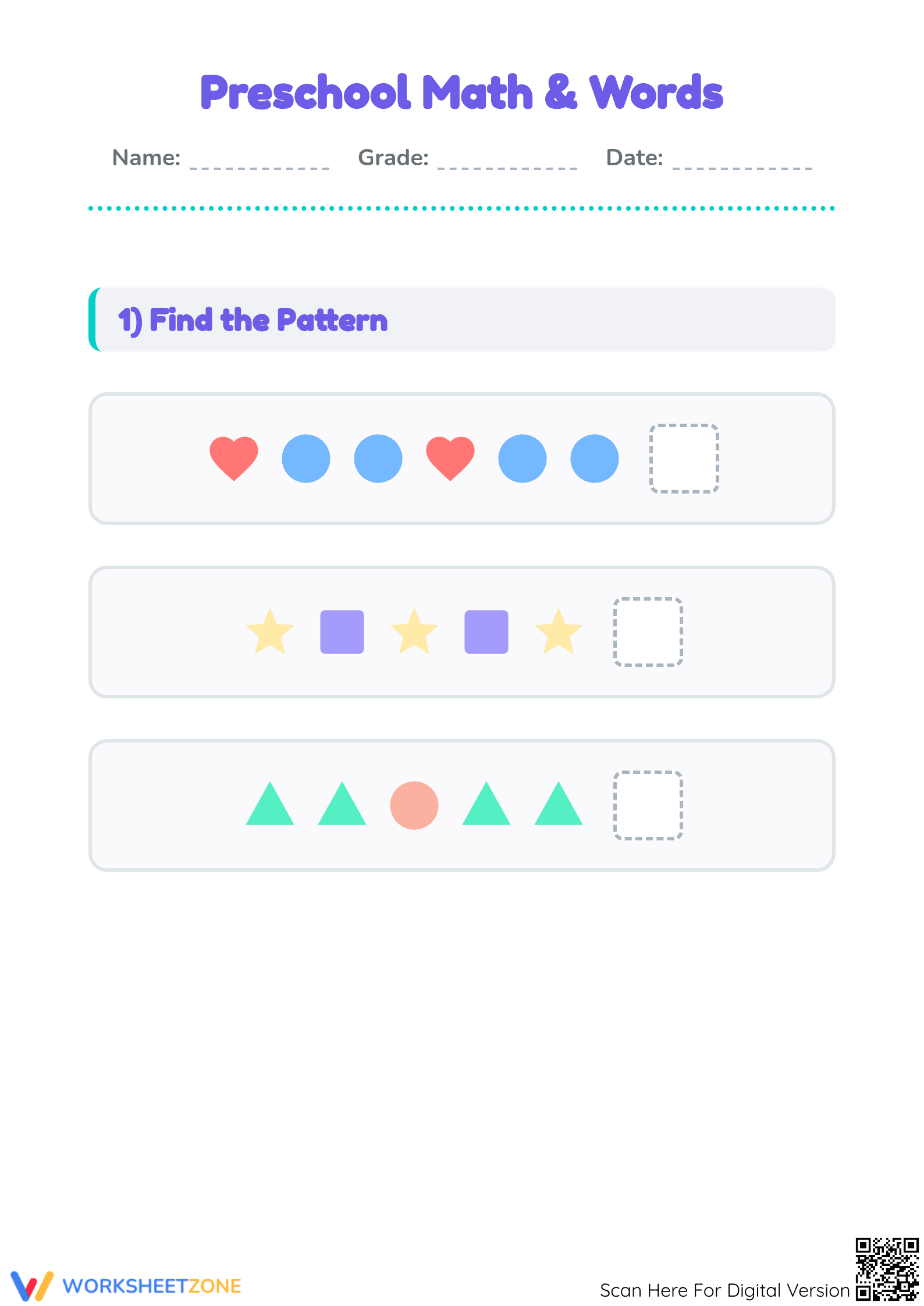



Printable Preschool Math & Words Worksheet | Grade PK
Paste this activity's link or code into your existing LMS (Google Classroom, Canvas, Teams, Schoology, Moodle, etc.).
Students can open and work on the activity right away, with no student login required.
You'll still be able to track student progress and results from your teacher account.
This Preschool Math & Words worksheet provides a comprehensive foundation for early learners, focusing on counting objects 1–10 and recognizing patterns. With 23 problems across five pages, students develop essential cardinality skills and number-word associations. This resource ensures a smooth transition from visual counting to written representation, supporting kindergarten readiness.
At a Glance
- Grade: Preschool · Subject: Math
- Standard:
CCSS.MATH.CONTENT.PK.CC.B.4— Understand the relationship between numbers and quantities and connect counting to cardinality- Skill Focus: Counting 1-10, Number Spellings, Patterns
- Format: 5 pages · 23 problems · Answer key included · PDF
- Best For: Early numeracy and literacy reinforcement
- Time: 20–30 minutes
What's Inside
This five-page PDF features five modules designed for early childhood engagement. It includes three pattern-completion exercises, eight count-and-match problems bridging quantities to numerals, and ten writing prompts for number spellings. Creative tasks for drawing shapes and an alphabet-counting module provide a holistic approach to numeracy and literacy, ensuring students stay focused through visual variety and interactive page layouts.
Skill Progression
- Guided Practice: Students start with pattern completion and counting sets to 6. Familiar icons allow teachers to model counting-on strategies effectively.
- Supported Practice: Learners transition to matching sets up to 10 with numerals. Number spellings (writing "one" through "six") reinforce the link between names and quantities.
- Independent Practice: Final tasks involve writing spellings for 7–10 and completing shape drawing and alphabet modules. This "I Do, We Do, You Do" framework ensures mastery of foundational pre-kindergarten skills.
Standards Alignment
The primary focus aligns with CCSS.MATH.CONTENT.PK.CC.B.4, where students understand the relationship between numbers and quantities. By matching sets of objects to numerals and writing number names, students demonstrate a grasp of cardinality. Both standard codes can be copied directly into lesson plans, IEP goals, or district curriculum mapping tools to track student progress toward kindergarten mathematics readiness.
How to Use It
Use this resource during guided practice after introducing physical manipulatives. Model the first pattern before letting students work through the count-and-match sections in pairs. For formative assessment, observe the writing portion to identify students struggling with letter formation or number sequences. Completion time is roughly 20–30 minutes, making it ideal for a focused math block or as a comprehensive review of early counting and literacy skills.
Who It's For
Designed for preschool and LKG students, this worksheet is effective for learners requiring a multisensory approach combining drawing and writing. It serves as a differentiation tool for kindergarteners needing extra cardinality support. Pair this resource with a counting-to-ten anchor chart or unifix cubes to provide a concrete reference point for the abstract numerical concepts presented on the pages.
According to Fisher & Frey (2014), the transition from visual modeling to independent writing is critical for retention in early math. This worksheet facilitates that transition by moving students from pattern identification to representing quantities through symbols and spellings, aligned with CCSS.MATH.CONTENT.PK.CC.B.4. The 23 problems across 5 pages provide the "spaced practice" required for preschoolers to move counting skills from short-term memory to functional mastery. Integrating literacy through alphabet counting and number-word writing improves school readiness scores by addressing multiple developmental domains. This structured approach ensures the plain-English skill of connecting numbers to quantities is reinforced multiple times, meeting the rigors of modern educational standards. This evidence-based design supports foundational numeracy and literacy development, making it an essential resource for preschool educators focused on achieving measurable student outcomes and preparing children for kindergarten success.


