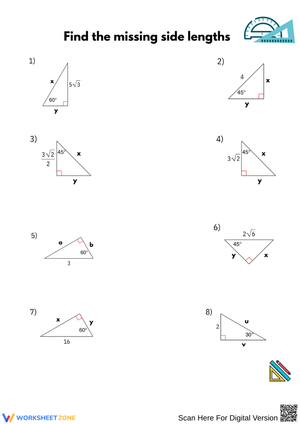
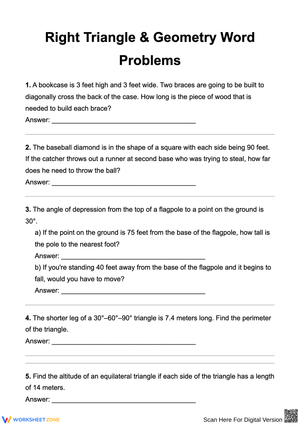
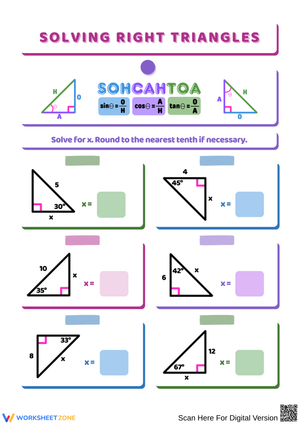
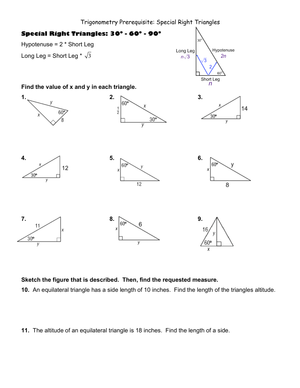
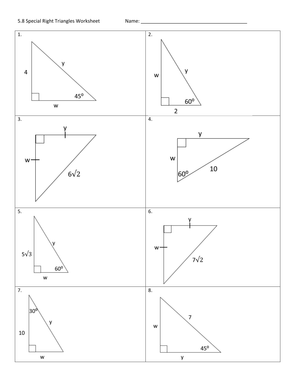
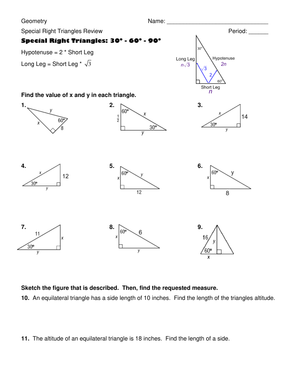
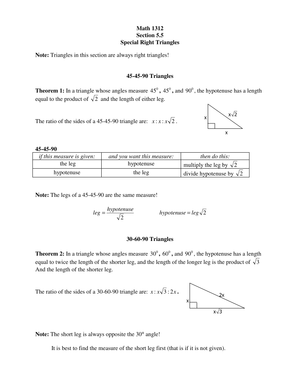
In a 45-45-90 triangle, the two legs are congruent, and the hypotenuse equals a leg times the square root of 2. In a 30-60-90 triangle, the side lengths sit in a fixed ratio of 1 to the square root of 3 to 2, opposite the 30, 60, and 90 degree angles respectively. These two facts are the entire content core of the unit, and a good worksheet keeps circling back to them rather than introducing extra complexity too soon.
The most common breakdown is not in remembering the ratio itself but in matching the ratio to the correct side. Students frequently place the square root of 3 next to the wrong leg in a 30-60-90 triangle, especially when the triangle is drawn in a rotated or unfamiliar orientation on the page. Worksheets that vary the triangle orientation from problem to problem, rather than always drawing the right angle in the bottom left corner, force students to identify angles first and assign ratios second, which is the actual skill being tested.
Classroom Implementation
Open the class period with a quick two-minute warm-up: sketch a square, draw its diagonal, and ask students to identify the two triangles formed. This primes the 45-45-90 derivation before the worksheet even starts. Then move into the worksheet itself, starting with the numeric-only tier for the first five to seven problems before introducing any radical simplification.
For pacing, plan on roughly 20 to 25 minutes of independent or partner work for a worksheet of 12 to 15 problems, with the final five minutes reserved for pulling two or three problems that most students got wrong and working them together on the board. Pair students of mixed ability for this unit specifically, since the derivation models benefit from talking through the square or the equilateral triangle out loud, and one partner catching the other's ratio mix-up in real time is more effective than catching it on a graded worksheet later.
Connecting to Real-World Structures
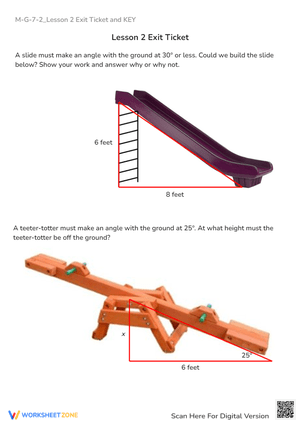
Special right triangles show up in contexts your students can picture: a wheelchair ramp built to a specific angle, the pitch of a roof, or the triangular bracing in an A-frame structure. Framing two or three worksheet problems around these contexts, rather than leaving every problem as an abstract labeled triangle, gives students a reason to care about the exact answer instead of an estimate. A ramp problem that asks for the exact rise given a 30 degree incline and a known ramp length connects directly to the 30-60-90 ratio without adding any new math content.
Bridging Into Trigonometry
Special right triangles are also the on-ramp to unit circle trigonometry. The exact trig values for 30, 45, and 60 degrees, the ones students are eventually expected to know without a calculator, come directly from these two triangles. A worksheet late in the unit that asks students to find sine, cosine, and tangent for these three angles using the side ratios they already derived turns an abstract memorization task, the unit circle, into an application of something they already understand geometrically.
This bridge is worth naming explicitly to students. Telling them up front that the ratios they are practicing now will reappear, unchanged, in trigonometry gives the current worksheet more weight than treating it as an isolated geometry topic that will not resurface.
Frequently Asked Questions
1. What grade level typically covers special right triangles worksheets
These worksheets are typically used in grades 9 and 10 as part of a standard high school geometry course, though they also appear in geometry review sections of pre-calculus and in targeted intervention or enrichment blocks.
2. What is the difference between a 45-45-90 and a 30-60-90 triangle worksheet
A 45-45-90 worksheet focuses on congruent legs and a hypotenuse equal to a leg times the square root of 2. A 30-60-90 worksheet focuses on the fixed 1 to square root of 3 to 2 ratio across three different side lengths, which requires more careful angle identification.
3. How can teachers help students avoid mixing up the side ratios
Vary the triangle orientation on the page so students cannot rely on position alone, and reinforce the square-diagonal and equilateral-triangle-bisection derivations so students have a way to reconstruct the ratio instead of relying purely on memory.
4. Can these worksheets be used without a calculator
Yes. The entire purpose of the special right triangle ratios is to let students find exact side lengths using radicals instead of a calculator, which supports mental math and estimation skills.
5. How do special right triangles connect to later trigonometry units
The exact side ratios from 45-45-90 and 30-60-90 triangles are the same ratios used to derive sine, cosine, and tangent values for 30, 45, and 60 degrees in unit circle trigonometry, making this unit a direct geometric foundation for that later work.