


























Views
Downloads

Grade 3-4 Math Puzzle Boxes — Printable No-Prep Worksheet
Paste this activity's link or code into your existing LMS (Google Classroom, Canvas, Teams, Schoology, Moodle, etc.).
Students can open and work on the activity right away, with no student login required.
You'll still be able to track student progress and results from your teacher account.
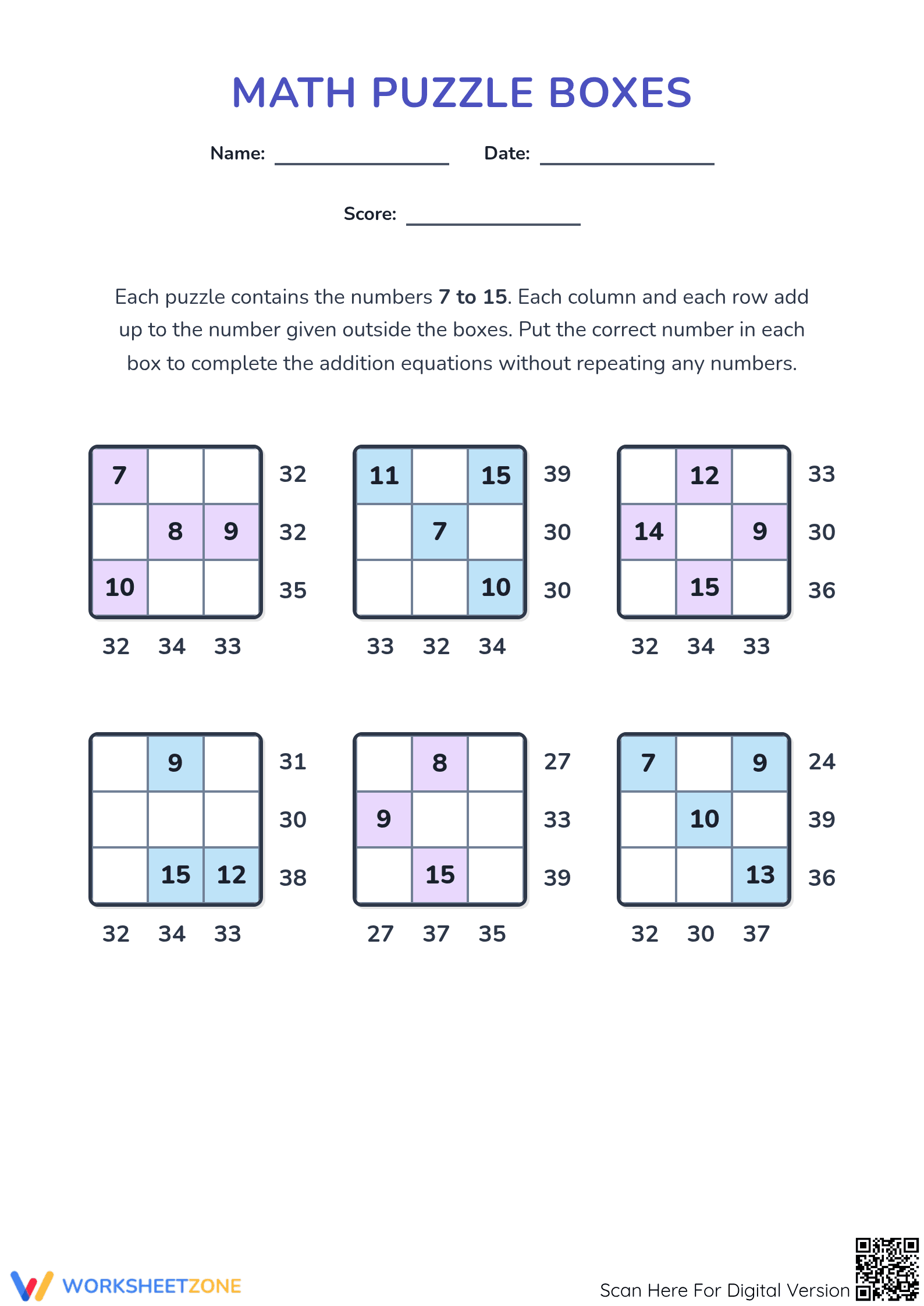
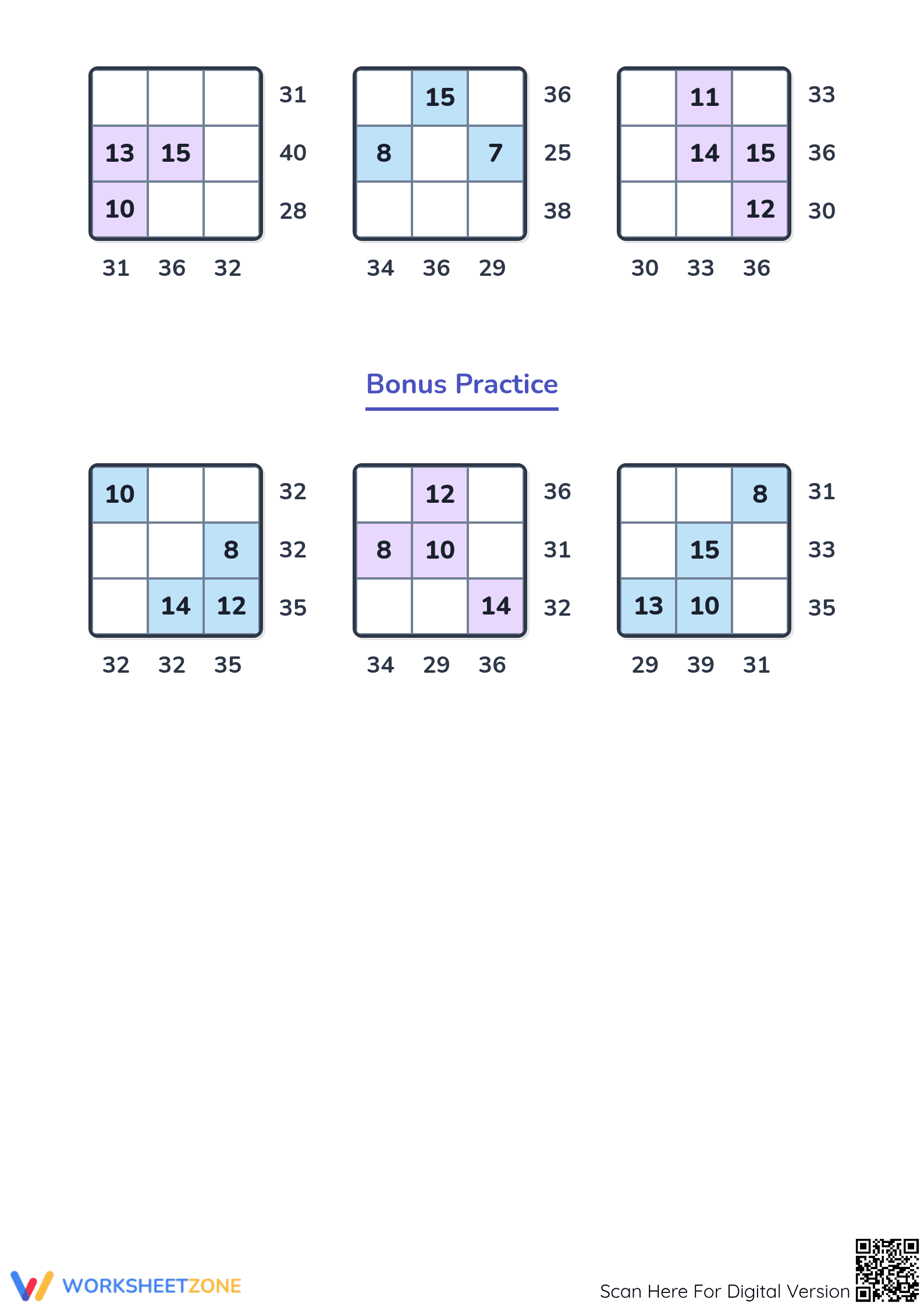
Engage students in mental math and algebraic thinking with these interactive Math Puzzle Boxes. This worksheet transforms standard addition practice into a logic-driven challenge where students must determine missing addends to satisfy row and column sums. By focusing on the relationships between numbers, learners develop a deeper number sense beyond rote calculation.
At a Glance
- Grade: 3–4 · Subject: Math
- Standard:
CCSS.MATH.CONTENT.3.NBT.A.2— Fluently add and subtract within 1000 using strategies and algorithms- Skill Focus: Addition Logic and Missing Addends
- Format: 2 pages · 12 problems · Answer key included · PDF
- Best For: Independent math centers or early finishers
- Time: 15–20 minutes
What's Inside
This printable PDF includes two pages featuring a total of 12 distinct math puzzle boxes. Each 3x3 grid challenges students to use the numbers 7 through 15 exactly once to reach specific sums provided at the end of each row and column. The layout includes a dedicated space for scoring and student identification, along with a full answer key for rapid verification of logical paths.
Zero-Prep Workflow
Implementing this activity requires minimal effort. First, Print the two-page document (30 seconds), ensuring enough copies for the class or laminating a set for reusable math centers. Second, Distribute the sheets to students as a bell-ringer or transitional activity (1 minute). Finally, Review the work using the included answer key, taking under 1 minute for the entire class to check for logical accuracy.
Standards Alignment
The primary focus of this resource is CCSS.MATH.CONTENT.3.NBT.A.2, which requires students to fluently add within 1000. These puzzles push students to apply "if-then" logic to determine which addends fit within the grid constraints. Both standard codes can be copied directly into lesson plans, IEP goals, or district curriculum mapping tools for seamless documentation of student progress toward algebraic reasoning mastery.
How to Use It
Use these puzzle boxes as an early finisher option to keep students cognitively engaged without requiring direct instruction. Alternatively, place them in a math center to encourage peer collaboration. To use this as a formative assessment, observe students' starting points: those who identify squares with two existing numbers first demonstrate a strong understanding of algebraic isolation and numerical relationships in complex systems.
Who It's For
This resource is designed for Grade 3 and Grade 4 students working on addition fluency and logical reasoning. It is effective for gifted younger learners who need a challenge, or for Grade 5 students who benefit from a game-like format to reinforce mental math accuracy. Pair this with a digital whiteboard demonstration or an addition anchor chart for a complete instructional cycle.
The integration of logic puzzles into math instruction is a proven method for increasing student engagement and cognitive endurance. Research from the RAND AIRS 2024 report suggests that when students engage in productive struggle through non-routine problems like these puzzle boxes, they develop a more resilient mathematical mindset. By addressing standard CCSS.MATH.CONTENT.3.NBT.A.2, this worksheet ensures that students aren't just performing isolated calculations but are instead analyzing how numbers interact within a system. The focus on missing addends reinforces the inverse relationship between operations, a critical bridge to middle-school algebra. Educators can utilize these 12 tasks to bridge the gap between procedural fluency and conceptual understanding. This standalone resource serves as a printable assessment of a student's ability to manipulate numbers 7 through 15 to meet complex constraints, providing clear evidence of mastery in mental addition strategies and logical deduction skills.


