


























Views
Downloads


10 More Worksheet | Printable Grade 2 Math
Paste this activity's link or code into your existing LMS (Google Classroom, Canvas, Teams, Schoology, Moodle, etc.).
Students can open and work on the activity right away, with no student login required.
You'll still be able to track student progress and results from your teacher account.
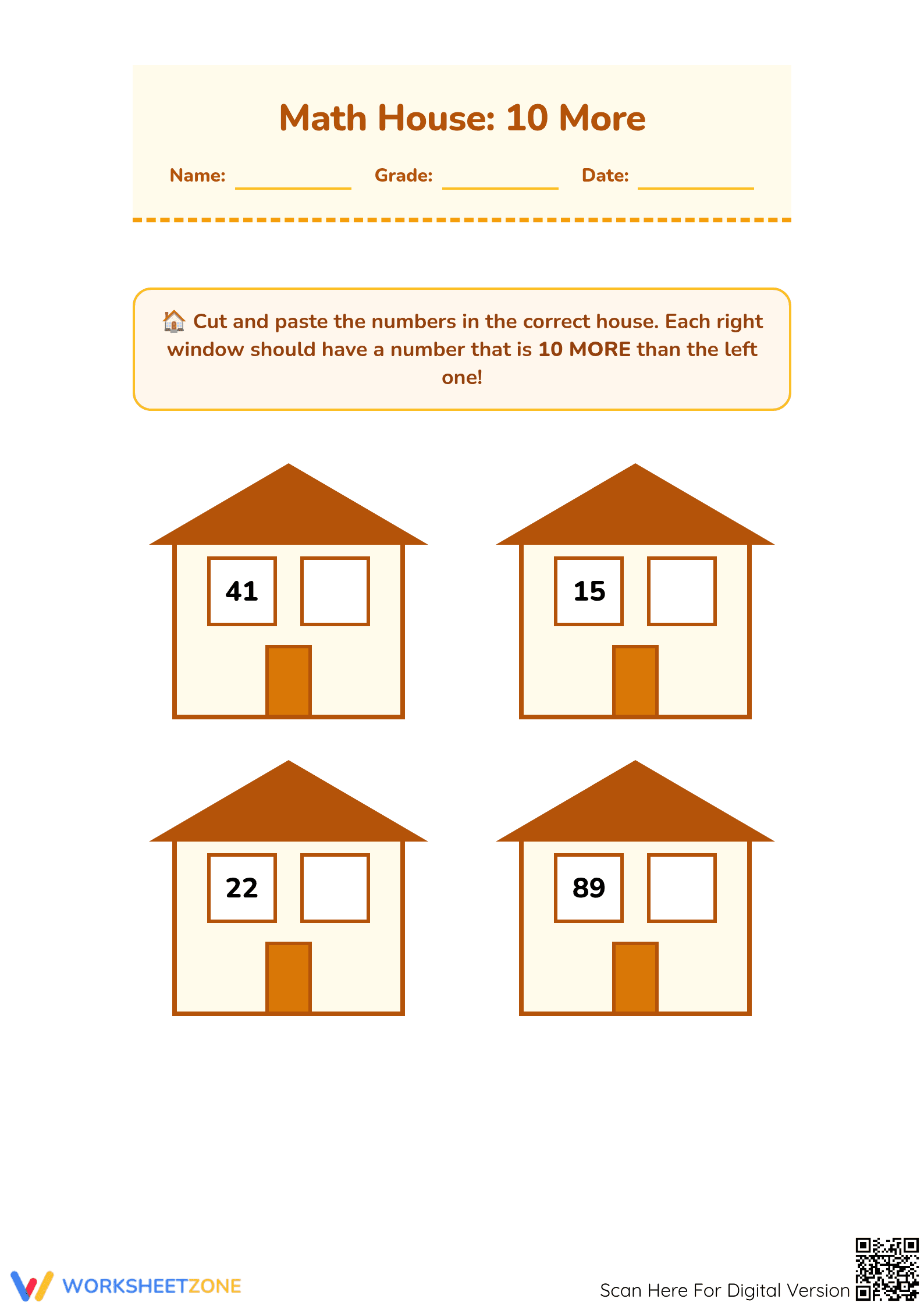
This engaging math worksheet helps students master mental addition by finding 10 more than a given two-digit number. Through a hands-on cut-and-paste activity, learners build base-ten fluency and number sense. The interactive format keeps young mathematicians focused while reinforcing essential place value concepts.
At a Glance
- Grade: 2 · Subject: Math
- Standard:
CCSS.MATH.CONTENT.2.NBT.B.8— Mentally add 10 to a given number- Skill Focus: Adding 10 more
- Format: 3 pages · 10 problems · Answer key included · PDF
- Best For: Independent math centers
- Time: 15–20 minutes
This resource includes three printable pages featuring a fun "Math House" theme. The first two pages contain ten house illustrations, each displaying a two-digit number in the left window and a blank space in the right window. The third page provides ten dashed-line number tiles for students to cut out and paste into the correct matching windows. A complete answer key is also provided for quick grading.
Skill Progression
- Guided practice: Begin by completing the first house together, modeling how to look at the tens digit and increase it by one.
- Supported practice: Have students work in pairs to cut out the number tiles and match them to the remaining houses before gluing.
- Independent practice: Students complete the extra practice page on their own, demonstrating their ability to mentally add ten without teacher assistance.
This gradual-release approach ensures students build confidence as they transition from the I Do, We Do, to the You Do phase of learning.
Standards Alignment
This activity is directly aligned to CCSS.MATH.CONTENT.2.NBT.B.8, which requires students to mentally add 10 or 100 to a given number. This worksheet focuses specifically on the foundational skill of adding 10 to two-digit numbers. Both standard codes can be copied directly into lesson plans, IEP goals, or district curriculum mapping tools.
How to Use It
This worksheet is perfect for math centers after direct instruction on place value. As a formative assessment tip, observe students while they match tiles; if they count up by ones instead of recognizing the tens pattern, they may need base-ten manipulatives. Expect completion in 15 to 20 minutes.
Who It's For
This resource is designed primarily for second-grade students, but it also serves as an excellent review for third graders who need extra support with mental math fluency. For differentiation, provide struggling learners with a hundreds chart to help them visually track the jump of ten. This worksheet pairs naturally with a direct instruction lesson using physical base-ten blocks.
Developing mental math fluency is a critical component of early elementary mathematics. According to a recent ScienceDirect TpT Analysis, interactive and tactile activities, such as cut-and-paste worksheets, significantly improve student engagement and retention of abstract numerical concepts. By practicing how to mentally add 10 to a given number, students strengthen their understanding of place value and base-ten systems, which are foundational for more complex arithmetic. This resource specifically targets CCSS.MATH.CONTENT.2.NBT.B.8, ensuring that learners are meeting essential grade-level benchmarks. Providing structured opportunities to manipulate numbers helps transition students from relying on rote counting to utilizing efficient mental strategies. Incorporating hands-on elements into standard math practice not only supports diverse learning styles but also fosters a deeper, more intuitive grasp of mathematical relationships, ultimately preparing students for future academic success.


